Quick Take
- Narrator: David Sadzin delivers Posnanski's journalistic prose with consistent warmth and appropriate restraint - the material does not need inflation and Sadzin does not provide any.
- Subjects: Negro League baseball and racial erasure, gratitude as a life philosophy, jazz and baseball as parallel American art forms
- Tone: Warm, humane, and quietly urgent about a history disappearing from living memory
- Bottom line: A genuinely moving audiobook portrait of Buck O'Neil and what the Negro Leagues represent in American culture - essential for baseball listeners and rewarding for anyone drawn to memoir-driven sports writing.
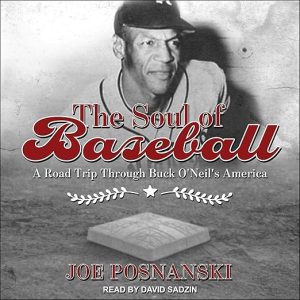
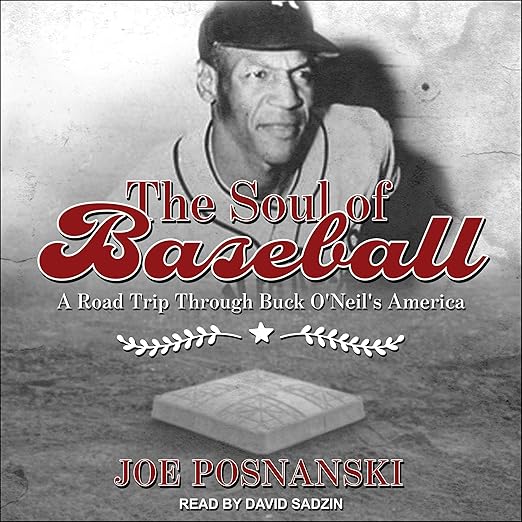
Buck O'Neil asked Joe Posnanski a simple question that the sports columnist could not answer easily: how did you fall in love with baseball? That question, posed by a 94-year-old Negro League legend in the early stages of what would become their year-long road trip together, is the seed from which The Soul of Baseball grows. Narrated by David Sadzin and running 7 hours and 52 minutes, this audiobook is Posnanski's account of the 2005 season he spent traveling the country with O'Neil, and it earns its title not through sentiment but through the accumulation of specific detail about a man who lived that love in public every day of his life, in every room he entered, before every audience that was willing to listen.
O'Neil's story is both larger and more complicated than the book's warm surface suggests. He played for the Kansas City Monarchs during the era of Negro League baseball that preceded integration - a period when some of the best baseball in America was being played in stadiums that white audiences did not enter, by players who would never appear in the World Series regardless of talent. O'Neil saw Satchel Paige pitch. He managed Ernie Banks before Banks went to the majors. He became the first Black coach in the major leagues in 1962. He campaigned for decades to have Negro League players recognized in the Hall of Fame and was himself not inducted during his lifetime, a snub that his response to - gracious, focused on others - is one of the most morally instructive moments in the book.
Posnanski is a sportswriter who understands that the best sports writing is not really about the sport. The baseball here is the occasion for O'Neil's jazz anecdotes, his philosophy of gratitude, his observations about what America's relationship to the game reveals about America's relationship to race. O'Neil's two passions - baseball and jazz - are presented by Posnanski as expressions of the same American creative impulse, improvised and collective, gorgeous and marginalized in similar ways for similar reasons. That parallel gives the audiobook an intellectual dimension that pure sports biography rarely achieves, and it is built not through analysis but through the accumulation of specific stories that O'Neil tells along the road.
What Stands Out
David Sadzin's narration captures the warmth of the material without turning it into nostalgia-bait. Posnanski's writing has a journalistic directness that Sadzin does not try to inflate into something more literary than it is. The road-trip structure, which takes Posnanski and O'Neil from county fairs to Negro League reunions to regular-season games, has an episodic quality that Sadzin's consistent pacing handles well - no single stop on the tour is treated as more important than the cumulative texture they create together.
The audiobook functions as a corrective to a specific kind of sports-cultural amnesia. The Negro Leagues produced extraordinary players whose statistics and records lived, for decades, outside official baseball history. O'Neil's generation carried that history in living memory when Posnanski traveled with him in 2005. By the mid-2020s, that generation is almost entirely gone. The audiobook preserves something of what O'Neil knew and what he was willing to share with anyone who sat close enough to ask. That documentary function - not the only function, but a real one - gives the audiobook a value that outlasts its sports-nostalgia surface. Listeners who read O'Neil's own memoir "I Was Right on Time" will find the Posnanski book a companion volume rather than a redundancy - the two capture different dimensions of the same person.
Before You Commit to The Soul of Baseball
Posnanski is a journalist turned narrator, not a biographer in the formal sense. The book does not attempt a comprehensive O'Neil biography - it captures a year, a series of conversations, a way of moving through the world. Readers who want a full treatment of O'Neil's career and the Negro Leagues as a historical institution should look at O'Neil's own memoir, which one reviewer identifies as the fuller version of what this book excerpts and distills. The Posnanski audiobook is the relationship and the road trip, not the complete archive of O'Neil's life and baseball's segregated history.
There is also an inherent limit to what a book written through the lens of admiration can offer. Posnanski spent a year with a man he genuinely revered, and the book reflects that closeness. O'Neil is presented as nearly uniformly wise, optimistic, and gracious - which by all accounts he was - but the uniform positivity means the audiobook reads as celebration more than examination. That is the book Posnanski intended to write, and it does what it intends well. But it is not a complicated portrait, and listeners who approach biography expecting full-dimensional critical engagement will find it operating in a different mode.
Best Suited For
Baseball fans who know the major league history but have limited exposure to the Negro Leagues will find this audiobook an engaging, humane entry point into a history that deserves more mainstream attention than it typically receives. Listeners who enjoy sports writing that uses the game as a lens on American culture - the tradition that Roger Angell built and that Posnanski continues - will find the format and approach immediately familiar. The 4.8 rating is well-earned: this is one of the better baseball audiobooks of the past two decades.
Non-baseball listeners who respond to memoir-style profiles of extraordinary people will also find this accessible - the baseball knowledge required is minimal, because O'Neil himself spends more time talking about what the game meant than about the game's technical mechanics. Skip it only if unrelenting warmth and optimism feel to you like insufficient emotional range for a seven-plus hour listening commitment.
Good to Know
Do you need to be a baseball fan to enjoy this audiobook?
Not particularly. O'Neil uses baseball as the occasion for observations about American race relations, jazz, gratitude, and how to live - content that resonates well beyond sports. Listeners who enjoy profile-driven narrative nonfiction will find the audiobook accessible without needing to follow the game closely.
Does this audiobook cover the full history of the Negro Leagues or focus mainly on O'Neil's personal story?
It focuses primarily on O'Neil's personal story and philosophy as experienced during the 2005 season Posnanski spent with him. For a comprehensive Negro Leagues history, O'Neil's own memoir 'I Was Right on Time' is the better choice. This audiobook is the relationship and the year, not the archive.
Is this audiobook appropriate for younger listeners who are interested in baseball history?
Yes - the material is appropriate for teenagers and up. The racial history is discussed honestly but without graphic detail. For young baseball fans who want context about the sport's segregated past, this is one of the most accessible entry points available in audiobook form.
How long is this audiobook and does it hold engagement across the full runtime?
The audiobook runs 7 hours and 52 minutes. The episodic road-trip structure keeps individual sections varied enough that the pacing stays fresh. The book builds emotional weight gradually rather than through dramatic incident, so it rewards patient listening rather than binge consumption.