Quick Take
- Narration: Tom Heilman delivers Cull’s instructional prose clearly and at a pace that allows each tip to register without feeling rushed.
- Themes: accelerated skill acquisition, the 80/20 principle applied to golf, mental game alongside physical technique
- Mood: Practical and motivating, without inflating its own importance
- Verdict: Under two hours of tightly focused instruction that bypasses the padding common in golf improvement books and delivers what it promises.
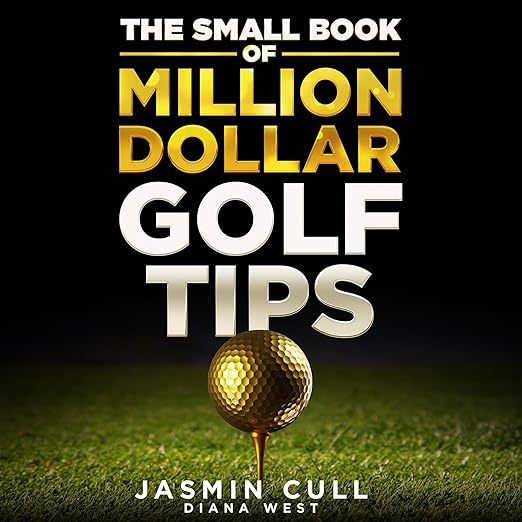
Golf instruction audiobooks occupy a genuinely difficult position: you are listening to advice about a physical activity that requires you to be somewhere else entirely to apply it. The books that work in this format are those that concentrate on principles and mental frameworks rather than swing mechanics that require visual demonstration. Jasmin Cull’s The Small Book of Million Dollar Golf Tips manages this more successfully than most, partly because its author knows his own origin story is the product.
Tom Heilman narrates the one hour and fifty minutes at a pace that suits the chapter-per-tip structure. The book is built on fifty-four golf secrets, as Cull describes them, each short enough to hold in mind during a round. Heilman reads with a brisk efficiency that respects the listener’s time without losing the practical weight of each point.
Our Take on The Small Book of Million Dollar Golf Tips
Cull’s backstory shapes everything here. He is a former professional volleyball player and construction worker who took up golf at age thirty-eight and reached professional level in three years without the full-time coaching access most promising golfers have from childhood. The book is his attempt to reverse-engineer that process: what is the twenty percent of instruction that produces eighty percent of the results?
That framing, borrowed from the Pareto principle, is not unique, but Cull applies it with useful specificity. The random practice theory, which appears early in the book and which several reviewers highlight as a standout insight, describes a counterintuitive approach to improvement that contradicts most conventional practice wisdom. Whether you have heard of blocked versus random practice in a sports science context or not, the explanation is clear and actionable.
Why Listen to The Small Book of Million Dollar Golf Tips
Because at under two hours it demands nothing unreasonable from your schedule. Listeners who typically abandon golf instruction books midway will complete this one, which matters because the later chapters on mental approach and pressure management are as useful as the technical sections on ball flight and swing consistency.
Several reviewers specifically noted that the tips accelerated their learning curve in ways they had not experienced from other instruction sources. One described it as saving years of slow stumbling self-learning. Another called the explanations digestible and easy to implement, which is the right standard for an audiobook where you cannot stop and run a drill mid-chapter.
What to Watch For in The Small Book of Million Dollar Golf Tips
The title is more modest than it sounds, and that is a feature rather than a bug. This is not a comprehensive instructional system. The fifty-four tips do not add up to a unified swing philosophy in the way a lesson program from a teaching professional would. Some tips are more compelling than others, and the mix of technical and mental content means the balance may not suit every listener’s current game priorities.
As with any instruction in audio format, the tips that concern body position or club path will be harder to absorb without visual reinforcement. Listeners who plan to take this to the range will benefit from making notes during or after the first listen.
Who Should Listen to The Small Book of Million Dollar Golf Tips
Adult learners at any level who feel their improvement has stalled or who are building from scratch without access to regular professional coaching. The book’s explicit framing, accelerated learning for those without unlimited time or money for instruction, makes it particularly relevant for recreational golfers who practice irregularly. At under two hours, the commitment is low enough that even skeptical listeners have little to lose by trying it. The tips that land will more than cover the time investment; the ones that do not will at least introduce you to concepts worth investigating further.
Less useful for scratch players or those already receiving structured professional coaching, who will find most of the material familiar. Best consumed before a practice session rather than as background listening, where the specificity of individual tips will blur without the context of actively working on your game.
Frequently Asked Questions
What is the random practice theory Cull describes?
Random practice is a training method drawn from sports science research that alternates between different skills in a session rather than drilling one skill repeatedly. Studies suggest it produces better long-term retention than blocked practice despite feeling less productive in the moment. Cull presents this as one of the most significant insights for accelerating improvement.
How does Tom Heilman’s narration handle technical golf instruction?
Clearly and efficiently. Cull’s writing is plain and instructional rather than literary, and Heilman does not overcomplicate it. The pace is quick enough to hold attention but not so rushed that individual tips blur together.
Is this suitable for complete beginners to golf?
Yes. Cull structures the book with beginners in mind, drawing on his own experience of starting at thirty-eight with no background. The tips are ordered from foundational to more nuanced, though experienced players will move quickly through the earlier chapters.
Can I apply these tips without also taking professional lessons?
That is Cull’s explicit argument: he designed the book for golfers who lack access to regular professional instruction. The tips are self-contained and do not require parallel coaching to apply. That said, a single lesson with a qualified professional to diagnose your specific swing issues would make the relevant tips more targeted.