Quick Take
- Narration: Andrew Tell brings Ben Brandt’s quiet determination to the surface with an understated performance that suits the character’s internal drive without over-dramatizing the dystopian stakes.
- Themes: Class stratification and genetic privilege, underdog athletic ambition, systemic inequality
- Mood: Propulsive and politically charged, with a slow-burning emotional core
- Verdict: A lean dystopian sports novel that earns its tension through character rather than spectacle, best suited to runners and readers who like their science fiction grounded in social realism.
I was somewhere around the second hour of this one on a Tuesday evening run of my own when I realized the particular irony of listening to a running novel while actually running. There is something that sharpens attention when the story you are tracking is about the same bodily experience you are currently having. Geoffrey Simpson’s The Slummer: Quarters Till Death works in that narrow, specific way: it reaches you through the body first, then the conscience. I kept going longer than I had planned because I could not bring myself to pause in the middle of a training sequence.
The setup is familiar in its bones. Benjamin Brandt lives in the slums of Cleveland’s Industrial Valley in the year 2083, part of the vast underclass the novel calls slummers in contrast to the genetically engineered elites who dominate professional athletics and essentially every other domain of public life. Ben is a natural runner, grinding miles through broken streets in a world where people like him are legally excluded from the public spaces the elites casually occupy. He sets his sights on the 5,000-meter national title. The rest, you can probably sketch in yourself. But what Simpson does with that framework deserves closer attention than the premise alone suggests, because the execution is considerably more careful than the synopsis makes it sound.
Running as Both Escape and Declaration
What separates this from a straightforward underdog narrative is how carefully Simpson renders Ben’s relationship to running itself. This is not a book about a kid who discovers a talent and rides it toward uncomplicated glory on a rising tide of public support. Ben’s training is obsessive, solitary, and suffused with a kind of defiant logic that the novel makes fully legible. He runs because it is one of the few things the elites cannot take from him within the geography of his own cracked streets. The national championship is not simply a goal. It is a provocation, a way of announcing that the system has not yet reached into the thing he built in its margins.
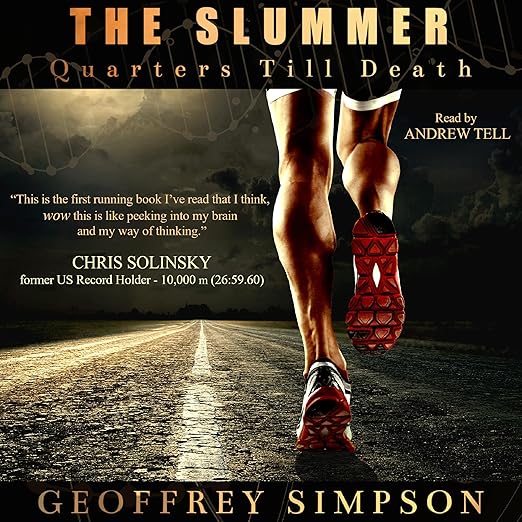
When Chris Solinsky, the former American 10,000-meter record holder, called this the first running book that felt like peeking into his own brain, that line stuck with me through the full nine hours. It is not blurb hyperbole. Simpson understands the interior monologue of distance running in a way that most fiction writers do not bother to get right. The loneliness of the long training run, the negotiation between physical pain and psychological will, the strange freedom of a session that takes place outside the rules of your social context: all of it is here, rendered with the specificity that only comes from someone who has lived inside that experience.
The Worldbuilding That Stays Out of Its Own Way
The dystopian architecture here is deliberately modest, and that modesty is a strength. There are no dazzling set pieces of futuristic technology, no overwhelming world mythology to memorize before you can follow the plot. The genetic engineering element lands as more disquieting than theatrical precisely because it tracks so closely to where CRISPR technology is already going. One reviewer described the genetic engineering component as absolutely believable given the current state of biological science, and that plausibility is exactly the point. Simpson keeps the speculative framing in the background just enough to let the class dynamics hit harder in the foreground.
The world of 2083 reads less like science fiction and more like a plausible extrapolation of the stratification already visible in athletic funding structures, Olympic qualification economics, and elite youth training programs in the present. The figure of the slummer, relegated to poverty and forbidden from the public spaces the elites occupy without a second thought, maps uncomfortably well onto existing social arrangements. That discomfort is fully intentional, and it gives the story its bite beneath the sports-fiction surface.
Andrew Tell and the Weight of Quiet Ambition
Andrew Tell’s narration is well-calibrated to a protagonist whose power is fundamentally internal. Ben does not make speeches or monologue his grievances into the air. He runs, and he thinks about running, and he thinks about what running toward a national title means in a world that has decided people like him are not permitted to compete at that level. Tell keeps that restraint intact, giving Ben a voice that is watchful and self-contained rather than heroically resonant. The training sequences, which could easily become repetitive in a less disciplined performance, maintain momentum through Tell’s subtle modulation of pace and attention.
At nine hours and seventeen minutes, the audiobook moves at a rate befitting its subject. The Readers’ Favorite 5-star distinction and the 4.6 rating across nearly 700 reviews suggest this has connected with a cross-section of listeners well beyond the running community. One reviewer noted it ticks off all the boxes for a running novel while also delivering hope, hopelessness, young love, and tragedy. The love subplot, though secondary, adds weight to what Ben stands to lose if his gamble fails. Simpson is disciplined enough not to let the sociopolitical elements flatten into lecture, and the idea that could turn his stratified society upside down is quietly revolutionary rather than grandly stated.
Who Should Listen and Who Might Step Back
If you are a competitive runner or a devoted fan of running literature, this belongs on your listening list. If you are drawn to dystopian fiction that prioritizes social critique over action spectacle, it will reward you across its full runtime. Where it may fall short for some listeners is in the middle stretch, where training sequences accumulate in ways that could feel repetitive to those not invested in the rhythms of distance running as a lived experience. Those who need their dystopian worlds elaborately constructed and their conspiracies layered with geopolitical complexity may find the leanness frustrating rather than purposeful. This is a character study wearing a science fiction jacket, and it works best when you meet it on exactly those terms without expecting something it never claimed to be.
Frequently Asked Questions
Do I need to know about competitive running to enjoy The Slummer?
Not at all, though familiarity with distance running culture deepens the experience considerably. The novel works equally well as a class-conflict story set in a dystopian future. Former American 10K record holder Chris Solinsky praised it, but listeners with no running background have responded just as strongly to the character and social dynamics at its center.
Is this the first book in a series or does it stand alone?
The subtitle Quarters Till Death suggests a standalone entry, and based on the synopsis and available metadata it reads as a complete story arc. There is no series designation attached to this title, so you can listen without any prior commitment to additional volumes.
How graphic or intense is the content? Is it appropriate for teen listeners?
The tone is gritty but not graphic. The setting involves poverty, systemic discrimination, and competitive pressure, but the content is not explicit in terms of violence or language. Older teens with an interest in both sports fiction and social commentary should find this fully accessible and genuinely engaging.
Does Andrew Tell’s narration work for a first-person male protagonist in a blue-collar dystopian setting?
Yes. Tell delivers Ben’s voice with a restrained intensity that fits the character well throughout the full nine-plus hours. Several listeners have noted that the narration keeps the emotional stakes present without tipping into sentimentality, which is exactly what a story this subdued in tone requires to succeed.