Quick Take
- Narration: Amanda Leigh Cobb delivers a tense, emotionally invested performance that sharpens the slow-burn tension between Oraya and Raihn, she handles both the feral danger of the Kejari and the quieter vulnerability of Oraya’s inner life with equal skill.
- Themes: forbidden alliance, survival in a world built against you, love as vulnerability and weapon
- Mood: Dark and blood-soaked, with a slow burn that earns every beat
- Verdict: If you have the patience for deliberate pacing in the first third, the payoff in the Kejari sequences is substantial, Broadbent builds a vampire world that feels genuinely original rather than borrowed.
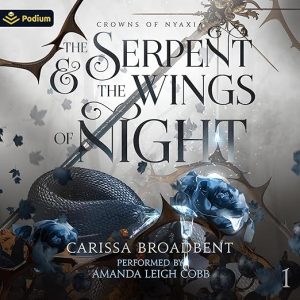
I started this one on a Friday night with no particular expectations, having heard the “Underworld meets Hunger Games” comparison tossed around and being mildly skeptical of it. By Saturday afternoon I had canceled two plans. That is not a guarantee I make lightly, and it is not one Carissa Broadbent earns cheaply, the first fifty pages are deliberate, almost stubbornly so, as she takes her time building the rules of a world where humans are prey and Oraya is the single most dangerous anomaly in it.
What Broadbent does with her worldbuilding is worth paying attention to. The three vampire houses, the goddess of death who holds the Kejari, the brutal logic of a tournament where alliance and betrayal are functionally the same move, none of it feels grafted from existing vampire mythology. The Crowns of Nyaxia series has its own cosmology, and this first book earns the right to call itself the foundation of something larger.
Our Take on The Serpent and the Wings of Night
The central tension is not the romance, exactly, even though the romance is what the book is most famous for. The central tension is Oraya’s survival problem. She is human in a world that categorizes humans as food, adopted by a vampire king in a relationship that is by turns protective and suffocating, and entering a tournament she has virtually no chance of winning. Raihn is the complication she cannot afford and cannot avoid. Broadbent is careful to make the attraction genuinely dangerous rather than decorative, Oraya’s draw toward him is framed as a potential death sentence, not a romantic fantasy.
Amanda Leigh Cobb narrates with the kind of controlled intensity that suits this material. She does not soften Oraya’s sharp edges, and she does not rush the moments that need to breathe. When Oraya is frightened, Cobb does not play it as fear exactly, it comes across more as vigilance, which is the right read of the character.
Why Listen to The Serpent and the Wings of Night
The Kejari sequences are the strongest stretches of the audiobook. The challenges are inventive and genuinely harrowing, and Broadbent uses them to reveal character rather than just stage action. Every trial strips something away from Oraya and forces her to reckon with what she is willing to become. Reviewers who called it charged with emotion are not exaggerating, there are sequences in the back half that are legitimately difficult to sit with, which is a mark of a writer who is not afraid to cost her protagonist something real.
The romance is slow. If you come in wanting heat from the first chapter, you will be frustrated. But the patience the book demands is what makes the eventual moments land with the weight they need. Broadbent understands that in a world this dangerous, trust is the real intimacy, and she makes you feel every increment of it being built.
What to Watch For in The Serpent and the Wings of Night
The opening chapters front-load a significant amount of worldbuilding. The rules of the vampire houses, the political stakes of the House of Night, and the mythology around the goddess of death all arrive in fairly dense succession. Some listeners find this investment worthwhile; others have noted the pacing feels slow before the Kejari begins. If you are someone who needs plot momentum from the first chapter, give it until the tournament begins before deciding.
There is also a class of reader who will find the enemies-to-lovers arc predictable in its broad strokes. That critique is fair in outline, the trope is not subverted so much as executed with more craft and consequence than the genre average. Whether that is enough depends on what you want from the category.
Who Should Listen to The Serpent and the Wings of Night
This is for readers who enjoy dark fantasy romance where the danger is structural and the stakes feel real, not gothic aesthetic but actual threat. Fans of authors like Hannah Whitten or Sarah J. Maas who want something with its own mythology rather than derivative worldbuilding will find a lot to engage with here. Listeners who want fast pacing from page one, or who find enemies-to-lovers mechanics tedious regardless of execution, will likely struggle with the first third.
Frequently Asked Questions
Do I need to have read other Crowns of Nyaxia books before starting this one?
No. The Serpent and the Wings of Night is the first book in the Crowns of Nyaxia series and the opening of the Nightborn Duet. It is fully self-contained as an entry point, though the series is structured so that each vampire house gets its own duet, meaning there is a direct continuation in book two.
How explicit is the romance in this audiobook?
Multiple reviewers describe it as having spice but not being overly explicit, one specifically praised the slow burn and noted it is not graphic. It is categorized as adult dark fantasy romance rather than erotica, so expect romantic tension and some intimate content without the emphasis on explicit scenes.
Is Amanda Leigh Cobb’s narration a good fit for Oraya as a first-person narrator?
Yes, from what reviewers and the material suggest. Cobb plays Oraya’s vigilance and wariness convincingly rather than softening her into a more conventionally sympathetic protagonist. The performance matches the character’s guardedness, which is central to why the eventual emotional openings land.
How does the Kejari tournament compare to similar competition structures in the genre?
The Kejari is distinctive because it is run by a goddess of death rather than a human institution, and the rules explicitly permit, even reward, betrayal. Unlike tournament arcs where the competition is the backdrop, the Kejari is the mechanism through which character and alliance are stripped down to their essentials. Reviewers compared it to Hunger Games dynamics more than to magical school competitions.