Quick Take
- Narration: Eileen Stevens captures Sideways Pike’s tactile, sensory-driven interiority with impressive precision, making the prose style feel like a feature rather than an obstacle.
- Themes: Queer identity and belonging, female friendship as coven, occult coming-of-age
- Mood: Feral and electric, with small-town claustrophobia pressing in at the edges
- Verdict: One of the more distinctive YA debuts of recent years, demanding in its prose but deeply rewarding for the right listener.
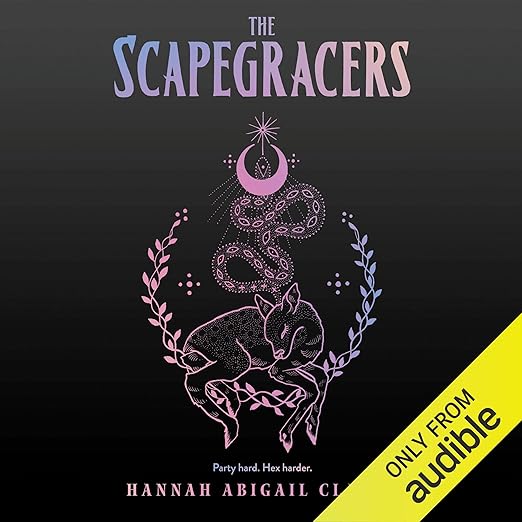
There are audiobooks where the narration simply conveys the story, and there are audiobooks where the narration becomes the story. The Scapegracers falls into the second category, and Eileen Stevens is the reason. Hannah Abigail Clarke’s debut novel is written in a prose style that privileges sensation over plot mechanics, Sideways Pike, the novel’s teenage lesbian witch narrator, experiences the world through touch, texture, and physical proximity, and listening to that prose performed aloud is a substantially different experience from reading it on a page.
I finished this one during a long Saturday walk, earbuds in, and came home having covered twice the distance I’d intended because I kept finding reasons not to stop. That’s the effect this book has when it works, which is most of the time.
Our Take on The Scapegracers
Sideways Pike sits near the bottom of West High’s social pyramid when the novel opens, performing magic tricks for Coke bottles under the bleachers. As a witch, a lesbian, and a chronic outsider, she has calibrated her expectations for human connection accordingly, which is to say, downward. When the three most popular girls pay her forty dollars to cast a spell at their Halloween party, what follows is not the genre-standard mean girls narrative but something genuinely different: a story about the particular intensity of female friendship when it chooses you rather than the other way around.
The coven that forms among Sideways and the trinity, the dangerous angels, the sugar-coated rattlesnakes, as the synopsis names them, is the novel’s emotional core, and Clarke refuses to flatten it into wish fulfillment. These are four people who bring their full complications to each other: their cruelties, their loyalties, their overconfidence about how the world works, their specific teenage certainty that adults have missed something essential about reality. One reviewer put it perfectly when they wrote that Clarke captures teens in all their messy glory, letting them be unreasonably petty and spiteful while bonding in ways adults never quite manage again.
Why Listen to The Scapegracers
Eileen Stevens handles Clarke’s prose style with real commitment. The writing is full of fricatives and phrases that beg to be spoken aloud, this is a book whose sentences were clearly written with sound in mind, and Stevens understands that. She doesn’t flatten the elevated, unusual language into something more conventionally YA. She leans into it, which is the right call. One reviewer noted the prose could feel like it didn’t capture teenagers authentically, that the language was too elevated. I’d argue the opposite: Sideways is not a conventional teenager, and her voice reflects a specific kind of queer, outsider interiority that has always coexisted with elevated language as a form of self-protection. Stevens conveys that without overplaying it.
The occult elements, coven magic, fundamentalist witch hunters, curses cast on dudebros, are handled with the right degree of seriousness. Clarke is not playing occultism for comedy or for shock value. The magic in this novel is real to its characters, which means it carries genuine stakes. The witch hunters pursuing Sideways and her coven represent an actual threat, not just a plot device, and when the supernatural danger escalates, the emotional groundwork Clarke has laid makes it land as catastrophic rather than merely exciting.
What to Watch For in The Scapegracers
Content note: at least one reviewer flags animal-related content that some listeners may find disturbing. It’s worth checking content warning resources if that’s a concern before you begin.
The novel’s demand on the listener is real. Clarke’s prose style is deliberately unusual, high on sensory metaphor, low on conventional narrative scaffolding. Readers expecting a straightforwardly plotted YA fantasy will find the experience more elliptical than they anticipated. What the novel prioritizes is interior experience and friendship dynamic over plot momentum, and if your preference runs toward efficient, event-driven storytelling, this will feel slow in its quieter stretches.
This is the first book in a trilogy, and it establishes world and character more than it provides resolution. The central threat from the witch hunters doesn’t fully resolve within this book, it sets up what follows. Listeners who respond best to complete arcs within a single volume should be aware of that going in.
Who Should Listen to The Scapegracers
Queer listeners, particularly those who grew up feeling like the wrong kind of person for the social world around them, will find something specific and true in Sideways Pike’s experience that more mainstream YA rarely provides. Fans of literary coming-of-age novels who also want genuine genre elements, real witchcraft, real threat, real magic, will find the combination rewarding. Readers who want fast-paced, action-first fantasy should look elsewhere, but those willing to live inside a character’s sensory experience for ten hours will come out the other side glad they did.
Frequently Asked Questions
Is The Scapegracers appropriate for younger teen listeners, or is it aimed at older YA readers?
It skews toward older YA and adult readers. The themes of queer identity, occult practice, and social complexity are handled with sophistication, and the prose style is demanding enough that younger teens may find it challenging. There are also content warnings, at least one reader flagged animal-related content.
Does the first book in The Scapegracers trilogy resolve its central conflict?
Partially. The immediate Halloween-party situation resolves, and the coven solidifies as a unit, but the larger threat from the fundamentalist witch hunters extends across the series. This is book one of three, and it reads like one.
How does Eileen Stevens handle the unusual prose style of Hannah Abigail Clarke’s writing?
Stevens commits to it fully rather than trying to normalize it. Clarke’s sentences are tactile and rhythm-driven, designed to be spoken, and Stevens delivers them as written, which is the right approach, even if some listeners may need a few chapters to settle into the style.
Is the magic system in The Scapegracers explained in detail, or is it kept vague?
It’s kept more impressionistic than systematic. The magic feels real and consequential within the story, but Clarke is more interested in what it feels like to be a witch than in building an elaborate rule-set. Readers who want detailed magic systems with clear limits will find this looser than their preference.