Quick Take
- Narration: Shannon Tyo captures Irene’s internal chaos with the right mix of warmth and comic timing, well-cast for a first-person college rom-com.
- Themes: Self-discovery through genre fiction, enemies to lovers, the gap between theory and lived experience
- Mood: Breezy and self-aware, with moments of genuine emotional depth
- Verdict: A clever meta-romance that earns its Kirkus starred review, Susan Lee understands what makes romance tropes work and then builds a story around why they aren’t enough.
I picked up The Romance Rivalry on a recommendation from a colleague who knows I have complicated feelings about the enemies-to-lovers trope. My general position is that the trope is exhausted, that the tension is almost always manufactured, that the obstacles keeping the protagonists apart are usually obstacles only because the plot requires them to be. Susan Lee’s debut novel is the most interesting argument I’ve encountered against that position, mostly because it’s a novel that makes the same argument and then demonstrates why it’s insufficient.
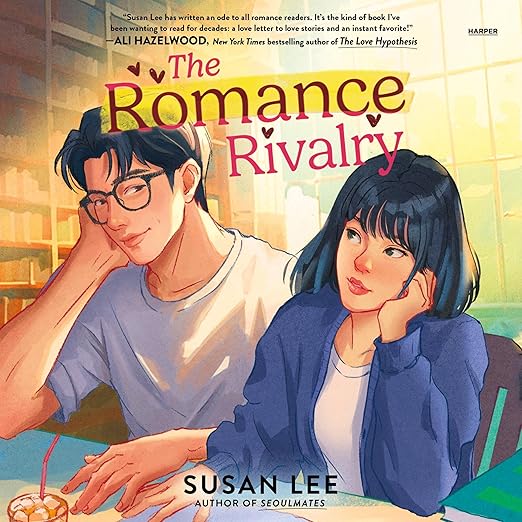
Irene Park is a college freshman with a large online following as a romance book reviewer and absolutely no romantic experience of her own. She decides to use romance novel tropes as a roadmap to finding love, a premise that is clever without being precious. Her nemesis is Aiden Jeon, her rival reviewer, who challenges her to see who can find love-by-trope first. When the competition forces them into a fake dating arrangement, the book becomes a meditation on what we actually want versus what we’ve convinced ourselves we want after years of reading about it.
Our Take on The Romance Rivalry
Shannon Tyo’s narration suits this material well. She handles Irene’s characteristic internal chaos, the overthinking, the circular self-analysis that one reviewer called “a little too chaotic” but accurately characterizes an eighteen-year-old questioning everything simultaneously, with affection rather than exasperation. Tyo also conveys the moments where Irene’s bookish confidence gives way to genuine vulnerability, which is where the novel does its most interesting work. The audiobook runs just over eight hours, which is the right length for this kind of college rom-com: substantial enough to let the relationship develop, compact enough to keep the pacing tight.
The reception is strong across the board. Kirkus gave it a starred review and called it “clever and delightful; a standout in the genre.” School Library Journal starred it as well, noting that it is a “must-have flirtation-via-tropes tale with all the swooning and joy readers want.” Ali Hazelwood, whose Love Hypothesis occupies similar territory in the adult romance space, called it the book she’d been wanting to read for decades. That cross-genre endorsement is meaningful: The Romance Rivalry is doing something that readers of both YA and adult romance will recognize and appreciate.
Why Listen to The Romance Rivalry
The novel’s smartest move is making Irene a genuinely competent reviewer who has thought seriously about what romance fiction does and why it matters, and then putting her in a situation where that expertise is both an asset and a liability. Her knowledge of how fake dating is supposed to work doesn’t protect her from the feelings that develop; if anything, it makes her more defensive about them. This is a better use of the bookish-heroine convention than most novels that deploy it, because Lee actually makes the literary knowledge plot-relevant rather than just characterization shorthand.
What to Watch For in The Romance Rivalry
Several reviewers noted that Irene is difficult to root for in the early chapters, her confidence tips into self-absorption in ways that require patience. One reviewer suggested feeling too old for the book, which is a legitimate response: Irene’s very specific brand of eighteen-year-old chaos is rendered accurately, and some readers will find that accuracy grating rather than endearing. The fake dating arc follows a relatively predictable path once it begins, and readers who know the trope well will see the structural beats coming. The pleasure is in Lee’s execution of those beats, not in their subversion.
Who Should Listen to The Romance Rivalry
Romance readers aged sixteen and up who want a YA entry point that takes the genre seriously as a cultural artifact rather than just deploying it. Listeners who enjoyed Ali Hazelwood, Helen Hoang, or Christina Lauren and want something in that register for a younger audience. Anyone who has been told they read too many romance novels and would like a novel that argues, convincingly, that they’re onto something. Not recommended for listeners who want straightforward romance without the meta-commentary layer, that layer is central to the book’s identity.
Frequently Asked Questions
Does The Romance Rivalry actually deploy the specific romance tropes it discusses, or does it just talk about them?
Both. The novel sends Irene and Aiden through several tropes deliberately, including fake dating, which becomes the central arc. The book discusses tropes as Irene would, analytically, as a reviewer, while simultaneously enacting them, which is the source of its particular humor.
How explicit is the romantic content in The Romance Rivalry?
The book is YA, and the romantic content is age-appropriate for that category, emotionally intense but not sexually explicit. The fake dating arc involves significant proximity and tension, handled within the conventions of the genre.
Shannon Tyo narrates Irene in first person, does she also voice Aiden distinctly?
Tyo’s narration is first-person from Irene’s perspective, so Aiden is rendered through dialogue and Irene’s observations. Tyo differentiates the characters through vocal register and pacing in dialogue sequences, which works well for the rom-com format.
Is this the first book in a series, or does The Romance Rivalry stand alone?
Based on available information, The Romance Rivalry is a standalone novel. The ending provides full resolution of Irene’s central arcs, her romantic situation, her relationship with Aiden, and her question about what she actually wants from her own life.