At a Glance
- Read by: Adriana Sevan is named as narrator for a first person that belongs to the author's mother rather than to the author.
- At its heart: The Armenian Genocide, a child's displacement, inherited memory and family testimony.
- Vibe: Quiet, plainspoken, and steadily devastating.
- Short version: One of the very few accounts of 1915 written for young readers, and it has kept convincing them for a quarter of a century.
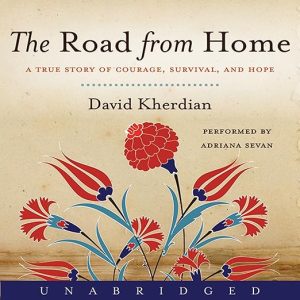
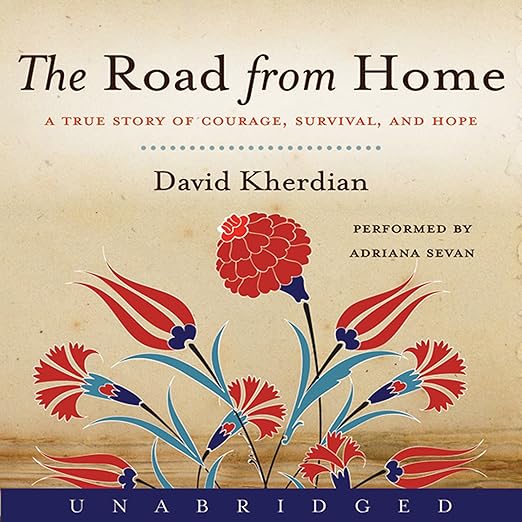
A son writing in his mother's first person is the whole architecture of this audiobook, and the publisher's description states it in the opening clause: David Kherdian re-creates his mother's voice to tell the story of a childhood interrupted in 1915, when the Turkish government began the systematic destruction of its Armenian population. Five hours and fifty-four minutes later you have followed one girl from a prosperous, loving household into deportation and out the far side. I have listened to a good deal of witness literature and this one is unusual for how young its intended reader is meant to be, and for how little it softens on that account.
Our Take on The Road From Home
It sits at 4.5 from 187 ratings, and the more revealing number is the date spread. The written notices run from October 13, 2000 to December 17, 2024, a stretch of twenty-four years and two months, which is an extraordinary run of agreement for a short book aimed at teenagers. The earliest of them predates the listing's own April 2009 date by more than eight years, so the page is pooling responses to the work across editions rather than to a single production. Read that spread as the endorsement it is: three separate decades of readers arriving at the same verdict.
Three of the five make the same recommendation, and it is a specific one. Lisa G., writing in 2000, promises that once teaching begins the book will go straight onto the required reading list, and A. Simmer, twenty-four years later, calls it entirely appropriate for a teenager working through a Charlotte Mason curriculum. M. Yates, who first read it at twelve and still loved it at thirty-two, wants it added to required reading because it 'illustrates war through the eyes of a young girl' in a way the classroom standard assigned instead did not. Brayden Walters came to it through an AP World History assignment. This is a book that keeps being handed to students.
Why Listen to The Road From Home
Intimacy at a terrible scale is the narrative strength. Brayden Walters describes a life 'filled with grief' whose feeling is carried throughout by the account of what she endured in Turkey, and is careful to add the crucial qualification: this is not a direct account, it is written by her son. Maryann Hopkins, who lived in Armenia for over a year, confirms how accurately it registers the weight the genocide still carries there. Between them they define the book's double value, personal testimony and communal history, without either swallowing the other.
Adriana Sevan is named as narrator, and the layering that creates is the most interesting production fact about this edition. The 'I' on the page already belongs to somebody other than the writer; a recording then gives that reconstructed voice to a third person entirely. Far from muddying anything, that suits the material, because oral testimony is how this history actually survived, passed from a mother to a son and onward. A listener is hearing the shape the story takes when it is spoken rather than written, which is closer to its original form than the printed page is.
Comparisons matter here too, and the one reviewers reach for is instructive. M. Yates sets it directly against The Diary of Anne Frank, the book assigned in school instead, and prefers this one for the clarity with which it renders a girl's war. That is a high bar and a fair one: both are a young life recorded against an organized attempt to end it, and both work on teenagers because the voice telling it is close to their own age. Kherdian's advantage is retrospect. His mother survived, and the telling knows it, which gives the book a steadiness the diary form cannot have. That difference matters for a young listener above all, because the dread has a floor under it.
What to Watch For in The Road From Home
One small metadata snag will confuse anyone checking names. The publisher's description spells the mother's name Vernon, while two reviewers who clearly read the book write Veron, which is also how the title of one review renders it. The discrepancy belongs to the listing rather than to the story, but if you are searching for further reading about her, the reviewers' spelling is the one that will get you there. Note as well that the two most detailed responses are cut short before they finish, including the fullest summary on the page. The listing names a print imprint for children's books as its publisher, which fits a title that has spent its entire life in classrooms.
Content needs stating plainly, because the young-adult filing can read as reassurance. A. Simmer names the territory precisely, genocide, war and refugee marches, and advises a parent to preview it first, which is sound. Lisa G. also warns of a slow opening, reporting real doubt about getting through it until around page twenty, and a listener has no page count to measure that against; in audio terms, give it the first thirty to forty minutes before deciding. Two reviewers describe handling a printed copy, one of them a signed collectible, so their pacing notes come from the page rather than the clock.
Who Should Listen to The Road From Home
Classrooms are the natural home for this, and the review pool has been saying so since 2000. Beyond that, anyone who reads witness literature, from Holocaust memoir to more recent refugee testimony, should hear it, because the Armenian Genocide remains conspicuously thinly represented in that shelf and it remains among the very few accounts written for a general young readership. Listeners of Armenian descent have an additional reason, and Maryann Hopkins speaks for that constituency directly. Adults should not be put off by the age label; the writing carries no condescension. Just under six hours also makes it one of the shorter items available on the subject, which matters a great deal when the alternative reading tends to run considerably longer.
Hold off, though, on treating this as a primary document. The voice is reconstructed by a son from his mother's account, which is a literary act, and readers who want testimony unmediated will feel that distance. Anyone seeking a historical survey of 1915, with causes, figures and diplomatic context, will need a different book entirely; this one stays inside a single child's field of vision. Timing matters as well: a reader currently raw about displacement or family loss should pick the moment rather than avoid the book.
Is this audiobook appropriate for a teenager?
Yes, with preparation. It was written for young readers and reviewers have been assigning it in classrooms since 2000. One recent reviewer recommends a parental preview first, since the book covers genocide, deportation and refugee marches directly. The prose is plain rather than graphic, but the events are not softened.
Does the audiobook start slowly?
One reviewer says so, reporting real doubt about finishing until roughly twenty pages in, after which the book became impossible to put down. With no page numbers to track, plan to give it the first half hour or so before judging. No other reviewer mentions a slow start at all.
How does it compare to The Diary of Anne Frank?
A reviewer makes exactly that comparison and prefers this one, saying it shows war through a young girl's eyes in a way the school-assigned alternative did not. The structural difference matters: Kherdian writes with hindsight and the knowledge that his mother survived, which changes the emotional arc entirely.