Quick Take
- Narration: Katherine Littrell captures the dual anger of Natasha and Della with genuine emotional range, the sapphic tension and the grief both land.
- Themes: Female rage, found family, magic as inherited trauma
- Mood: Southern gothic and ferocious, lush and unsettling in equal measure
- Verdict: An ambitious YA fantasy that earns its darkness and refuses to let its women be passive, best for readers who want their magic stories to have something real to say.
I came to The River Has Teeth on a recommendation from a colleague who described it as a book about angry women who fight back. That framing stuck with me through the whole listen, because Erica Waters is doing something specific with anger here, she is not merely writing characters who are fierce, she is writing a novel about what happens when the violence the world directs at women becomes the source of a terrible, literal power.
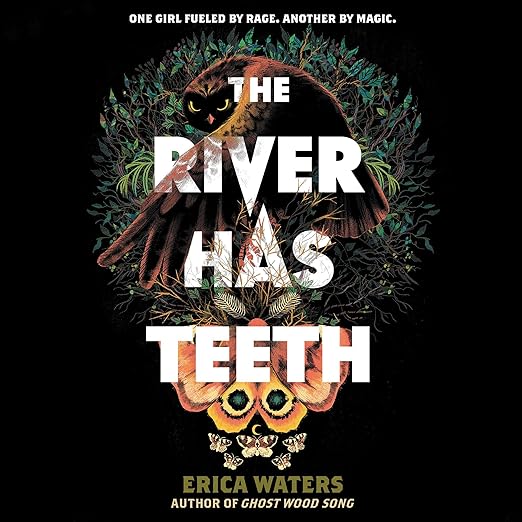
The premise: girls have been going missing in the woods. When Natasha’s sister disappears, she turns to Della, a local girl rumored to be a witch, for help. Della suspects the creature responsible is her own mother, transformed by magic gone catastrophically wrong. Both young women are operating from different kinds of desperation, and the novel builds its tension from the friction between their perspectives and motivations rather than from the mystery alone.
Our Take on The River Has Teeth
Waters writes with a confidence that doesn’t always announce itself. The southern gothic atmosphere is earned through specificity, this is not a generic dark forest but a particular place with its own logic, its own community, its own grief. The magic system, such as it is, grows organically from family history rather than from constructed rules, which gives the supernatural elements an emotional grounding that genre mechanics alone can’t provide.
The sapphic love story is handled with notable care. As one reviewer put it, the book doesn’t spend its energy on a gay struggle narrative, it simply allows two girls to love each other, redirecting that energy toward the systemic issues it actually wants to examine. This is a genuine formal choice, not a gesture toward representation. The relationship develops with the same weight and complexity as the plot itself.
Why Listen to The River Has Teeth
Katherine Littrell’s narration is what elevates this from a good audiobook to an excellent one. The dual POV structure, alternating between Natasha’s grief-fueled urgency and Della’s reluctant protectiveness, requires a narrator who can hold two distinct emotional registers without flattening them. Littrell does this. The anger in both characters feels specific to each rather than interchangeable, and the quieter moments of tenderness between them are handled without sentimentality.
The novel pulls from a tradition Erica Waters herself identifies, fans of Wilder Girls and Bone Gap are the explicit comparison, and it lands there. But it also stands on its own terms. The sister bond between Natasha and the missing girl functions as an emotional anchor throughout, giving the fantasy plot consequences that feel genuinely personal rather than merely plot-mechanical.
What to Watch For in The River Has Teeth
One reviewer who read this for book club abandoned it at 80 pages, describing it as lackluster. I think that is the wrong book for a casual reading club, but it is a fair signal: this is a novel that requires a reader willing to sit with atmospheric slowness before the central conflict crystallizes. The first quarter is deliberately disorienting. If you need momentum from the opening chapters, you may struggle with the early pacing.
The character of Rochelle drew some criticism as one-dimensional in her anger. There is something to this, her impulsiveness occasionally reads as functional rather than fully realized. But one reviewer made the sharper observation that this may reflect something about how fictional women are rarely permitted sustained anger without being coded as flawed. Waters is aware of this tension; whether she fully resolves it is a legitimate question.
Who Should Listen to The River Has Teeth
Essential listening for readers who want YA fantasy with real emotional stakes and a perspective on gendered violence that doesn’t soften its argument. Not for listeners who need their dark fantasy to resolve cleanly, or who want a fast-paced plot over atmospheric immersion. At over eleven hours, it rewards patience. Listeners who loved Ghost Wood Song, Waters’s debut, will find everything they loved there deepened here.
Frequently Asked Questions
Do I need to read Ghost Wood Song before The River Has Teeth?
No. The River Has Teeth is a standalone with entirely different characters and a new setting. Reading Waters’s debut is not required, though fans of Ghost Wood Song will recognize the same atmospheric approach.
How prominent is the sapphic romance, and is it central to the plot?
It is woven throughout rather than sidelined. The relationship between Natasha and Della is central to the emotional arc of the novel, and Waters treats it with the same weight as the fantasy plot rather than as a subplot.
Is this appropriate for younger YA readers, or does the content skew older?
The book deals with missing girls, violence against women, and a mother transformed into something monstrous by magic. It is firmly in older YA territory and most appropriate for readers 16 and up who are comfortable with dark subject matter.
Does Katherine Littrell’s narration effectively differentiate Natasha and Della across the dual POV chapters?
Yes. The tonal shift between chapters is clear and consistent. Littrell brings distinct emotional textures to each character without exaggerating the distinction, which is exactly what a dual-POV structure requires.