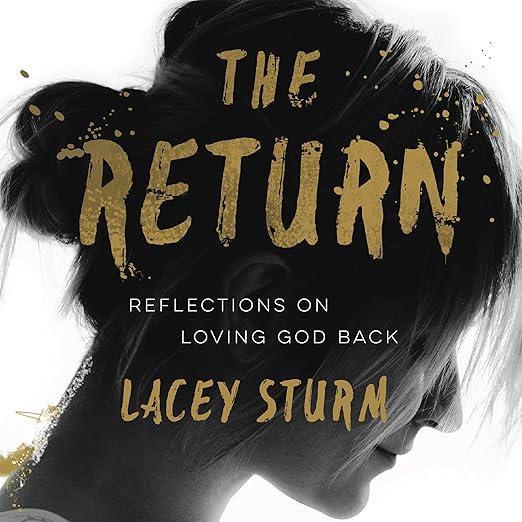
I came to The Return knowing Lacey Sturm primarily as the former lead singer of Flyleaf, which meant I expected something more explicitly dramatic than what I got. The audiobook, at just over four hours, is quieter than I anticipated. Sturm does not perform her faith; she inhabits it, and the difference registers immediately when she begins speaking. I finished this one on a Friday morning with coffee going cold beside me, not because the material was relentlessly gripping but because stopping felt wrong, like putting down a letter mid-sentence.
The book is organized around a central question: what does God want us to do with the time he has given us? Sturm approaches that question through personal reflection, journal entries, prayers, and what one reviewer accurately called post-modern psalms. It is not a traditional memoir in the narrative sense. There is no single dramatic arc driving from beginning to end. Instead it accumulates, each section adding a layer to a portrait of a person working out what her gifts mean and how they belong to something larger than her career.
What Lacey Sturm Delivers
What makes this audiobook work in a way that many Christian self-help titles do not is Sturm's refusal to issue directives. She is not telling the listener what to believe or what to do. She is sharing what she found when she looked closely at her own experience, and she is doing so with enough transparency that the listener can hold her conclusions next to their own life and see what fits. One reviewer noted that she never makes the listener feel lesser for holding different views, and that generosity of spirit is present from the opening pages. She even offers optional prayers for listeners who want to open themselves to faith without requiring them of anyone who does not.
The journal entries scattered through the text are particularly strong. They have the specific texture of private thought that has been honest enough with itself to be useful to a stranger. When Sturm describes the tension between her public creative life and her interior life of faith, it does not read as confession so much as careful observation. She is a precise writer, and the precision serves the material well.
The answer is almost entirely in the narration. Sturm reading her own words collapses the distance between author and listener in a way that a hired voice could not replicate. Her tone is conversational rather than oratorical. She sounds like someone talking to you specifically, not like someone addressing an auditorium. At 4.9 stars across 307 ratings, the response from listeners reflects how directly this quality of presence lands.
One reviewer described Sturm's voice as generating the deepest catharsis they had experienced in a long time. Another called the book an honest account of vulnerability that gently unravels the tightly wound soul. Both are describing the same thing: a speaker whose openness creates permission for the listener to be open in return. That is not a common quality in devotional audio.
Where Lacey Sturm Loses Some Ground
The book's structure will not appeal to everyone. If you are looking for a linear narrative with a clear beginning, middle, and end, the collage of journal entries, reflections, and prayers may feel shapeless. This is more meditation than memoir in the traditional sense. The thematic coherence is real but it requires a different kind of attention than plot-driven books demand.
The explicitly Christian framework is also central rather than peripheral. Sturm is not writing for a general spiritual audience; she is writing from a specific faith tradition, and while she holds that tradition with warmth rather than rigidity, it saturates every page. Listeners looking for a faith-neutral exploration of vocation and meaning will find the frame limiting.
Who Should Pick Up The Return
Young people wrestling with questions of purpose and calling will find Sturm's perspective genuinely useful, as the synopsis promises. Fans of Flyleaf who have followed Sturm's spiritual journey will find in this book the most direct articulation she has given of what that journey means to her. Anyone who has felt they were coasting through their days and wanted a quiet, specific prompt to think differently about time and gifts will get that here. Listeners who prefer secular frameworks for personal development, or who want more narrative momentum, should probably look elsewhere.
Quick Take
- Narrator: Lacey Sturm reading her own work transforms this into something close to a spoken prayer, intimate, unguarded, and quietly powerful.
- Subjects: Faith and purpose, spiritual identity, creative vocation as an act of worship
- Tone: Reflective and warm, like a long conversation with someone who has thought carefully about what it means to live
- Bottom line: For readers navigating questions of faith and calling, Sturm's self-narrated memoir offers rare sincerity without preachiness.
Questions Listeners Ask
Does Lacey Sturm's narration of her own book make a significant difference to the listening experience?
Yes, substantially. Multiple reviewers specifically cite her voice as transforming the material. The intimacy of a writer reading their own prayers and journal entries creates a quality of presence that a professionally cast narrator would struggle to replicate.
Is The Return primarily for existing Flyleaf fans or does it work for listeners who don't know her music?
It works independently of her musical background. The book focuses on questions of faith, purpose, and creative vocation rather than on memoir from the music industry. Prior knowledge of Flyleaf enriches the context but is not required.