Quick Take
- Narration: Jonny Unitus delivers a clean, energetic read that suits the motivational arc of the material without tipping into the kind of relentless pep that alienates serious athletic readers.
- Themes: Mental toughness, youth sports psychology, growth mindset under pressure
- Mood: Focused and practical, like a good pre-game conversation with someone who has actually played
- Verdict: A well-researched sports psychology guide that works for young athletes, coaches, and parents in equal measure, grounded in real athlete interviews that save it from feeling generic.
I finished this one on a Tuesday morning after a run that went badly. Not dramatically badly, just that particular kind of flat and joyless that sometimes follows a stretch of good training without explanation. I was already thinking about resilience in the most mundane possible sense when the first interview segment arrived, a young goalkeeper from Wrexham FC and Burnley FC academies describing how he rebuilt confidence after a string of poor performances. I stopped walking and listened to the whole thing standing on a sidewalk. That is about the most honest endorsement I can give a sports psychology audiobook.
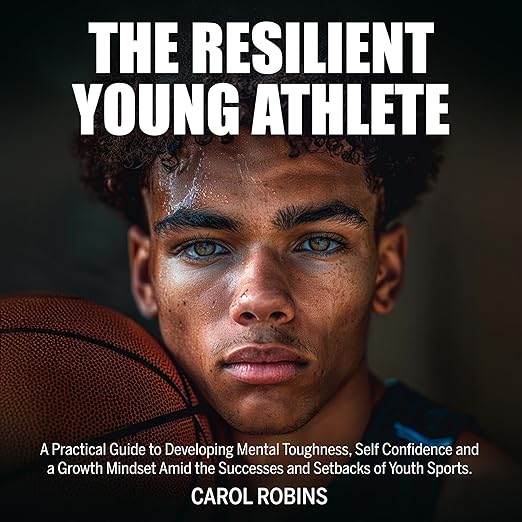
Carol Robins’s The Resilient Young Athlete is part of her Resilient Young Athlete Series, running four hours and fourteen minutes narrated by Jonny Unitus. The audience is explicitly three-part: young athletes who are losing confidence or battling anxiety, parents who want to support without overwhelming, and coaches looking for frameworks to build mental toughness into practice environments. The book largely succeeds on all three fronts, which is a genuine achievement given how differently those audiences typically want information presented.
Our Take on The Resilient Young Athlete
The science-backed framing is credible. Robins draws on established sports psychology research around SMART goal-setting, growth mindset, and performance anxiety management without drowning the listener in academic citation. The balance is right for the audience. What lifts the book above the generic is the inclusion of two interview subjects: Ruben Borg, an NCHSAA and AAU basketball player, and Kai Calderbank-Park, the Wrexham and Burnley goalkeeper mentioned above. These are not celebrity athletes. They are talented young competitors who faced real setbacks and have specific, particular things to say about how they worked through them. One reviewer noted that the combination of scientific techniques with real-life stories is the book’s greatest strength. That reads correctly to me.
Why Listen to The Resilient Young Athlete
Jonny Unitus handles the material with appropriate energy. He does not oversell the motivational passages, which is a meaningful restraint; sports psychology content has a tendency to tip into the kind of breathless positivity that credible athletes find condescending. The interviews break up the instructional sections effectively, giving the listener something to anchor the theory against real experience. At just over four hours, the runtime is short enough to revisit specific chapters before competitions or training periods where a particular concept is relevant, game-day stress, recovering from criticism, setting benchmarks rather than outcome goals.
What to Watch For in The Resilient Young Athlete
The book positions its toolkit as customizable to individual needs, which is true in the sense that the strategies are broad enough to apply across different sports and different temperaments. Parents of athletes in individual sports, gymnastics, swimming, tennis, may find that the team-dynamics content sits slightly awkwardly for their context, though the core mental toughness framework is transferable. One four-star reviewer noted the book is a useful resource without being transformational on its own. That seems accurate: this is a strong primer for mental game development rather than a comprehensive coaching system.
Who Should Listen to The Resilient Young Athlete
Young athletes roughly twelve to twenty who are struggling with performance anxiety, confidence loss after setbacks, or the pressure gap between training performance and competition performance will find the most immediate value. Parents who want language for the conversations their athletes are not quite having with them will also benefit. Coaches looking for a structured mental toughness framework can extract the chapter-by-chapter exercises into their practice planning. Skip it if you are looking for elite-level sports psychology at the competitive adult level; the framing is squarely youth-focused, and the content is calibrated accordingly.
The series format is worth noting: this is the opening volume of the Resilient Young Athlete Series, which signals that Robins intends to expand into related territory. As a standalone first volume it is coherent and complete, but listeners invested in the mental game of youth sports will likely want to follow subsequent releases if the quality holds.
Frequently Asked Questions
Are the athlete interviews with Ruben Borg and Kai Calderbank-Park substantial enough to add real value, or are they brief inserts?
They are substantive. Both athletes are given enough time to describe their setbacks and recovery in specific detail rather than offering motivational soundbites. Calderbank-Park’s discussion of rebuilding confidence in the goalkeeper position is particularly concrete and was the section I found most valuable as a standalone listening moment.
Does this audiobook address the specific pressures of youth sports culture, including parental pressure and early specialization?
Yes, and more directly than many youth sports books do. Robins includes a section for parents on fostering open communication and guiding difficult conversations, which implicitly addresses the ways parental pressure can undermine athletic development. The book is candid about the gap between how adults think they are supporting athletes and how that support is experienced from the inside.
Is Jonny Unitus’s narration well-suited to the material, or does it feel like a mismatch for a sports psychology guide?
It works. Unitus brings enough energy to keep instructional passages engaging without performing the excessive enthusiasm that tends to undermine credibility in this genre. The interview segments, where his voice serves as framing rather than content, are handled well; he gets out of the way appropriately.
Is this book specifically about mental toughness in competitive sport, or does it also address recreational and developmental youth athletes?
Both, though the competitive framing is dominant. The SMART goal-setting and game-day stress management content is applicable across levels, but the examples and interview subjects are clearly competitive athletes. A recreational young athlete will find the material useful but may occasionally feel the intensity level is calibrated slightly higher than their context requires.