Quick Take
- Narration: Katy Sobey’s warm, measured voice gives Ella’s teenage perspective genuine authenticity and keeps the darkest moments from collapsing into despair.
- Themes: Survival and complicity, friendship under impossible conditions, beauty as resistance
- Mood: Quietly devastating and strangely luminous
- Verdict: One of the more honest and humane YA books set in the Holocaust, told from an angle that makes familiar history feel newly specific and morally alive.
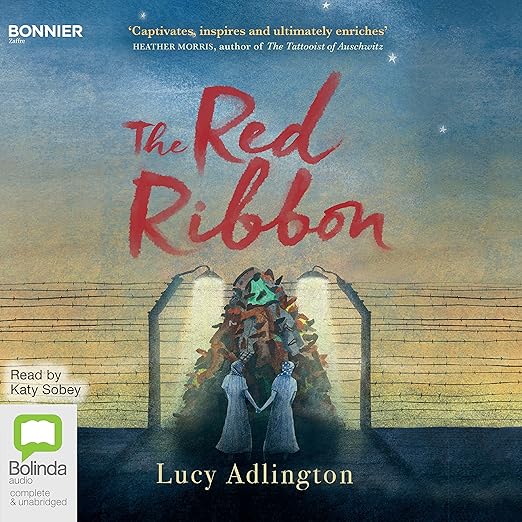
I was halfway through my morning commute when a particular passage in this book stopped me cold enough that I had to take out an earbud and look out the window for a moment. It was not a scene of violence. It was Ella, fourteen years old, running her fingers along a bolt of fabric in the sewing room at Birkenau-Auschwitz, thinking about what it would look like made into a dress. The beauty of the thought against the horror of the place was almost too much to hold at once, and yet that tension is precisely what Lucy Adlington is doing throughout The Red Ribbon.
Adlington is a fashion historian by training, and her expertise in textiles and clothing history is not decorative in this novel. It is load-bearing. The world of the seamstresses who sewed for the wives of the SS at Auschwitz is documented and real, as any reader who has also picked up Adlington’s nonfiction The Dressmakers of Auschwitz will recognize. This fictional version takes the same historical foundation and asks what it cost individual women to survive by working those sewing machines.
Our Take on The Red Ribbon
Ella arrives at Birchwood, the name the novel uses for Birkenau-Auschwitz, as a fourteen-year-old with a talent for dressmaking and a survival instinct she has not yet fully acknowledged in herself. The cast of women around her, Rose, Marta, Carla, and others, feel like genuine people rather than symbolic figures, which is harder to achieve than it sounds in fiction of this kind. Adlington writes the friendships with the same care she gives to the moral dilemmas.
The central question of the book is not whether Ella will survive, though that suspense is real. It is whether the love of beauty, of craft, of the physical pleasure of good fabric and clean seams, is a form of collaboration with her captors or a form of resistance against them. Adlington does not resolve this question cleanly, which is the right choice. The novel lives in the discomfort of not knowing, which gives it an ethical seriousness that distinguishes it from more consolatory Holocaust fiction aimed at young readers.
Why Listen to The Red Ribbon
Katy Sobey’s narration is one of the most important reasons to choose the audio version. She gives Ella the voice of a girl who is very smart and not yet sure how smart she is, watchful and frightened and occasionally capable of humor even here. That lightness of touch is essential. Without it, the darker material would become oppressive. Sobey calibrates the tone carefully across seven and a half hours, never letting the narrative slip into either sentimentality or relentless grimness.
The audiobook format also makes the detail work in Adlington’s prose more vivid than it might be on the page. The descriptions of fabric, of cutting and sewing and fitting, read as pleasure in the listening even while their context is nightmarish. That dissonance is the book’s moral engine, and having it delivered aurally, in a voice that does not flinch, makes it land harder.
What to Watch For in The Red Ribbon
A reviewer noted that the friendship between Ella and Rose reminded them strongly of the documented real-life friendship between the Dressmakers of Auschwitz survivors, and while the novel is fiction, those resonances are intentional on Adlington’s part. Readers who want to follow up with the nonfiction account will find The Dressmakers of Auschwitz an illuminating companion read.
The novel is marketed as YA, but adult readers drawn to WWII fiction will not find it thin. The moral complexity is genuine and the emotional intelligence is high. What makes it YA is the protagonist’s age and the accessibility of the prose, not a softening of the material. Parents reading alongside younger listeners should know that while the violence is not graphic, the book does not pretend the reality was other than it was.
Who Should Listen to The Red Ribbon
Ideal for readers aged fourteen and up who want Holocaust fiction that respects their intelligence. Adults who enjoyed The Tattooist of Auschwitz will find this quieter and in some ways more finely observed. The focus on women’s experience and the specific world of the Auschwitz sewing workshop makes it distinct from most fiction in the space. Listeners who prefer their historical fiction driven by action over interiority may find the pace too contemplative, but those who respond to character psychology and moral nuance will find it affecting in ways that stay with you. The red ribbon itself, a symbol of hope passed between friends in the worst possible place, is earned by everything that precedes its final appearance.
Frequently Asked Questions
Is The Red Ribbon based on a true story?
It is fiction, but it is based on documented historical reality. Lucy Adlington is also the author of The Dressmakers of Auschwitz, a nonfiction account of the real women who sewed for SS wives in the camp. The fictional Ella is drawn from that research.
Is this appropriate for younger YA readers, say twelve or thirteen years old?
It depends on the reader. The violence is not graphic, but the context is unflinching. Adlington does not pretend the Holocaust was anything other than what it was. For mature twelve or thirteen year olds who have been introduced to this history, it is appropriate and valuable. Younger readers would benefit from a parent or teacher reading alongside.
How does Katy Sobey’s narration handle the emotional extremes of the story?
With impressive control. She gives Ella a young, watchful voice that carries both the character’s intelligence and her fear without melodrama. The passages that describe the pleasure of fabric and sewing are given the same warmth as the scenes of friendship, which makes the surrounding horror feel more rather than less devastating.
Does the book deal with the question of complicity in survival?
Yes, and it does not resolve it neatly. Ella must reckon with whether sewing beautiful clothes for the wives of her captors is survival or collaboration, and the novel holds that tension throughout rather than providing a comfortable answer.