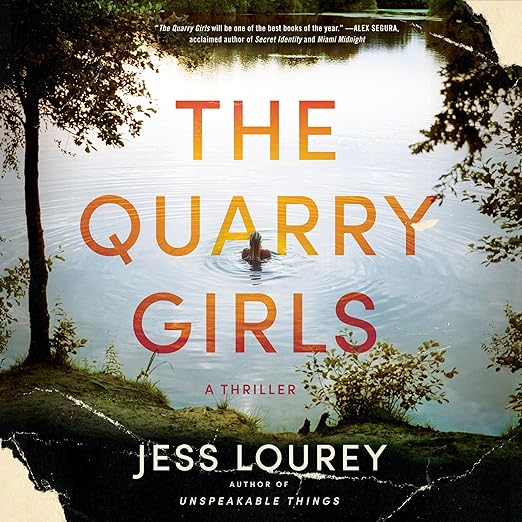
Quick Take
- Narration: Jess Nahikian captures the dissonance of 1977 small-town summer, balancing teenage voice with mounting dread in a way that keeps the period from feeling like costume.
- Themes: Community complicity in predatory systems, the particular vulnerability of girls, secrets as protection and as trap
- Mood: Oppressive and claustrophobic, lit by brief flashes of summer warmth
- Verdict: A true-crime-inspired thriller that does serious psychological work on how authority protects itself – disturbing in the ways it means to be.
I started this one on a Thursday evening that felt too warm for anything heavy, and by midnight I was still listening. Jess Lourey is a careful writer, and The Quarry Girls is careful in a way that the thriller genre does not always permit itself to be. The plot mechanics are there, girls disappearing, secrets kept, a protagonist piecing together a horror that has been hiding in plain sight. But the book’s real subject is something more specific and more uncomfortable than plot: it is about how entire communities become complicit in predatory systems, not because everyone is monstrous, but because the systems are built to be believed and defended by ordinary people.
Minnesota, 1977. Heather and Brenda are best friends navigating the particular freedom of a close-knit community summer: late nights at the quarry, the county fair, the tunnels beneath the city that give the book some of its best atmospheric writing. Then girls start disappearing. And Heather realizes that what she and Brenda saw in the dark is connected to the disappearances. And she realizes, slowly and then with terrible clarity, that the authorities are not going to help.
Our Take on The Quarry Girls
The book is inspired by real events in St. Cloud, Minnesota, in the 1970s, and Lourey handles that foundation carefully. The specific geography and social landscape of Pantown, the neighborhood where the story is set, are reconstructed with precision that one reviewer who knows the area confirmed as accurate and visceral. The period is not nostalgia; it is context. The 1970s setting matters because it explains specific institutional failures: a law enforcement culture that was not equipped to recognize patterns, a community ethos that prioritized reputation over investigation, a world where teenage girls’ testimony was structurally underweighted before anyone made a formal decision to discount it.
One reviewer raised the critique that the lead character takes too long to act on what she knows and that the people around her are willfully obtuse. This is worth addressing directly because it is the most substantive criticism of the book. Heather’s slowness to act is, I think, the point Lourey is making. Heather is not stupid. She is a teenager in 1977 in the Midwest who has been trained by every institution around her, school, family, law enforcement, to defer to authority, to assume she is wrong when her perception conflicts with what trusted adults tell her. The horror of the book is not that Heather doesn’t see what is happening. It is that she sees it and still cannot make herself act in the ways an adult reading in 2024 might expect. That is psychologically honest, even when it is frustrating.
Why Listen to The Quarry Girls
Jess Nahikian’s narration preserves Heather’s specific register: a girl who is intelligent and perceptive and operating in a social context that has taught her to second-guess both qualities. The summer setting comes through in the narration, the heat of the quarry nights, the false safety of familiar streets. The tunnels scenes are handled with real atmospheric skill; Nahikian drops her pace there in ways that heighten the claustrophobia without forcing it.
One reviewer wrote that they could taste the heat and feel the scenes from the description. That is the specific pleasure Nahikian’s delivery amplifies: Lourey’s sensory precision lands harder in audio because the narration adds another layer of embodied detail to an already immersive text.
What to Watch For in The Quarry Girls
The true-crime inspiration means the book moves in the shadow of real events, and Lourey is careful about that weight. She is not exploiting the source material; she is using it to make an argument about institutional failure that extends well beyond the specific case. Readers who come in expecting pure plot mechanics may find the sociological layer a complication. Those who read thrillers partly for the structural argument they make about society will find it one of the book’s main strengths.
The pacing in the first half is deliberate enough that some listeners will feel the slow build is extended beyond what the story requires. The final third accelerates considerably, but the payoff depends on having sat with the dread that the first half accumulates. This is a book that requires patience before it delivers.
Who Should Listen to The Quarry Girls
Listeners who want psychological depth in their crime fiction, particularly stories interested in how communities enable predation, will find this compelling. Lourey’s other books in this vein, including Unspeakable Things and Bloodline, suggest a pattern of interest worth exploring if this one resonates. True-crime readers who appreciate fiction that takes real events seriously rather than sensationalizing them will find the approach responsible and affecting. Skip it if character psychology and deliberate pacing are not what you look for in a thriller; this is not a speed-read.
Frequently Asked Questions
What is the true-crime case that inspired The Quarry Girls?
Lourey based the book on a series of crimes in St. Cloud, Minnesota, during the 1970s. The specific case involved crimes that were inadequately investigated or connected by authorities at the time. The book uses the setting and general circumstances as inspiration rather than as a direct fictional account of the specific events.
Is the slow pace of Heather’s realization a flaw in the book or an intentional choice?
It is intentional. Lourey is making a specific argument about how the social conditioning of teenage girls in the 1970s Midwest made it structurally difficult to act on what they knew. The frustration a reader feels watching Heather hesitate is part of the book’s critique of how communities make that hesitation rational from within.
How does the Minnesota setting contribute to the atmosphere of the book?
The Pantown neighborhood setting is rendered with specific sensory and social precision that reviewers with knowledge of the area have confirmed as accurate. The 1977 period is handled as context rather than nostalgia, with the community’s social structures given as much attention as the physical landscape.
Does The Quarry Girls work as a standalone, or is it part of a series?
It is a standalone novel. Lourey has written other books, and some of her work shares thematic territory, but The Quarry Girls does not require familiarity with any prior book. It begins and concludes its story without sequel obligation.