Quick Take
- Narration: Ariana Delawari handles the alternating Book and Hope perspectives with clarity, keeping the chapter-by-chapter voice switch from becoming disorienting.
- Themes: State-sanctioned hunting as dehumanization, survival through collective resistance, identity under oppression
- Mood: Lean and urgent, with the momentum of a chase that never fully stops
- Verdict: A solid dystopian debut that earns its Maze Runner and Hunger Games comparisons while developing its own grim internal logic.
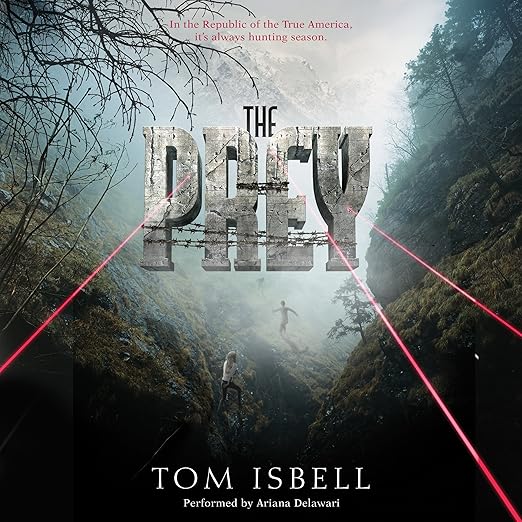
I came to The Prey with some skepticism about the comparison marketing. When a debut novel is positioned as the meeting point of two already-celebrated properties, the implicit message is often that the book cannot justify itself on its own terms. Tom Isbell’s first YA novel does not have that problem. The Prey is positioned at the intersection of The Maze Runner and The Hunger Games, but the specific horror at its center, an established republic that raises orphaned teenagers to be hunted for sport by the elite, has its own cold logic. The abbreviation LT, which the characters are told stands for lieutenant, actually designates Less Thans. The double meaning lands with the matter-of-fact brutality of the best dystopian worldbuilding.
Ariana Delawari narrates across nine and a half hours, managing the alternating perspectives between Book and Hope as the chapter structure shifts between them.
Our Take on The Prey
Isbell has a background as a theater professor, and that background surfaces in how he writes his characters into situations. The action in this book is physical and immediate. A reviewer who watched Isbell for years before reading his debut described the writing as lean and tight, noting that he grabs you in the first paragraph and hauls you along. That is an accurate description of the audiobook’s kinetic quality. The pacing does not dawdle on setup; it drops you into a world whose mechanics are already fully operational and lets you learn the rules through experience rather than exposition.
Book and Hope, the two narrative voices, are given genuinely different perspectives on the same events. Book’s chapters, in which the male Less Thans are processing their situation with a mix of fear and collective resolve, read differently from Hope’s, in which the Sisters are dealing with their own haunting fate. The pairing of these two groups, joining forces once both escape their respective camps, is the structural motor of the novel’s second half.
Why Listen to The Prey
Ariana Delawari’s dual narration is the key decision in the audiobook version. Chapter-by-chapter perspective shifts can create tonal whiplash when a single narrator cannot convincingly differentiate between two distinct characters. Delawari handles this more successfully than a reviewer’s mild complaint about initial disorientation would suggest, and most listeners adapt to the structure within the first few chapters. The action sequences are clear and spatially grounded in audio, which matters for a book built around pursuit and evasion.
The book’s emotional register is deliberately lean. Isbell is not interested in extended interior reflection; he is interested in what happens when people are put under maximum pressure and asked to find the best in themselves to fight the worst in their enemies, as one reviewer puts it. That economy of feeling works well in audio format, where the narrative momentum carries you through before you have time to demand more interiority from characters whose situation does not allow for it.
What to Watch For in The Prey
The dystopian framework is sketched rather than fully developed. The Republic of the True America exists as a context for the book’s action rather than a world that invites close examination. Readers who want the political and social infrastructure of their dystopias to be internally coherent at a level of detail will find The Prey less satisfying than novels that build their collapsed worlds with more architectural care.
One reviewer gave three stars and wrote simply just okay, and that minority view reflects the risk of lean, propulsive fiction: when the momentum pauses, there is less beneath it than in more interior-focused work. The romance between Book and Hope develops alongside the survival narrative, but neither element dominates. This is primarily an escape story, and it succeeds on those terms.
Who Should Listen to The Prey
Listeners who burned through The Maze Runner or The Hunger Games wanting more of the same kinetic energy and institutional horror will find The Prey a satisfying discovery. It suits listeners who prioritize forward momentum over deep worldbuilding or extended character interiority. At 4.3 stars across 186 ratings, it has a broader and more mixed reception than the five-star reviews alone suggest, so calibrate expectations accordingly. This is the first book of a trilogy; the sequel is The Capture.
Frequently Asked Questions
What does LT actually stand for in the Republic of the True America, and why does that matter?
The Less Thans are told LT stands for lieutenant, the conventional military abbreviation. The revelation that it stands for Less Thans is the book’s foundational horror, establishing how the state manufactures dehumanization through language before it manufactures it through violence.
How does Ariana Delawari handle the alternating Book and Hope chapters?
One early reviewer noted some initial difficulty following the perspective shifts, but most listeners adapt quickly. Delawari differentiates the two voices well enough that the chapter-by-chapter switching becomes navigable after the first few transitions.
Is The Prey the first book in a trilogy, and does it end on a cliffhanger?
Yes, it is the first installment in the Prey Trilogy, followed by The Capture and The Release. The ending sets up the next volume but functions as a natural stopping point rather than an abrupt cut.
How does The Prey compare to The Maze Runner and The Hunger Games beyond the marketing?
The Prey shares The Maze Runner’s institutional captivity premise and The Hunger Games’ state-sanctioned violence against youth, but its specific focus on Less Thans raised by the state as prey is its own invention. It is less interested in constructing an elaborate game structure and more focused on the survivor psychology of the escape itself.