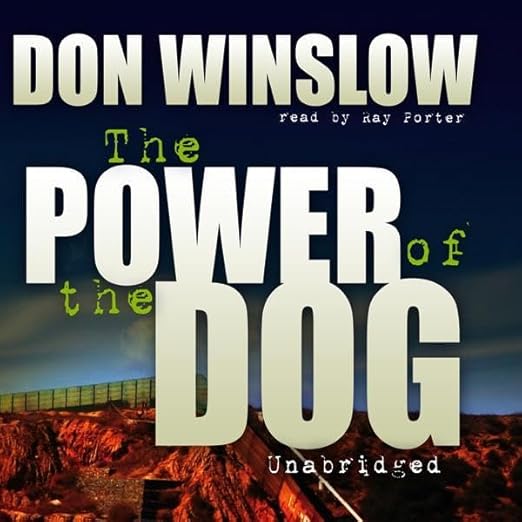
Quick Take
- Narration: Ray Porter is one of the best narrators working in crime fiction, and his performance here across a large ensemble cast of morally complicated characters is a clinic in how to serve a demanding text.
- Themes: The true cost of the war on drugs, corruption as systemic rather than individual, violence and complicity
- Mood: Dense and relentless, with the accumulated weight of a decade-spanning moral reckoning
- Verdict: At nearly nineteen hours this is a significant commitment, and it earns every minute of it as one of the most serious novels ever written about the drug trade.
I started The Power of the Dog on a long drive, planning to listen for an hour or two and then switch to something lighter. I did not switch. By the time I reached a stopping point it was late in the evening and I had been with Art Keller and the Barrera brothers and Nora Hayden and Father Parada for most of the day, and what I felt was not so much entertained as shaken. Don Winslow is not writing entertainment. He is writing an indictment, assembled with the craft of a novelist who understands that moral argument lands harder when it is embodied in specific, irreducible human lives.
The Power of the Dog is the first book in what became a trilogy about the Mexican drug trade, set roughly ten years before its sequel The Cartel. The cast is large and deliberately representative: Keller is the DEA agent whose obsession with the Barrera family shapes and eventually consumes his life. The Barreras are the heirs to the Federacion, a drug empire built with the tacit cooperation of American intelligence agencies. Nora Hayden moves from jaded teenager to high-class escort in ways that illuminate the economic logic of the world Winslow is describing. Father Parada represents incorruptibility in a landscape where that quality is almost always fatal. Callan, the Irish-American hitman, is perhaps the most morally disturbing figure: a man who kills efficiently and without apparent conflict, whose psychological interior Winslow renders with unsettling precision.
Our Take on The Power of the Dog
A reviewer called this one of the best books they had ever read, and another described it as painstakingly researched. Both are accurate. Winslow spent years reporting on the actual history of the DEA’s operations in Mexico, and the novel is grounded in documented events: the abduction and torture of DEA agent Kiki Camarena, the rise of specific cartel organizations, the ways American foreign policy and the CIA’s Cold War priorities intersected with and enabled the drug trade. He does not present the United States as a corrupted force operating against a clean international order. He presents corruption as the operating system of the entire enterprise, on both sides of the border, at every level of government.
Why Listen to The Power of the Dog
Ray Porter is one of the reasons this audiobook works at the level it does. At nearly nineteen hours, a lesser narrator would lose the listener across the book’s multiple time periods and dozen-plus named characters. Porter differentiates voices subtly rather than broadly, which is the correct approach for material this serious: he is not performing characters, he is inhabiting them, and the effect accumulates over hours of listening in a way that makes the emotional devastation of the final sections genuinely earned. A French reviewer, reading in their second language, described the prose as reminiscent of Elmore Leonard in certain dialogue passages, which is a sharp observation. Winslow has Leonard’s ear for the way power expresses itself in speech, though his register is darker and more sustained than Leonard typically maintained.
What to Watch For in The Power of the Dog
Winslow does not soften anything. The torture sequences are described with the explicitness that the historical record demands, and several reviewers in various languages have noted that sensitive readers should be prepared. This is not gratuitous: the violence functions as argument. When Winslow shows what the war on drugs costs in human terms, on both sides, he is making the case that the policy’s failure is not accidental or correctable through better implementation. The failure is the point. That argument is sustained across nearly nineteen hours, which is a long time to hold a single moral thesis, and the book’s structure occasionally shows the effort. Some of the middle sections, particularly those tracking Nora’s trajectory, require patience. They pay off, but the payment is deferred.
Who Should Listen to The Power of the Dog
Listeners who want serious crime fiction with historical grounding and moral ambition will find this among the best examples of what the genre can achieve. Those who want something tightly plotted and propulsive without the depth will find it occasionally demanding. The book is not for listeners who want clear protagonists and satisfying resolutions: Winslow distributes guilt too widely for that kind of comfort. Fans of The Wire as television or of writers like James Ellroy or Elmore Leonard should consider this essential. Listen to this before The Cartel; the investment in the earlier period makes the sequel’s reckoning considerably more devastating.
Frequently Asked Questions
Does The Power of the Dog need to be listened to before The Cartel, or can it stand alone?
The Power of the Dog functions as a prequel to The Cartel, set about ten years earlier. It can be listened to independently, but the emotional and narrative payoff of The Cartel is substantially greater for listeners who know this book first.
How accurate is the historical research underlying the novel? Is this fiction or reported history?
Winslow researched the book extensively and grounds it in documented events, including real DEA operations and cartel history. The characters are fictional composites and inventions, but the institutional landscape is closely based on historical reality.
Is Ray Porter’s narration consistent across the many different character perspectives and nationalities in the book?
Porter is one of the most technically skilled narrators in crime audiobooks. He differentiates characters through subtle voice and rhythm adjustments rather than broad accent performances, which serves the serious tone of the material well.
How graphic is the violence, and is there any content that listeners should be specifically prepared for?
The violence is explicit and depicted with detail that reflects its historical basis. Torture sequences in particular are not softened. This is a deliberate authorial choice, not sensationalism, but listeners with low tolerance for graphic content should be aware.