Quick Take
- Narration: Holly Black narrating her own work brings an authority and tonal precision that few hired narrators could replicate.
- Themes: Dark transformation, social outsider experience, subverted genre conventions
- Mood: Eerie and sardonic, with unexpected humor threading through the darkness
- Verdict: A short story collection that does what the form does best, leaving images and questions that linger well past the final chapter.
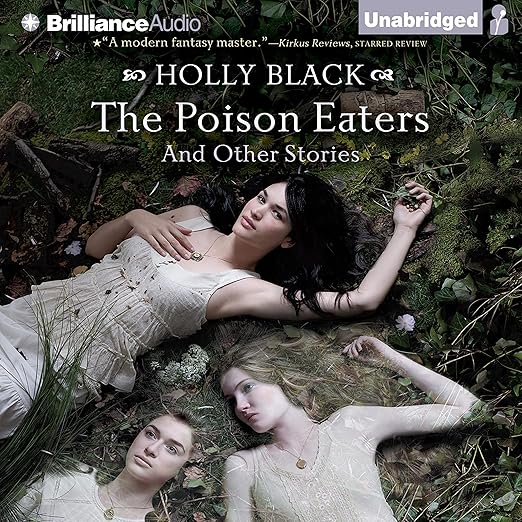
I have a complicated relationship with short story collections on audio. The format requires a kind of sustained attention that does not always survive the natural stopping points between stories, and anthologies narrated by authors can veer into performance that prioritizes intention over craft. Holly Black narrating The Poison Eaters and Other Stories does neither of those things. I listened through on a long drive, and the transitions between stories felt more like movements in a larger piece than discrete interruptions. There is a recognizable sensibility holding all twelve stories together: a fascination with what happens to people at the edges of the fantastical, where something monstrous or magical has touched them and left them altered.
Black is one of the architects of contemporary YA fae fantasy, most visibly through the Modern Faerie Tales series and The Spiderwick Chronicles. These twelve stories, several of which were previously published in other anthologies, show the range behind that reputation.
Our Take on The Poison Eaters and Other Stories
The opening story, The Coldest Girl in Coldtown, is the seed for what became Black’s novel of the same name and is worth the price of the collection on its own. A reviewer notes that Black makes vampirism genuinely terrifying in this telling, with a protagonist trying desperately not to become what hunts her. That is the collection’s governing logic: it takes the creatures you think you know and reorients them so their familiar shapes cast unfamiliar shadows. Faeries who return to Ironside searching for love do not find what they expect. The devil’s eating contest carries its own weight.
Black’s range across twelve stories is notable. She moves between horror, dark comedy, and something closer to fairy-tale tragedy without losing the collection’s essential mood. The junior prom turned bacchanalia is a highlight, using social embarrassment and mythological excess in ways that are simultaneously funny and unsettling. A teacher who reviewed the collection found it well suited to a mature YA audience grappling with family drama, acceptance, and loss, noting that the stories deal with these themes without hectoring.
Why Listen to The Poison Eaters and Other Stories
Author narration is not always the right choice. Authors who read their own work can become overly deliberate, stressing meanings that a professional narrator would let surface naturally. Black avoids this. Her pacing is assured, and her voice for the stranger, more unsettling passages has a quality of comfortable familiarity with the darkness she is describing. She does not announce that something is frightening; she simply moves into it, and that restraint is what makes the collection’s horror sequences effective rather than theatrical.
A reviewer who teaches at the high school level described the collection as well suited to a mature and diverse audience, and noted that the stories blend dark fantasy with the kinds of issues teens genuinely grapple with: acceptance by society and peers, loss, identity. Those themes are present without being the point of the stories, which is the right balance.
What to Watch For in The Poison Eaters and Other Stories
At four hours and forty-seven minutes, this is a short listen, and the collection’s brevity means that some stories feel more like sketches than fully developed narratives. A reviewer noted that a couple of stories were less memorable than the rest, which is common in anthologies where the best material can make the merely good feel slight by comparison.
Listeners who prefer their fantasy at novel length, where worldbuilding has room to accumulate and character relationships develop over time, may find the collection’s pace of establishment and resolution too compressed. Short fiction rewards a different kind of reading attention than novels do, and the transition between stories requires active re-engagement that not every listener will find natural.
Who Should Listen to The Poison Eaters and Other Stories
This collection is ideal for Holly Black readers who want to understand the full range of her concerns as a writer, or for fans of dark YA fantasy who have not yet encountered her work and want an efficient introduction. It is also an excellent choice for listeners who want something that can be consumed in a single sitting or across a few commutes without losing the thread. Readers who need novels will find the format unsatisfying, but listeners comfortable with short fiction will find twelve stories that reward attention and return visits.
Frequently Asked Questions
Is The Coldest Girl in Coldtown story in this collection the same as Holly Black’s novel of the same name?
The story is the seed from which the novel grew. Reading or listening to the story is not equivalent to the novel, which expands the premise substantially, but the collection version is a complete narrative in its own right.
How does Holly Black perform as a narrator of her own work?
She narrates with authority and tonal precision, particularly in the darker passages. She does not over-explain her own intentions, which is the common failure of author-narrated collections, and her pacing is more assured than many professional narrators who come to the material cold.
Are all twelve stories previously published, or does this collection include new material?
A reviewer notes that only a couple of stories were previously unpublished at the time of this collection’s release. Most had appeared in other anthologies. The collection brings them together in one place rather than offering primarily new work.
Is the content appropriate for younger YA readers, or does the darkness skew older?
A teacher who reviewed the collection described it as well suited to a mature and diverse YA audience. It deals with homosexuality, loss, and disturbing fantasy imagery in ways that are not gratuitous but are genuinely dark. It is not appropriate for young middle-grade readers.