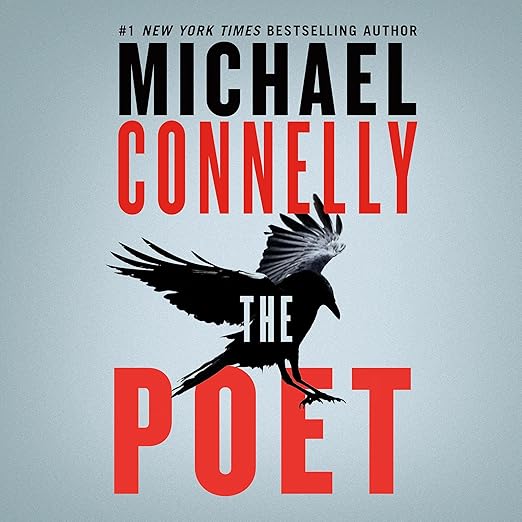
Quick Take
- Narration: Buck Schirner brings a journalist’s pragmatic flatness to Jack McEvoy, which works for the character even if it doesn’t produce the most dramatic performance in Connelly’s catalog.
- Themes: Serial killer investigation, journalism versus law enforcement, grief as a driving force
- Mood: Dark, methodical, and propulsive until the final stretch
- Verdict: A foundational Connelly thriller that holds up in audio form, though listeners who came for a clean resolution should prepare for a divisive ending.
There’s something useful about returning to a Michael Connelly novel from 2008 in audio form, when you’ve read his more recent Harry Bosch work and think you know what to expect. The Poet predates a lot of Connelly’s mature stylistic patterns, and it’s a different kind of book than the Bosch series: grittier in places, more willing to let its protagonist make genuinely bad decisions, and structured around a darkness that the Bosch novels occasionally pull back from. I was halfway through a commute when the plot turned in a way I hadn’t anticipated, and I drove past my exit.
The premise is both simple and well-calibrated for audio. Jack McEvoy is a crime reporter whose brother, a homicide detective, appears to have died by suicide. McEvoy, unable to accept that explanation, begins investigating and discovers that his brother’s case is one of a pattern: homicide detectives across the country, all haunted by unsolvable cases, all dead in ways that have been attributed to suicide. A serial killer is targeting cops. And his calling card is Edgar Allan Poe.
Our Take on The Poet
Connelly’s decision to use Poe as the killer’s aesthetic signature is more than a clever hook. The gothic quality of Poe’s work, the preoccupation with death and hidden guilt and unreliable narration, rhymes structurally with what Connelly is doing in the novel. McEvoy is not an entirely reliable narrator; his grief distorts his judgment in ways the reader can see before he can, and the investigation is partly a story about what happens when personal stakes compromise professional detachment. That’s the kind of literary self-awareness that Connelly has sometimes been underrated for.
Buck Schirner’s narration establishes McEvoy’s voice efficiently. He reads with a journalist’s controlled flatness, which is appropriate for a character who has spent his career processing other people’s disasters. The performance is less emotionally textured than some of the more celebrated Connelly narrators, but it suits the story’s procedural rhythm.
Why Listen to The Poet
This is a fifteen-hour audiobook that earns most of its length through sustained investigation. Connelly is at his best when he’s letting a character follow the logic of evidence from wrong assumption to correction and then to something closer to the truth, and The Poet has several of those sequences in its first two-thirds. The FBI procedural elements are carefully rendered. The cross-country investigation structure, with McEvoy moving from Denver to Washington to Los Angeles and accumulating connections that aren’t visible to any single law enforcement agency, plays to Connelly’s considerable skill at constructing institutional blind spots.
Several reviewers noted the character of Rachel Walling, the FBI profiler who becomes a complicated ally and something more. Walling is the most interesting secondary character in the book, and Connelly’s decision to return to her in later work suggests he knew it. Her introduction in The Poet is worth listening to in that context.
What to Watch For in The Poet
The ending is the point at which reader opinion splits most sharply. One reviewer offered a detailed breakdown of what they found implausible in the FBI agent’s behavior in the third act; another found the final turns genuinely gripping. I’ll say only that Connelly takes a risk in the resolution that not every thriller writer would take, and whether that risk pays off for you will depend on how much you’re invested in procedural plausibility versus narrative surprise.
This is a standalone novel within the broader Connelly universe, and Jack McEvoy is a series character who appears in later books. Knowing that going in doesn’t spoil anything but might adjust expectations about how much narrative risk Connelly will take with him.
Who Should Listen to The Poet
Connelly fans who have worked through the Bosch and Lincoln Lawyer series and want to explore the broader universe will find The Poet an essential early entry. It showcases Connelly’s plotting at a stage where he was willing to be more structurally experimental than the later procedural work. Crime fiction listeners who appreciate journalistic protagonists, a la Carl Hiaasen’s protagonist or the narrative mode of Erik Larson’s nonfiction, will find McEvoy an engaging point-of-view character. Listeners who need their endings to be unambiguous and plausible should approach the final act with managed expectations.
Frequently Asked Questions
Is The Poet a completely standalone audiobook, or does it require familiarity with any other Connelly series?
It’s completely standalone. Jack McEvoy appears in subsequent Connelly novels, but The Poet functions as his origin story and doesn’t assume any prior knowledge of the author’s other series.
How does Buck Schirner’s narration compare to other performers who have voiced Connelly’s work?
Schirner is capable but less celebrated than narrators like Len Cariou who have defined other Connelly audiobooks. He reads McEvoy as a controlled, observational presence, which fits the character’s journalist background more than it produces dramatic range.
The killer’s use of Edgar Allan Poe quotations is central to the plot, does Connelly use that motif in a superficial way or does it carry thematic weight?
The Poe material is well-integrated rather than decorative. Connelly uses Poe’s preoccupations with guilt, death, and unreliable witness in ways that reflect back on McEvoy’s own investigative limits.
Is the ending of The Poet controversial among Connelly fans, or does it land cleanly?
It’s genuinely divisive. The third-act plotting takes risks that some readers find implausible, particularly regarding FBI procedural behavior. Others find the resolution surprising in ways that reward the investment. Coming in knowing this may help calibrate expectations.