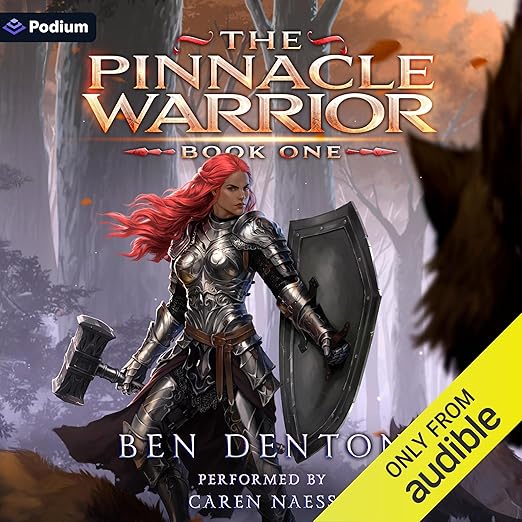
Quick Take
- Narration: Caren Naess brings Astrid to life with warmth and grit, handling combat sequences and quieter emotional beats with equal confidence.
- Themes: Chosen class anxiety, found family, self-reliance in a dungeon-crawler world
- Mood: Energetic and optimistic, with rising stakes
- Verdict: A strong opener for LitRPG fans who want character growth woven tightly into their dungeon runs.
I picked up The Pinnacle Warrior on a commute that stretched forty minutes longer than expected, and I barely noticed. Ben Denton’s series opener does something the best LitRPG does: it grounds its game mechanics in a character whose frustrations feel genuinely human. Astrid Warrior, raised by a Spellblade mother and a Talismartist father, inherits a Warrior class at eighteen and watches her carefully assembled friend group scatter to pursue their own paths. That premise lands harder than you might expect from a genre built on stat sheets.
By the time Caren Naess hit the scenes where Astrid is delving alone for the first time, refusing to let class envy curdle into bitterness, I was invested in a way that had nothing to do with skill trees.
Our Take on The Pinnacle Warrior
Denton has a particular talent for balancing tense, grounded fight scenes with meaningful character moments, as one reviewer put it, and that balance is what separates this from the endless flood of isekai-adjacent LitRPG that treats protagonists as vessels for power accumulation. Astrid is not overpowered. She does not unlock a secret ability that suddenly makes the Warrior class cool in the eyes of the people who abandoned her. She earns her place through preparation, observation, and stubbornness, and that process is satisfying to follow across eleven hours of audio.
The worldbuilding is dense without being overwhelming. Denton introduces Humanity’s Bulwark, the surrounding inhuman factions, and the dungeon delving economy in layers rather than front-loading exposition. Readers who come in fresh to this author’s work will find the setting accessible; returning fans of his other projects will recognize the same meticulous imaginative infrastructure at work.
Why Listen to The Pinnacle Warrior
Caren Naess’s narration is the key ingredient that lifts this from a competent genre entry to something more. She modulates between Astrid’s inner monologue, which runs dry and self-deprecating, and the more heightened register of dungeon encounters without jarring tonal shifts. A reviewer who binged the entire audiobook in two days noted losing track of time entirely, and Naess’s pacing is a significant reason for that. She never lets the stat-check sequences feel like a textbook recitation.
The parental relationship is also worth mentioning explicitly: Astrid’s mother and father are described by reviewers as awesome parents, a detail that is almost a novelty in YA fantasy. Denton avoids the absent-or-dead-parent shortcut and lets Astrid’s drive come from a place of love and identity rather than grief and revenge. That grounding gives her psychology more texture than the genre usually provides.
What to Watch For in The Pinnacle Warrior
One reviewer docked a star specifically for the cliffhanger ending, calling it bad craft rather than a deliberate structural choice. That is a fair warning. This is book one of a series, and Denton does not wrap things up neatly. If you are the kind of listener who needs resolution at the close of an installment, you will finish this one feeling the pull toward book two more acutely than you might like.
The pacing also runs hectic at points, particularly in the back half, where the narrative pressure of enemies closing in can make Astrid’s development feel compressed. The combat framework is built around martial disciplines rather than magic, which is an intentional thematic choice but one that some listeners find less engaging than the magical system running alongside it. That asymmetry is baked into the premise, and Denton seems aware of it.
Who Should Listen to The Pinnacle Warrior
This audiobook is well suited to listeners already comfortable in the LitRPG or dungeon-crawler space who are tired of protagonists handed power from page one. It rewards readers who liked the character-centric approach of series like Cradle or Dungeon Crawler Carl but want something with a more traditional fantasy setting and a female lead. Skip it if you need self-contained stories: the cliffhanger is real, and the wait for book two will be uncomfortable. At 4.7 stars across 153 ratings, it has clearly found its audience.
Frequently Asked Questions
Does Astrid’s Warrior class feel like a handicap throughout the whole book, or does it become an asset?
It starts as a source of anxiety and social isolation, but Denton gradually reframes it as a genuine strength. By the end of book one, Astrid is building a case for why her class suits her better than any magical alternative would have.
How much of the runtime is dungeon combat versus character development?
The balance is roughly even across the 15-plus hours. Reviewers consistently note that Denton integrates the psychological growth into the action rather than keeping them separate, so neither element dominates.
Is The Pinnacle Warrior accessible to listeners new to LitRPG?
Yes. Denton introduces the class and skill systems gradually, and the novel does not assume familiarity with the genre’s conventions. The emotional throughline is strong enough to carry listeners who find stat mechanics less interesting.
Does Caren Naess handle both the action sequences and Astrid’s quieter internal voice convincingly?
Most listeners find her excellent in both registers. She has a warm, slightly sardonic quality that matches Astrid’s personality, and the dungeon sequences maintain energy without becoming breathless or monotonous.