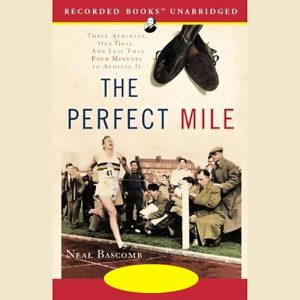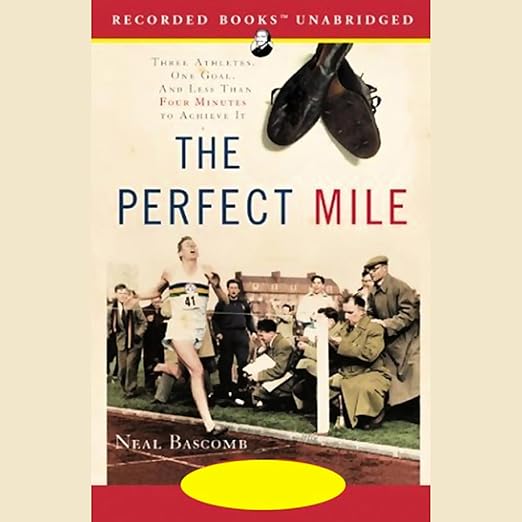
Neal Bascomb's The Perfect Mile covers the years between 1952 and 1954, when three runners from three different countries independently converged on the same target that experts had declared impossible. Roger Bannister, an English medical student training between hospital shifts. John Landy, an Australian from a wealthy family who trained with a ferocity that bordered on pathological. Wes Santee, an American farm boy with raw speed and a bureaucratic battle with the Amateur Athletic Union threatening to end his career before it peaked. This audiobook, narrated by Nelson Runger across fourteen hours and fourteen minutes, follows all three men through their separate preparations and their eventual collision at a series of races that held the sporting world's attention in a way sports rarely achieves outside major championships.
Bascomb published this in 2004 in the tradition of Laura Hillenbrand's Seabiscuit: a sports history that reconstructs its subject with novelistic specificity while remaining rigorously factual. The comparison is apt not just as a marketing category but as a structural one. Both books work by embedding sporting achievement in a specific historical moment, making the outcome feel genuinely uncertain even when the reader knows how the story ends. Bascomb spends the first third of the book establishing 1952 as a year when the four-minute barrier felt not just unbroken but possibly unbreakable, and that establishment is the work that makes the eventual breaking of it land with the force it needs. Without that foundation, the record is a number. With it, it is a horizon.
The three-character structure is Bascomb's most ambitious choice and his most successful. Bannister, Landy, and Santee are distinct personalities with distinct approaches to training, competition, and the pressure of public expectation, and Bascomb researched their individual stories deeply enough that the book never loses any of them behind the central race narrative. The 1952 Helsinki Olympics, where none of the three achieved what they had hoped, functions as a shared failure that sends each man back to his training with different lessons and different urgencies. One reviewer who identified herself as a runner who has loved the sport since it was not always easy for her found the book illuminating about what elite dedication actually requires at the daily level. That response is common: the training chapters carry as much weight as the races themselves.
The book's historical placement in the early 1950s is not incidental decoration. Bascomb grounds the public response to the four-minute barrier in a specific cultural moment: the Korean War ongoing, Edmund Hillary's Everest ascent happening in the same spring as Bannister's record attempt, the first years of a Cold War that turned athletic achievement into national statement. That context enriches the athletic narrative rather than competing with it. The three runners were operating in a world that was looking for evidence that human limits were not fixed, and Bascomb understands that the record meant something specific to that world that it cannot mean in the same way now.
The Best Parts of The Perfect Mile
The fourteen-hour runtime reflects the book's structural commitment to all three stories rather than choosing a single protagonist, and Runger manages the transitions between these three arcs without losing momentum or flattening the distinctions between the men. Some listeners will feel drawn more strongly to Bannister's story, partly because the May 1954 race at Oxford is the best-known historical event and partly because his medical training frames the barrier-breaking as an intellectual project as much as a physical one. Others will find Landy the more compelling figure: he broke the record himself, weeks after Bannister, and then faced him in the race that answered the season's central question. Runger's narration does not tip the scales toward either man, which is the correct choice for a book that insists on treating all three protagonists as equally central to its argument.
The audiobook format handles Bascomb's propulsive chapter structure particularly well. He cuts between the three men at the point of maximum tension in each training cycle and competition sequence, which in print can occasionally feel like interruption but in audio creates an almost cinematic forward momentum. The listener is always moving toward the next race, the next breakthrough, the next setback, and Runger's steady pacing ensures that momentum accumulates rather than dissipates across the full fourteen hours.
Before You Commit to The Perfect Mile
Listeners who want primarily a technical analysis of running biomechanics or training methodology will find Bascomb covers both but always in service of narrative rather than instruction. This is not a training book, and it does not provide a template for athletic achievement. The physiological detail serves characterization: Bannister's medical understanding of oxygen debt, Landy's refusal to reduce training load even when it was breaking his feet, Santee's raw speed against institutional obstruction. These details reveal who the men are, not how to replicate what they did.
The Wes Santee thread, which is the least familiar of the three to most international listeners, rewards patience. Santee's story involves the Amateur Athletic Union preventing him from competing at the level his talent warranted, and those chapters deal with institutional obstruction in ways that are slower than the race narratives. Bascomb needs that material to make the point that the four-minute mile was contested not just between men but between different national systems for developing and managing athletic talent. Listeners who skip or skim the Santee chapters will misunderstand the book's larger argument.
Should You Listen to The Perfect Mile?
Runners who have already read John L. Parker Jr.'s Once a Runner and want a factual counterpart to that novel's fictional treatment of elite distance running will find this audiobook their natural next listen. Listeners who came to sports history through Seabiscuit or David Halberstam's work and want similar quality in a different athletic domain will find Bascomb working at that level. Readers with no particular interest in running but a strong appetite for narrative history built on primary research will find the book gives them enough period detail and character complexity to stay fully engaged across the full runtime. People who want sports biography focused on a single protagonist should know this is a three-way structure, and the book is stronger for it.