Quick Take
- Narration: Brittany Pressley sustains tension in the procedural sections, differentiates Madeline’s public control from her private desperation, and manages a large ensemble cast cleanly.
- Themes: Wealthy family secrets, the performance of domestic perfection, small-town Texas community dynamics
- Mood: Atmospheric domestic suspense with a slow-building second act
- Verdict: Solid Gudenkauf that delivers the atmosphere and information asymmetry the author does well, even if it does not match her strongest earlier work.
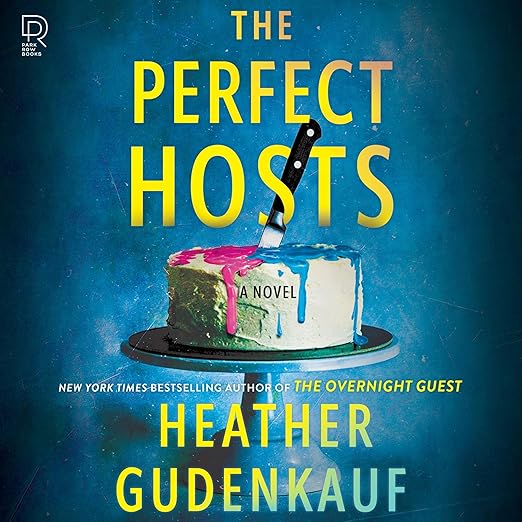
I was halfway through my morning commute when I started The Perfect Hosts, and I deliberately missed my stop because I wanted to get to the end of the chapter before surfacing. Heather Gudenkauf has built a career on domestic suspense that finds its hooks in the gap between a household’s public face and its private reality, and this book deploys that approach with a setting that is almost absurdly well-suited to it: a gender reveal party for two hundred guests at a sprawling Texas horse ranch, where the celebration itself becomes the crime scene.
Madeline and Wes Drake are the kind of couple who do nothing in half-measures. Their pistols-and-pearls gender reveal party is described as sensational enough to make headlines, and that detail is load-bearing: these are people who want to be watched. When the celebratory explosive misfires and kills one of the guests, the question is not whether this family has secrets but how many and whose hands they are in. Brittany Pressley narrates with the crisp urgency the genre demands, keeping the pacing tight through an investigation that produces more questions than it initially resolves.
What the Setting Does for the Plot
The horse ranch setting is not decorative. Gudenkauf uses the physical and social geography of a wealthy family’s private estate with purpose: the grounds provide space for secrets to be kept, the guest list provides suspects who have their own reasons to be present, and the status dynamics of a small Texas community provide the kinds of loyalty and rivalry that make everyone’s motives complicated. The gender reveal party premise initially reads as a piece of contemporary commentary on performative celebration culture, but Gudenkauf quickly subordinates that thematic possibility to the mechanics of the thriller. The party exists to create a situation where a large number of people with contradictory interests are all present in the same place at the same time, which is exactly what a well-constructed thriller needs.
Reviewer Sheila C. Siarkiewicz noted that the book creates genuine uncertainty about who was the actual target of the explosion, which is the central mystery the book refuses to resolve quickly. Agent Jamie Saldano arrives with his own unspecified demons from the past, and those demons add a layer of psychological complexity to the investigation that prevents the procedural sections from becoming purely mechanical. The appearance of unexpected houseguests, which the synopsis flags as deepening the mystery, does so by importing history that the Drake family would have preferred to remain elsewhere and that Saldano must now factor into an investigation that keeps expanding its cast of potential suspects with each new revelation.
Where the Book Delivers and Where It Tests Patience
Gudenkauf is reliable at building atmospheres of sustained unease, and The Perfect Hosts maintains that quality throughout. Reviewer Vikkil noted that the book dragged a bit in the middle sections before picking up strongly toward the end, which reflects a structural pattern visible in several of the author’s earlier works: she sometimes requires patience in the second act before the third act acceleration makes the investment worthwhile. That pattern will be familiar to readers of The Overnight Guest or Little Mercies, and those who found those books rewarding will likely extend similar patience here and find the payoff similarly satisfying when it arrives.
Reviewer Summer B, a self-described longtime Gudenkauf fan offering three stars, expressed concern that the characters were not developed with the depth she had come to expect from this author, and that the plot felt more formula-driven than her earlier work. That is a legitimate criticism from a reader with a comparative frame of reference. Listeners approaching this as their first Gudenkauf will not have those expectations to work against, and they are likely to find the book more fully satisfying as a result since they will encounter the formula without awareness of what has come before it.
Brittany Pressley and the Pace of Suspense
Brittany Pressley is among the more capable narrators working in commercial suspense fiction, with a talent for sustaining tension during the procedural passages that would flatten in lesser hands. She differentiates between Madeline’s controlled public presentation and her private desperation with a subtlety that rewards careful attention. Her Saldano is appropriately guarded, the voice of a man who is observing everything and revealing little of himself in return. At just under ten hours, the audiobook moves well in both its faster and slower sections. The ensemble cast of party guests, each a potential suspect with their own layered motivations, could become confusing in audio format, but Pressley manages the differentiation well enough that major players remain distinguishable throughout the full runtime.
The Gap Between Public and Private in Gudenkauf’s Work
One structural quality that Gudenkauf handles well in this book is the management of information asymmetry: the reader knows things individual characters do not, and individual characters know things the reader does not, and the gap between those two kinds of knowledge is where most of the suspense lives. Pressley’s narration supports this through her rendering of characters’ private thoughts during moments when their public behavior is performing something entirely different. That gap between internal state and external presentation is the emotional territory Gudenkauf maps most carefully across her body of work. At 4.1 stars across 765 ratings, the book sits slightly below her peak, which is consistent with solid genre fiction from a writer whose dedicated audience knows what to expect and generally finds it waiting here.
Frequently Asked Questions
Is this a good entry point to Heather Gudenkauf’s work, or should I read her earlier novels first?
It works as a standalone and requires no prior knowledge of Gudenkauf’s other books. Readers who start here and enjoy it will likely want to seek out The Overnight Guest and Little Mercies for the same combination of domestic atmosphere and information management.
How does Agent Jamie Saldano’s backstory figure into the investigation, and does it get resolved?
His unspecified demons from the past are woven into his investigative approach and become more relevant as the case expands. The resolution addresses his personal arc alongside the central mystery, which is typical of Gudenkauf’s approach to her investigator characters.
The gender reveal party premise seems very contemporary. Does the book engage with the cultural commentary potential, or is the premise mainly structural?
Gudenkauf uses the premise structurally rather than thematically. The party creates the crime scene and the suspect pool. Readers expecting extended commentary on performative celebration culture will find that thread subordinated quickly to the thriller mechanics.
Reviewer Vikkil mentioned the middle section dragging before a strong finish. How substantial is the pacing issue?
The second act is slower than the opening and closing sections, which is a pattern in several Gudenkauf novels. Listeners who commit through the slower middle will find the third act acceleration and resolution genuinely satisfying. At under 10 hours total, the investment is manageable.