Quick Take
- Narration: Jayne Entwistle navigates the novel’s multiple voices and medieval setting with precision. Her ability to distinguish Dolssa’s mystical register from Botille’s street-smart pragmatism is essential to the book’s emotional impact.
- Themes: sisterhood under institutional persecution, faith as dangerous interiority, the cost of hiding someone you love from the state
- Mood: Intimate and increasingly desperate, with the Inquisition tightening like a slow-closing door throughout
- Verdict: A rigorous and moving piece of historical YA fiction that treats its medieval setting with real seriousness. The ending is not gentle, and the book is better for it.
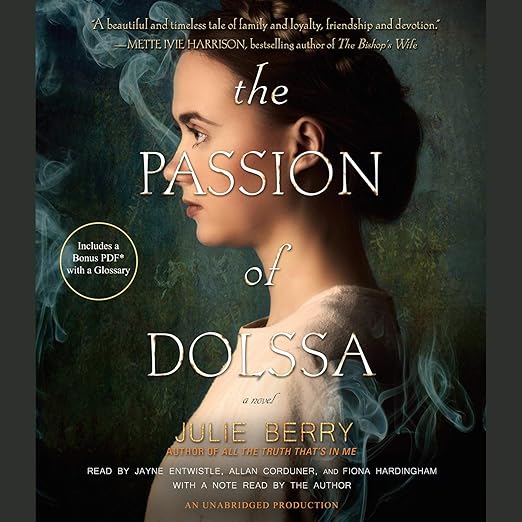
I read The Passion of Dolssa on a long train journey, and I remember the specific sensation of the landscape outside the window becoming irrelevant as the Inquisition closed in on the village of Bajas. Jayne Entwistle’s narration has that quality: it makes the distance between a twenty-first century listener and a thirteenth-century Provencal village feel very small. When the book opens with Botille writing that she must burn this account when she has finished it, you already feel the danger pressing against every sentence.
Julie Berry’s novel is built around a real historical phenomenon, the Albigensian Crusade and the papal Inquisition that followed it in thirteenth-century southern France. Into that setting she places two invented women: Dolssa, a mystic from Toulouse whose personal experience of divine love marks her as a heretic in the eyes of the church, and Botille, a pragmatic matchmaker who rescues Dolssa from the riverside and conceals her, gradually and catastrophically, from the friar hunting her down. Their friendship is the book’s real subject, even when the historical machinery is loudest.
Our Take on The Passion of Dolssa
Berry does something technically ambitious here: the novel is narrated in multiple voices, including testimonies from villagers speaking to unknown interlocutors, giving it the texture of discovered documents rather than conventional third-person fiction. Botille’s voice is immediate and specific, alive with the tactical intelligence of someone who has survived by her wits. The secondary village voices add moral complexity, showing how ordinary people under genuine threat make genuinely compromised choices. The result is a portrait of a whole community rather than just two protagonists, which makes the eventual reckoning feel appropriately larger than a personal story.
What the synopsis does not fully communicate is how deeply the friendship between Dolssa and Botille carries the emotional weight. This is, at its heart, a novel about what you risk for someone you love, and about what that person’s truth costs the people who choose to protect it. Dolssa’s gift, her apparent ability to heal through prayer, is presented with deliberate ambiguity: Berry neither confirms nor denies the miraculous, letting the novel hold both the possibility of genuine mysticism and the possibility of devoted, wishful human perception.
A reviewer who describes reading in ‘increasing anxiety’ about the characters’ fate identifies the experience accurately. Berry builds that anxiety slowly and honestly, through investment in specific people rather than through narrative manipulation. When the danger arrives fully, it lands with the weight of actual historical tragedy rather than the managed suspense of genre thriller fiction.
Why Listen to The Passion of Dolssa
Entwistle’s narration is the ideal vehicle for a multi-voiced novel. She distinguishes the testimonial voices from the primary narrative clearly, and she handles Dolssa’s language, which Berry writes in a slightly elevated register to signal her particular interiority and spiritual preoccupation, without letting it become mannered or distant. The eleven hours and forty-two minutes of the full listen allows the historical setting to accumulate weight: Berry is not working with medieval France as decoration but as a fully rendered world where the Inquisition is an institution with real procedures and real men executing them with bureaucratic thoroughness.
The novel includes a bonus PDF glossary, which extends the historical context usefully for listeners who want more grounding in the specific vocabulary and historical figures Berry draws on. It is not necessary for understanding the story, but it enriches it.
What to Watch For in The Passion of Dolssa
The opening requires some orientation. The multiple-voice structure and the medieval setting demand patience before the story finds its footing. Listeners who give it two to three hours will be fully committed by the time the concealment plot is in full motion. Those who bounce off the first chapter may be misjudging the whole book.
The religious content is historically embedded rather than devotional. Berry is not advocating for any particular faith position; she is depicting a world in which faith is everything, including a death sentence. One reviewer describes this accurately as ‘historically religious, but not pushing religion,’ and that balance holds throughout. The horror of the Inquisition is rendered clearly without the novel becoming a polemic in either direction.
Who Should Listen to The Passion of Dolssa
YA historical fiction readers who are not afraid of tragic endings and who want a novel that takes the Middle Ages seriously will find this among the best available. Adults who enjoy historical fiction centered on women’s lives rather than the movements of armies will find it deeply satisfying. Those who need happy endings as an absolute should be warned in advance. And anyone interested in the Cathar heresy, the Inquisition, or medieval women’s mysticism will find Berry’s research and fictional extension of those worlds genuinely rewarding and carefully handled.
Frequently Asked Questions
Is The Passion of Dolssa based on real historical events and people?
The historical backdrop, the Albigensian Crusade and the papal Inquisition in thirteenth-century southern France, is entirely real and closely researched. Dolssa and Botille are fictional, but Berry built them around real documented individuals and events. The bonus PDF glossary extends the historical context for interested listeners.
Does Jayne Entwistle handle the multiple-voice narration structure effectively?
Yes. The novel uses testimonial voices alongside the primary narrative, and Entwistle distinguishes them clearly enough that the structure enhances rather than confuses the story. Her handling of Dolssa’s elevated spiritual register versus Botille’s pragmatic street voice is particularly strong.
How does the book handle the question of whether Dolssa’s gifts are genuine miracles?
Berry maintains deliberate ambiguity throughout. Dolssa’s apparent ability to heal is never definitively confirmed or denied as miraculous. The novel holds both possibilities simultaneously, allowing readers to interpret events through the lens of faith or through the lens of devoted human perception and wishful love.
Is this an appropriate listen for younger teen readers given its themes of religious persecution and execution?
Berry handles the violence with restraint rather than graphic detail, but the themes are serious: religious persecution, death by fire, and the cost of concealing someone the state wants to execute. Most readers suggest it is appropriate for mature teens and adults, but parents of younger readers should preview it first.