Quick Take
- Narration: Jamie K. Brown gives Spencer a warm, slightly nervous energy that feels authentically teenage without being performed – the voice carries both the humor and the harder emotional moments.
- Themes: Trans identity and passing, friendship versus advocacy, first love
- Mood: Warmhearted and emotionally honest, with real stakes underneath the feel-good surface
- Verdict: Isaac Fitzsimons’s debut brings genuine emotional intelligence to its premise – Spencer’s dilemma between safety and visibility is rendered with the kind of specificity that makes it stick.
I finished The Passing Playbook on a Tuesday evening after a fairly bleak news cycle, which turned out to be exactly the right context for it. Not because it is escapist in the comfortable sense – it deals directly with discriminatory legislation and the very real cost of being forced to choose between safety and self-advocacy – but because it takes that weight seriously while also insisting on the possibility of good things. Spencer Harris is fifteen, transgender, and navigating a new school where nobody knows his history. The combination of high-school social anxiety and something much larger underneath it gives the story its particular charge.
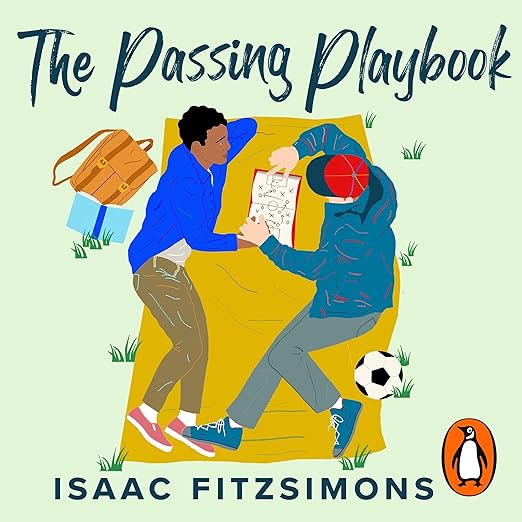
The comparison to Love, Simon and Friday Night Lights on the cover is doing promotional work, but it is also not wrong. Fitzsimons knows that the sports narrative and the queer coming-of-age narrative can operate together without one swallowing the other, and he manages that balance thoughtfully. Soccer here is not a metaphor. It is something Spencer is genuinely good at, something that gives him pleasure independent of what it represents for his integration into Oakley, and that specificity matters. When the discriminatory law forces his coach to bench him after discovering the F on his birth certificate, the loss is both legal and deeply personal – not just a rights violation but the removal of something that was his.
Our Take on The Passing Playbook
What distinguishes this from other LGBTQ+ YA titles is Fitzsimons’s refusal to let the advocacy plot flatten the characters. Spencer’s dilemma is not simply whether to fight for his rights – it is whether he is willing to sacrifice the safety and invisibility he fought hard to achieve, the privacy of being a person rather than a cause, in order to do the right thing publicly. That tension is rendered without easy resolution, even when the plot moves toward optimism. One reviewer described the story as “sharply observant,” and that phrase captures what makes the character writing feel earned rather than programmatic.
The secondary cast includes representations that feel organic rather than checklist-driven: a BIPOC best friend, an autistic character whose neurodivergence is part of how he moves through the world rather than a plot device. These characters have their own subplot threads, some of which receive more resolution than others by the end. The romantic subplot between Spencer and his teammate develops with a nerve-wracking, will-they-won’t-they quality that Fitzsimons calibrates well – there is genuine uncertainty in it, not just performed obstacle.
Why Listen to The Passing Playbook
Jamie K. Brown’s narration is a genuine contribution to the experience. Spencer’s internal monologue is where a lot of the novel’s emotional intelligence lives, and Brown gives it the right kind of uncomfortable self-awareness that teenage introspection actually has. He does not iron out Spencer’s uncertainty into something polished. The performance captures someone who is figuring out what to say while he is saying it, which is exactly what the character requires. The Penguin Audio production is clean, and at seven hours the listening experience moves at a pace that never drags.
One reviewer, in a passage that is hard to read without feeling something, described how the book touched them at a moment when their own life was in pieces – specifically around the theme of chosen family and the absence of it. That kind of reader response does not happen by accident. It happens when a writer has put real emotional architecture into their material. Fitzsimons, writing from a debut position, shows an understanding of how loneliness and belonging interact that is more sophisticated than much YA fiction operating in this space.
What to Watch For in The Passing Playbook
The novel’s optimism is deliberate and not naïve, but some readers may find the private school setting at Oakley – more accepting than most real institutions would be, as one reviewer gently noted – requires a degree of suspended disbelief. Fitzsimons is writing toward a world he wants to exist more than a strict documentary of the one that does. Whether that is a feature or a limitation depends on what you are looking for. For younger listeners in particular, seeing the acceptance modeled may matter more than whether it is statistically representative.
The political dimension, specifically the discriminatory legislation that drives the second-act crisis, is handled without being preachy. One reviewer specifically called out how the novel negotiates religious conservative perspectives versus LGBTQ+ rights without reducing either side to a caricature, which is a genuinely difficult balance and one that Fitzsimons manages with more grace than most adult fiction attempts.
It is also worth noting what Fitzsimons does with the secondary characters around religion and conservative belief. Where many YA novels treating LGBTQ+ themes simply cast religious objectors as antagonists, this book makes room for the complexity. One reviewer specifically praised the handling of religious versus LGBTQ+ tensions as not preachy, which in this genre is a real achievement. The story allows characters to hold difficult positions without reducing them to obstacles, and that maturity in the character writing extends the book beyond its most obvious audience.
Who Should Listen to The Passing Playbook
The obvious audience is teen and YA readers looking for trans representation that feels human rather than symbolic. But the book’s emotional intelligence makes it useful for adult readers who want to understand what navigating trans identity in a school setting actually feels like from the inside. Parents, educators, and anyone who works with young people will find it illuminating and accessible in equal measure. Fans of Adam Silvera, Becky Albertalli, and similar writers in the contemporary LGBTQ+ YA space will find this a confident debut alongside those voices. Skip it if you are looking for plot density or narrative complexity over character interiority – this is fundamentally an emotional character study wearing soccer cleats.
Frequently Asked Questions
Is The Passing Playbook appropriate for younger teens, or does it skew toward older YA?
The content is solidly within YA range and appropriate for readers 13 and up. There is no explicit content. The emotional weight around trans identity, bullying, and advocacy is handled with care, making it suitable for younger teens as well as adults. One reviewer described it as ‘very PG’ in terms of content.
Does the audiobook work for listeners who are not soccer fans?
Yes. Soccer is a meaningful part of Spencer’s identity and the plot mechanics, but Fitzsimons does not assume familiarity with the sport. The matches and practice scenes are rendered through Spencer’s emotional experience more than technical detail, so non-sports listeners lose nothing in the listening.
Does Jamie K. Brown’s narration handle both the comedic moments and the heavier emotional scenes?
Brown manages the tonal range well. The lighter moments around Spencer’s friend group and early soccer success have a natural warmth, while the heavier confrontations, particularly around the discriminatory law and family dynamics, are given appropriate weight without becoming melodramatic. The consistency of voice across both registers is one of the narration’s strengths.
How does the novel handle the coming-out element, given Spencer is already out as trans but not at his new school?
The story deals specifically with the concept of ‘passing’ – Spencer is trans but not publicly out at Oakley. The tension is not a traditional coming-out arc but rather a question of whether to disclose identity that was previously private. This is a more nuanced setup than many YA trans narratives, and Fitzsimons handles the distinction between safety through stealth and the cost of that invisibility with genuine thought.