Quick Take
- Narration: Justine Eyre brings a measured, period-appropriate steadiness to McKinley’s deliberately unheroic Robin, though the denser passages demand patient listening across nearly 11 hours.
- Themes: Reluctant heroism, Saxon identity under Norman rule, collective resistance over individual glory
- Mood: Earthy and literary, with stretches of quiet camp life punctuated by occasional action
- Verdict: A retelling for readers who want their Robin Hood complicated and their outlaws genuinely human, though the middle third tests patience.
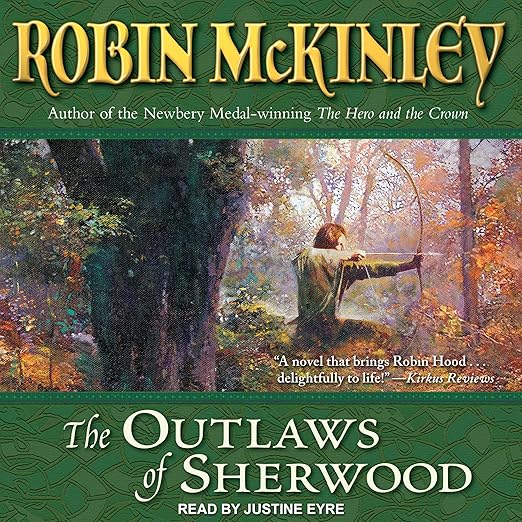
I have a particular fondness for Robin Hood retellings that resist the urge to make Robin the most capable person in any room. So when I came across The Outlaws of Sherwood on a weekend morning when I had time to commit to something deliberately paced, I was in exactly the right frame of mind for what Robin McKinley was offering. The book has been around since the late 1980s, but the Tantor Audio edition narrated by Justine Eyre brought it to me fresh.
McKinley’s version of Robin is, by design, not the archer you expect. He is described by more than one character as among the worst shots in his group. That inversion is the key to everything McKinley is doing here. She is not interested in celebrating a legend. She is interested in examining how legends get made, and the gap between the reality of living in Sherwood Forest and the story that eventually gets told about it.
Our Take on The Outlaws of Sherwood
What McKinley does exceptionally well is the ensemble. Little John, Will Scarlet, Much, and especially Marian emerge as people with their own competencies and agendas. Marian in particular is significantly more capable than Robin in several areas, and the book does not make this a point of dramatic irony. It is simply the truth of the situation. Reviewers have noted that Cecily and Little John frequently steal scenes, and I found that accurate. The secondary cast is where McKinley’s patience with character pays off most visibly.
The world-building situates the story within a specific political reality: Saxon resistance to Norman occupation. This is not backdrop. It informs why the outlaws gather, what they risk, and what they hope to preserve. McKinley treats the class and ethnic dimensions of the conflict with more seriousness than most Robin Hood adaptations attempt, and this is part of what makes the slower sections feel earned rather than indulgent.
Why Listen to The Outlaws of Sherwood
Justine Eyre narrates with an attention to the rhythm of McKinley’s prose that is genuinely impressive. McKinley writes in a style that one reviewer accurately described as having a stylistic wordiness of the period, with passages that require careful attention to catch their full meaning. In audio, this means Eyre has to carry a lot of weight in her pacing, and she generally manages it. She does not rush the longer sentences into incomprehensibility, and she modulates her energy well across the 10-hour-and-56-minute runtime.
The audiobook suits the material because McKinley’s prose has a quality that rewards listening rather than skimming. The rhythms are deliberate. There is something almost medieval in the accumulation of detail, the way camp life is catalogued before the action arrives. Eyre honors that quality.
What to Watch For in The Outlaws of Sherwood
The middle section of this book is genuinely slow. One reviewer called it a slog and specifically noted that the stealing-from-the-rich mechanics, which should be the exciting part of any Robin Hood story, become something of a catalogue rather than a series of set pieces. The action returns at the fair and at Tuck’s establishment, but listeners who need consistent forward momentum will struggle with the extended camp-life sequences.
The ending satisfies in the way that a story with a known destination can satisfy. The happy ending is a given. What varies is how McKinley gets there, and her route is more circuitous and more interested in ordinary life than adventure fiction typically permits. One reviewer found the ending left a little to be desired; another found the book richly satisfying. Both responses are honest, and both are available to you.
Who Should Listen to The Outlaws of Sherwood
This is for readers who love literary fantasy with historical texture and who are willing to meet a deflated Robin Hood. Fans of McKinley’s other work, particularly The Blue Sword or The Hero and the Crown, will recognize her characteristic approach: characters who reveal themselves gradually, whose courage is complicated, whose story is not a triumph so much as a reckoning. Skip it if you need your Robin Hood to be the best archer in England. Come to it if you want him believably, interestingly average.
Frequently Asked Questions
How faithful is this retelling to the traditional Robin Hood legend?
McKinley is deliberately unfaithful in certain respects and faithful in others. The major characters are all present, but their roles and competencies are redistributed. Robin is not the dominant archer of legend. Marian is more capable than tradition gives her credit for. The Norman-Saxon conflict is foregrounded more than in most popular versions. Consider it a revisionist retelling that takes the social and political context seriously.
Is The Outlaws of Sherwood suitable for younger teen listeners or is it written for adults?
McKinley wrote it as YA, and it has no content that would concern most parents. The prose style is more demanding than contemporary YA, with longer sentences and period-inflected diction that some teen listeners may find challenging. Eyre’s narration helps with comprehension, but this is not a breezy listen regardless of age.
Does Justine Eyre’s narration distinguish the large cast of outlaws clearly?
Eyre does reasonable work with the ensemble, though the sheer size of the Sherwood band means some minor characters blend together. Little John, Marian, Much, and Robin are distinctly rendered. The more peripheral outlaws are less differentiated, but this reflects the text as much as the narration: McKinley herself gives more space to some characters than others.
Is there a romantic plot between Robin and Marian, and does it work in audio format?
There is a romance, but McKinley handles it with characteristic restraint. It is present rather than central, and it develops slowly alongside the political story. In audio, Eyre gives the romantic moments appropriate weight without melodrama. Listeners who want a romance-forward story will find it somewhat backgrounded compared to the world-building and ensemble dynamics.