Quick Take
- Narration: Mark Sanderlin handles the material with sincerity, though the short runtime means the performance doesn’t have much room to develop beyond its initial register.
- Themes: Gay coming-of-age in rural America, small-town identity and belonging, the courage required by first love
- Mood: Warm and earnest, with occasional melodrama that feels appropriate to the age of its protagonists
- Verdict: A short, heartfelt YA novella that will resonate most with readers who want uncomplicated warmth from their LGBTQ+ fiction.
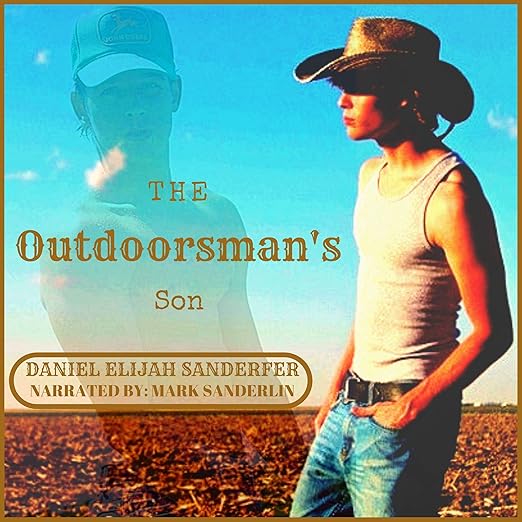
The Outdoorsman’s Son is ninety-six minutes long. I listened to it on a Sunday afternoon between two longer books, as a kind of palate cleanser, which turned out to be a reasonable way to approach it. Daniel Elijah Sanderfer writes young adult gay romance with the earnestness of a writer who understands what that fiction meant to him as a young person, and that understanding comes through even when the execution is uneven.
Derrick, our narrator, is seventeen and newly arrived in Dale, Indiana, after his family moves following his grandfather’s death. He’s already used to adjustment, and Sanderfer establishes that quality quickly without belaboring it. Then Timothy arrives, and the book does exactly what it says it will do.
Our Take on The Outdoorsman’s Son
The setup is a familiar one for the genre: new kid meets popular boy who is already in a relationship, complicated feelings ensue, and the conflict forces everyone to be braver than they expected. Sanderfer isn’t trying to subvert these conventions, and the book is better for its lack of pretension on that point. What he does well is the specific texture of rural Midwestern gay adolescence: the way the outdoors shop that Timothy’s father owns becomes a charged space, the way the spring break party at the farm is simultaneously a setting for belonging and danger, the way small-town social hierarchies create pressure that feels disproportionately consequential when you’re seventeen.
Timothy’s situation, trapped in an arranged relationship with Mindy as a kind of social camouflage, is where the book locates its tension. One reviewer noted that the dialogue occasionally tips into unrealism, citing “my heart longed to know if you and I should be we” as an example of the kind of line that sounds more like a romantic novel than a conversation between rural Indiana teenagers. That’s a fair critique, and it applies to several moments in the book. But another reviewer pointed out the book’s “universality” and found the characters “very relatable,” which suggests the earnestness lands differently depending on what you’re looking for.
Why Listen to The Outdoorsman’s Son
Mark Sanderlin’s narration is warm and straightforward. He doesn’t try to do too much with the material, which is probably the right instinct for a ninety-six minute novella. The intimacy of the story benefits from a narration that feels personal rather than performed. At this length, the audiobook functions differently from a full-length novel: it asks for focused attention during a single sitting rather than the sustained investment a twelve-hour audiobook requires.
The book is the first in a series, which explains some of its structural choices. Sanderfer is establishing characters and a world rather than completing them. The resolution is emotionally satisfying but not entirely conclusive, which makes sense if you know there are more volumes. Listeners who finish wanting more of Derrick and Timothy can continue with the series; those who prefer a self-contained story should know that this one is open-ended.
What to Watch For in The Outdoorsman’s Son
Multiple reviews note the book’s roughness. One described it as “cute but error-filled” and in need of proofreading, which is an honest assessment of the production quality. The dialogue, as noted above, occasionally fails the test of how actual teenagers speak. The antagonist, Mindy, and Derrick’s father get the reduced characterization that series openers often assign to figures who will presumably be developed in later volumes.
The conflict involving Timothy’s arranged relationship is resolved more quickly than the setup earns, and the final confrontations feel slightly rushed given the emotional stakes Sanderfer has been building. One reviewer noted having to “fight back tears” by the end, which suggests the emotional impact lands for the right readers even when the technical execution is imperfect. Coming-of-age stories often carry that paradox: the emotion outpaces the craft, and the emotion wins.
Who Should Listen to The Outdoorsman’s Son
YA readers who are specifically looking for gay coming-of-age stories set in rural America will find this worth their time. The lack of explicit content makes it accessible to younger audiences. Readers who want technical polish and realistic dialogue should look elsewhere. Fans of Sanderfer’s other work will recognize his warmth and his commitment to his characters. The short runtime makes it easy to try without a major investment of time, which is probably the most accurate recommendation: if the first chapter works for you, the rest will too.
Frequently Asked Questions
How explicit is The Outdoorsman’s Son? Is it appropriate for younger teen readers?
The book is relatively clean. The romance is emotionally intense but not sexually explicit. One reviewer described it as ‘pretty innocent’ between the main characters. It’s appropriate for teens who are old enough to engage with LGBTQ+ themes but doesn’t require content warnings for explicit material.
Is The Outdoorsman’s Son self-contained, or do I need to continue the series for a complete story?
The main emotional arc is resolved by the end of this first volume, but the book is clearly designed as an opener for a continuing series. Some threads are left open. Listeners who want a fully closed story may find the ending slightly incomplete; those happy to continue will find enough resolution to feel satisfied before moving on.
The runtime is only 96 minutes. Does the story feel rushed at that length?
Some parts feel more compressed than others. The setup and the central relationship are given adequate space. The resolution, particularly the confrontations that force Timothy’s situation into the open, moves quickly. At novella length, some compression is expected, but the final act does feel faster than the emotional stakes warrant.
How does The Outdoorsman’s Son handle the challenges of being gay in a conservative rural setting?
The book doesn’t flinch from the real pressures of that environment. Timothy’s arranged relationship with Mindy is presented as social self-protection, and the consequences of coming out in a small Indiana town are taken seriously. The story is ultimately hopeful rather than tragic, but it doesn’t pretend the obstacles are trivial.