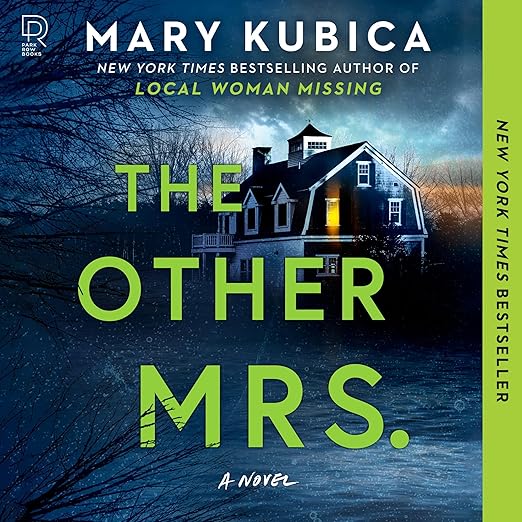
Quick Take
- Narration: Piper Goodeve delivers Sadie’s unraveling with controlled unease, her shifts between suspicion and guilt feel earned rather than performed.
- Themes: Small-town suspicion, domestic secrets, unreliable perspective
- Mood: Claustrophobic and cold, like a Maine winter that won’t let up
- Verdict: If you want atmospheric domestic suspense with a payoff ending and don’t mind some genuinely dark subject matter, Kubica delivers.
I started The Other Mrs. on a gray Thursday evening when I had no particular plans and a blanket I wasn’t willing to leave. By midnight I was still on the couch, Maine coast mist practically seeping through my headphones. Mary Kubica has a talent for building dread from ordinary domestic misery, a difficult new household arrangement, a professional step backward, a marriage stretched thin, and then letting something much darker seep in through the cracks.
Sadie and Will Foust have relocated from Chicago to a small coastal island in Maine after Will’s sister dies and they become guardians to her teenage daughter, Imogen. Sadie misses the ER where she thrived. She resents the move. The family is tense and awkward before a neighbor, Morgan Baines, turns up dead. Then suspicion falls on the new family in town, and Sadie finds herself drawn deeper into a mystery she may have more to do with than she initially lets on.
Our Take on The Other Mrs.
What Kubica does well here is stack her pressures carefully. Sadie’s discomfort with Imogen, her sense of professional diminishment as a small-town physician after years of ER medicine, and her growing unease about her own past all compound before the murder plot even takes center stage. The mystery functions almost as a pressure release valve, something external to anchor all that internal dread. Reader Susan M. Baumann’s description of the book as dark with a capital D is fair warning: this is not a cozy whodunit. The subject matter involving suicide, child abuse, and bullying is depicted with real weight, and Kubica doesn’t soften the edges.
The small-town setting earns its keep. Reviewer shain.taylor, who actually lives in coastal Maine, found the gossip and community suspicion entirely believable, that sense of everyone knowing everyone’s business, of new arrivals being watched, shapes the tension throughout. The island geography does real work, making escape feel psychologically impossible even before the plot demands it.
Why Listen to The Other Mrs.
Piper Goodeve’s narration is well-suited to the material. She keeps Sadie restrained without making her opaque, which matters enormously in a novel where the protagonist’s inner life is itself a clue. The pacing of nearly twelve hours allows the domestic unraveling to breathe, you feel the weeks of tension rather than being rushed to the reveal. Kubica’s prose, at its best, creates genuine atmosphere: the cold, the quiet, the feeling of being watched.
The ending genuinely surprised several reviewers, including one who described it as altogether unpredictable, that’s Karin Slaughter’s blurb on the cover, but it holds. The plot threads that seem to be running in parallel eventually converge in ways that recontextualize earlier moments. That retroactive satisfaction is part of what makes Kubica’s approach effective.
What to Watch For in The Other Mrs.
There are legitimate criticisms. One reviewer found the pacing uneven before the midpoint, and the multiple tonal registers, domestic drama, dark psychological history, whodunit mechanics, don’t always sit comfortably together. The trigger warning note is worth taking seriously: the depictions of self-harm and child abuse are not handled lightly or quickly. For readers who find those subjects particularly difficult, this is a book to approach with care rather than skip entirely, but the warning is real.
The supporting cast, particularly Imogen, occasionally feels more like a narrative device than a full character. Her resentment serves the tension reliably, but her interiority gets less room than Sadie’s. This is a consistent feature of first-person domestic thrillers, but it’s worth noting.
Who Should Listen to The Other Mrs.
Best suited for listeners who enjoy psychological suspense with a literary lean, readers who liked Kubica’s Just the Nicest Couple, or who appreciate the slow-build domestic tension of B.A. Paris or Lisa Jewell. Not ideal for anyone seeking a lighter thriller or who prefers to avoid heavy subject matter. If you want unpredictable plotting in an atmospheric setting and you can handle the darkness, this one holds together well.
Frequently Asked Questions
Does The Other Mrs. work as a standalone, or do I need to read Kubica’s previous books first?
It stands completely alone. No familiarity with Kubica’s other novels is required, and there are no shared characters or continuity with her earlier work.
How dark is the content, are there specific triggers listeners should know about?
Quite dark. The audiobook includes detailed depictions of suicide, child abuse, and bullying. One reviewer specifically flagged this as a book that needs trigger warnings. The mystery plot is genuinely disturbing rather than thrilling in a fun way.
Does Piper Goodeve’s narration handle the multiple household voices distinctly enough to follow?
Yes. Goodeve differentiates the characters without resorting to exaggerated accents, keeping Sadie’s unreliable perspective at the center while making the supporting cast distinguishable.
Is the ending satisfying, or does it rely on a twist that doesn’t hold up on reflection?
Reviewers who finished it found it genuinely satisfying and logically consistent with earlier material, not a twist that collapses under scrutiny, but one that reframes what came before in a way that feels fair.