Quick Take
- Narration: Rosie Jones brings genuine energy and wit to Emry’s voice, capturing the humor and vulnerability of a teenager navigating an impossible situation.
- Themes: Gender identity and disguise, Arthurian legend reimagined, first love and ambition
- Mood: Witty and warm with real emotional stakes
- Verdict: A confident and genuinely funny Arthurian retelling that earns its comparisons to The Gentleman’s Guide, with a protagonist whose choices feel meaningfully difficult.
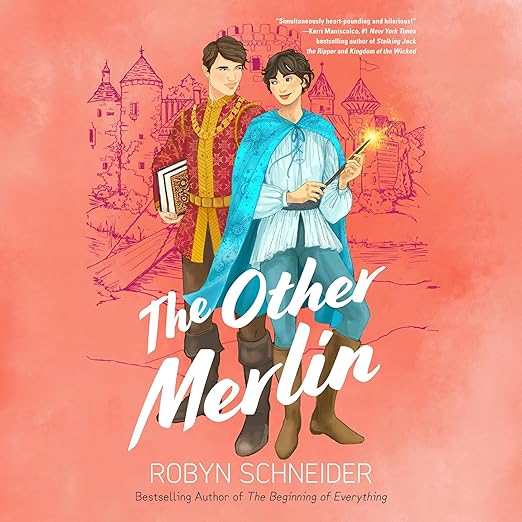
I was halfway through my Tuesday evening commute, sitting on a delayed train with nowhere to be in a hurry, when I realized I had missed my stop because Emry Merlin had just walked into the great hall of Camelot disguised as her twin brother and immediately managed to offend both Princess Guinevere and Lord Gawain within the space of a single paragraph. Robyn Schneider’s Arthurian reimagining is that rare YA fantasy that earns its blurb comparisons rather than just wearing them. The Gentleman’s Guide to Vice and Virtue comparison on the jacket is not wishful thinking.
The premise is elegantly constructed. In this Camelot, girls cannot practice magic, so Emry Merlin arrives at court wearing her brother Emrys’s identity, carrying salvaged equipment and a particular talent for causing exactly the wrong kind of scene. Prince Arthur, meanwhile, is a deeply unlikely future king, a botanist at heart who would genuinely prefer to spend his days with books and plants rather than courtly politics. Lancelot is present, but demoted to castle guard following a lie he cannot undo. The women of the Arthurian cycle, from Guinevere to the enchantresses, are given their own motivations and agency rather than existing as props for the male characters.
Our Take on The Other Merlin
What Schneider does exceptionally well is keep the comedy and the emotional stakes in genuine tension with each other. Emry is funny, and her internal monologue has real wit, but her situation is not trivially difficult. The risk of discovery is constant, and the cost of being found out is not just embarrassment but the loss of everything she has worked toward. Her casual bisexuality is handled with refreshing matter-of-factness rather than as a plot point requiring resolution, which is exactly the right choice for this kind of story.
Arthur is a thoughtful co-protagonist. His depression and his preference for quieter intellectual pursuits read as genuine character traits rather than quirks deployed for contrast. The slow build of his relationship with Emry works because both characters are clearly struggling with what they want versus what their circumstances allow. One reviewer noted that the switches the author makes, casting Merlin as female, Arthur as sensitive, and the Knights as rowdy difficult young men, kept them reading steadily to see what new twists would follow. That captures the appeal well.
Why Listen to The Other Merlin
Rosie Jones narrates with a light touch and genuine comic timing. The humor in Schneider’s dialogue depends on rhythm and delivery, and Jones gets it right consistently. She differentiates the supporting cast well enough that a large court’s worth of characters never becomes confusing, and her performance of Emry’s more vulnerable moments lands without tipping into melodrama. For a thirteen-plus hour audiobook, maintaining that kind of energy throughout is no small achievement.
Listeners who enjoy YA fantasy with strong romantic subplots will find the pacing well-calibrated. The story is properly plotted, with a third act that actually raises the stakes rather than coasting on established goodwill. Publishers Weekly named it one of the best books of the year, and based on the audiobook experience, that recognition feels deserved.
What to Watch For in The Other Merlin
The book is unambiguously the first in a series, and it ends in a way that resolves the central dramatic question while clearly positioning the next installment. Listeners who prefer self-contained stories may find the ending slightly open. This is the beginning of something rather than a complete arc.
The Arthurian mythology is used freely and inventively rather than reverentially. Listeners who have strong attachments to specific versions of the legend, particularly the more tragic and austere tellings, may find the comedy and modernized sensibility jarring. But for readers who come to the legend primarily through a sense of what it could be rather than what it has been, Schneider’s version is genuinely exciting.
Who Should Listen to The Other Merlin
Ideal for YA readers and adults who enjoy genre fiction with strong romantic subplots, clever dialogue, and protagonists whose internal lives feel fully inhabited. Fans of Leigh Bardugo, Mackenzi Lee, and similar authors will find immediate common ground here. Listeners who want a reverent or tragic treatment of Arthurian legend should look elsewhere. This Camelot is busy, funny, and full of teenagers making bad decisions in the best possible way.
Frequently Asked Questions
Do I need to know the Arthurian legends to enjoy The Other Merlin?
Not at all. Schneider reimagines the setting freely enough that prior knowledge enhances rather than gatekeeps the experience. The book works as an independent story even if you have never read Malory.
Is Rosie Jones a strong narrator for this material?
Yes. Her comic timing matches Schneider’s dialogue well, and she handles both the humor and the emotional beats with genuine range. For a long audiobook, her energy is consistently engaging.
How is bisexuality handled in this story?
Emry’s bisexuality is established casually and without drama as a simple fact of who she is. It informs her perspective and her romantic feelings but is not positioned as a source of internal conflict or a lesson to be learned.
Does The Other Merlin end on a cliffhanger?
The central plot of book one reaches a resolution, but the ending clearly sets up the sequel. It is more of an open door than a cliffhanger, but listeners should know this is the start of a series.