Quick Take
- Narration: Scott Brick is one of the most experienced thriller narrators working, and his Evan Smoak voice, cool, precise, contained, is exactly right for a former assassin operating on a strict personal code.
- Themes: Identity and reinvention, the cost of a lethal skillset, captivity and escape
- Mood: Propulsive and tightly controlled, this is a pressure-cooker listen
- Verdict: A sequel that raises the stakes in exactly the right way, and Scott Brick’s narration makes the 12 hours feel shorter than they are.
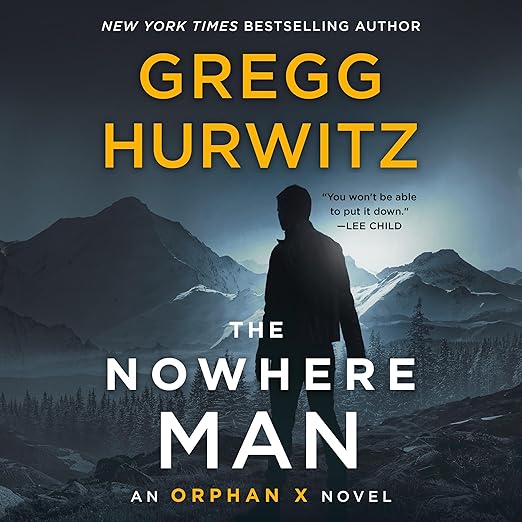
I was halfway through my evening walk when The Nowhere Man’s opening chapters locked me in. That is the Orphan X series’ particular trick: Gregg Hurwitz writes his thrillers with a structural intelligence that makes every scene feel necessary, and Scott Brick narrates them with a cool authority that keeps you from noticing you have been listening for two hours straight. Book two opens with Evan Smoak mid-job, which is the right choice, you are back in his world before you have time to wonder whether the sequel will recapture what the first book built.
What The Nowhere Man does that Orphan X did not is put its protagonist in a position of genuine helplessness for a sustained period. Evan is captured, drugged, and transported to a remote estate whose location he cannot determine. The man who has spent his life being impossible to find is now the one who has been found, caged, and studied. Hurwitz understands that the best thriller tension comes not from action sequences but from the question of how a specific person, with specific skills, specific constraints, and a specific moral code, survives a situation that those skills alone cannot solve.
Our Take on The Nowhere Man
The book’s structure is confident in a way that rewards attention. While Evan works to understand and then dismantle his captors’ operation, a parallel storyline involves a kidnapped young woman trapped in a shipping container, a job Evan was in the middle of when he was taken. The dual pressure of his own situation and his unfinished obligation is what gives the book its particular charge. Evan operates by a personal code that is non-negotiable, and the novel’s central question is whether that code can hold under conditions designed to break it. Reviewers who call this among the best action novels they have read are responding to that structural intelligence more than to the set pieces, even when they do not name it as such.
Why Listen to The Nowhere Man
Scott Brick has been the voice of Evan Smoak from the beginning, and that continuity matters for a series built on a very specific character voice. Brick does not play Evan as invincible, he plays him as someone who moves through uncertainty with discipline. The internal monologue sequences, where Evan assesses his environment and devises improvised solutions, are where the narration shines. Brick’s pacing in those moments, measured, methodical, with flickers of dark humor, matches how Hurwitz writes Evan’s cognition. Publishers Weekly’s starred review calls it a book that keeps readers on the edge of their seats, and on audio that physical metaphor becomes literal.
What to Watch For in The Nowhere Man
If you have not read Orphan X first, you will not be lost, but you will miss the weight of certain relationships and the significance of Evan’s code of conduct. This is a series where the first book’s setup pays dividends across subsequent installments. Some reviewers note that the pacing flags slightly in the middle section, a structural choice that seems designed to let the reader feel the claustrophobia of Evan’s captivity, though it will frustrate listeners who want constant forward momentum. The ending is described by multiple reviewers as excellent and surprising, which in the context of a thriller is the only thing that matters after 12 hours invested.
Who Should Listen to The Nowhere Man
Thriller readers who gravitate toward protagonist-driven series with a strong moral architecture, similar to the Jack Reacher books in structure but notably more psychologically complex, will find this series one of the best current examples of the form. Evan’s history as a child recruited into a black-ops program is treated with more nuance than most action thrillers attempt. Start with book one if you can, but this is a worthy entry point for the curious. Reviewers who place it above the Gray Man and Lance Spector series are not wrong to do so.
Frequently Asked Questions
Do I need to listen to Orphan X before starting The Nowhere Man?
You can follow the plot without it, but the series rewards reading in order. The character relationships and Evan’s personal code carry more weight if you have the context of how he got there. Book one is a strong, self-contained thriller worth the time before this one.
How does Scott Brick handle the extended captivity sequences where Evan has limited options?
Very well. Brick’s strength is the internal assessment sequences, the measured, methodical cognition of a man thinking his way out of a situation rather than fighting his way out. Those passages, which could feel slow in less capable hands, are the best stretches of the audiobook.
Is the violence in The Nowhere Man graphic or restrained?
It is present and visceral but not gratuitous. Hurwitz writes action with precision rather than spectacle. The violence serves character and plot, it tells you something about Evan and about his captors, rather than existing for shock value.
How does this compare to other contemporary thriller series like the Gray Man or Lance Spector books?
Reviewers who have read across those series consistently place the Orphan X books at the top or near it for psychological complexity. The Nowhere Man in particular stands out for the captivity structure, which is a genuinely original variation on the lone-operative premise.