Quick Take
- Narration: L.J. Ganser brings Baker’s propulsive historical prose to life with the authority of a seasoned storyteller, a natural fit for nearly 20 hours of densely populated American history.
- Themes: Baseball as American identity, immigration and assimilation, race and exclusion in sport
- Mood: Buoyant, richly detailed, and occasionally jaw-dropping in its scandals
- Verdict: The New York Game is the rare sports history that doubles as genuine urban history, essential listening for anyone who has ever wondered why baseball is called America’s pastime.
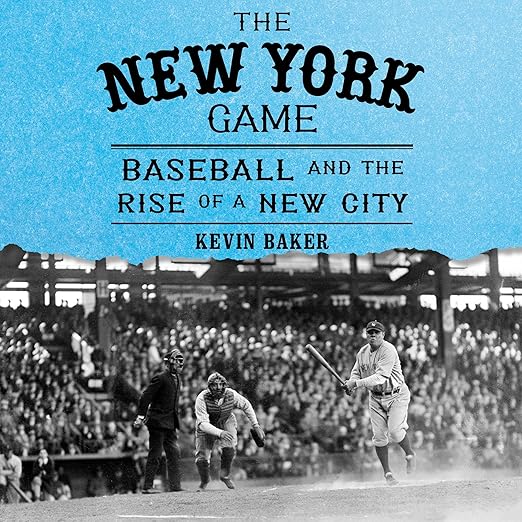
I almost passed on The New York Game. Twenty hours of baseball history felt like a commitment better suited to someone who grew up with box scores on the breakfast table, not someone whose relationship with the sport is more theoretical than devotional. But the Sports Illustrated designation as the number one book of 2024 nagged at me, and I picked it up on a long weekend drive across the Catskills. I finished the last two hours in my driveway, unwilling to get out of the car.
Kevin Baker has written something that transcends the genre it nominally belongs to. This is not simply baseball history. It is New York history, a portrait of a city finding itself through its sport, and it happens to be one of the most entertaining works of popular history I’ve encountered in years.
Our Take on The New York Game
Baker’s central argument, that baseball is the New York game because New York is where it was invented, refined, and mythologized, unfolds across more than a century of material that somehow never feels exhausting. He starts in the 1820s, when innings were played in vacant lots and tavern yards, and carries the story through VE Day in 1945. Along the way, he addresses the controversies that have calcified into legend: Did Babe Ruth call his shot? Was Merkle genuinely out? Was the 1919 World Series fixed? Baker engages these questions with the rigor of a historian and the instincts of a storyteller, never letting accuracy bleed the fun out of the narrative.
What is most impressive is how Baker holds the social and the sporting in equal tension. The chapters covering Hispanic and Black players who developed their own version of the game when white baseball actively excluded them are among the most powerful in the book. Baker doesn’t treat this history as a sidebar; it sits at the center of his argument about what baseball meant to a city defined by waves of immigration and the violent ambivalence of assimilation.
Why Listen to The New York Game
L.J. Ganser’s narration is exactly what nearly twenty hours of dense American history requires: measured authority without stuffiness, capable of shifting register when Baker’s prose veers from scandal to eulogy to comedy. Ganser doesn’t perform the material so much as inhabit it, and for a book whose characters include gangsters, visionaries, corrupt owners, and genuinely heroic athletes, that range matters. The audio format suits the book’s oral-history energy, Baker writes like someone who has been telling these stories at dinner parties for decades, and Ganser understands that rhythm.
Reviewers have been consistent: one called it simply the best baseball history they had read in a long time, baseball or not. Another noted the book covers an enormous amount of ground both chronologically and materially without ever losing its thread. That last point is no small achievement for a work of this scope.
What to Watch For in The New York Game
Baker’s focus ends at 1945, which means everything from Jackie Robinson’s debut in 1947 onward falls outside the book’s frame. Listeners expecting coverage of the postwar Yankees dynasty, the Mets’ unlikely championship, or the departure of the Dodgers and Giants for California will need to look elsewhere for that material. Baker’s choice to stop at the conclusion of World War II is deliberate, he’s tracing a specific era of formation, but it’s worth knowing the book’s chronological limits before you begin.
The density of names can also be challenging in audio format. Baker populates his history with an enormous cast of players, managers, owners, and civic figures, and without a physical book to glance back at, it can be difficult to track everyone across chapters. Ganser’s clean diction helps, but some listeners may want to keep a running list.
Who Should Listen to The New York Game
This is ideal for anyone who loves American social history, whether or not baseball is their sport. Readers who enjoyed works like Robert Caro’s New York writing or Geoffrey Ward and Ken Burns’s Baseball companion book will find Baker’s approach familiar and deeply satisfying. Baseball purists will get the deep dive into the game’s mechanics and mythology, while history-first listeners will find the social and political context richly developed. At 4.7 stars across nearly 400 ratings, the audience response reflects genuine enthusiasm rather than niche loyalty.
Frequently Asked Questions
Does The New York Game cover the integration of Major League Baseball?
The book ends at 1945, just before Jackie Robinson’s 1947 debut. Baker does cover the parallel baseball world that Black and Hispanic players built when white baseball excluded them, which provides important context for understanding why integration was both necessary and delayed.
Do I need to be a baseball fan to enjoy this audiobook?
Multiple reviewers with varying levels of baseball knowledge report enjoying it as social history of New York. The sport provides the framework, but the book’s real subject is the city, immigration, corruption, ambition, and reinvention.
How does L.J. Ganser handle the volume of names and statistics in audio format?
Ganser’s diction is clean and unhurried, which helps with the density of proper nouns. The audio format does require more attention to track the cast across 20 hours, and some listeners may want to take occasional notes on key figures.
Is this a New York Yankees-centric history, or does it cover all New York teams?
Baker covers the full New York baseball ecosystem, including the Dodgers, Giants, and the various earlier clubs that preceded them. The book is a history of the city’s relationship with the sport, not a single franchise’s story.