Quick Take
- Narration: Amy Landon handles the four-POV structure with clear vocal differentiation across thirteen-plus hours, an essential performance for a book that would collapse without it.
- Themes: Sisterhood severed and sought, elemental magic as political inheritance, the cost of a world kept broken by old decisions
- Mood: Epic and elemental, vast landscapes, claustrophobic courts, and a mythology that feels genuinely original
- Verdict: One of the most inventive YA fantasy settings in recent years, carried by worldbuilding ambitious enough to justify its duology structure.
I came to The Never Tilting World the way I come to a lot of YA fantasy, with the slightly defensive awareness that the genre has produced some of the most genuinely original speculative fiction of the past decade, and some of the most formulaic. Rin Chupeco’s reputation from The Bone Witch series gave me reason to expect the former. What I found was something that earned that expectation by the end of the first act and then kept finding new ways to complicate it.
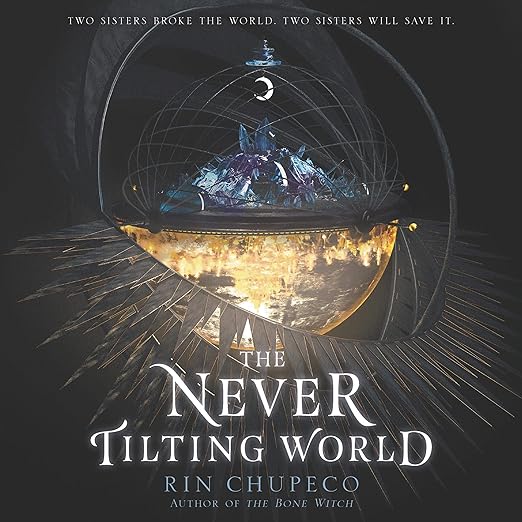
The central premise is one of the more striking I’ve encountered: the world of Aeon was governed by twin goddesses whose betrayal of each other created a permanent fracture. One half of the world is locked in eternal night, frozen around the fortress city of Aranth. The other half burns perpetually under a sun that never sets, centered on the Golden City. Both realms are dying slowly. The daughters of each goddess must travel, in opposite directions, toward the same point of rupture, to try to heal what their mothers broke. It’s the kind of premise that sounds simple in summary and turns out to be anything but in execution.
Our Take on The Never Tilting World
The comparison to Frozen meets Mad Max: Fury Road that the publisher reaches for is less silly than it sounds. The eternal-night world has a frozen, survivalist texture, communities clustered for warmth, resources rationed, movement constrained by cold and darkness. The eternal-day world has the exhaused, hallucinatory quality of too much sun and too little water. Chupeco builds both environments with physical specificity: you can feel the grit of the Golden City’s sand-locked streets and the cold weight of Aranth’s ice. That sensory grounding makes the political structures inside each world feel like organic responses to physical conditions rather than fantasy-world wallpaper.
The four-POV structure is the book’s boldest technical choice. Haidee, the daughter of the sun-goddess, and Odessa, the daughter of the night-goddess, each have their own voice and traveling companion, and the narrative alternates between their journeys as they converge on the Breaching, the point of the original fracture. One reviewer found four perspectives too many and occasionally got lost; another found the parallel structure exhilarating. Chupeco manages the convergence with structural confidence: the paths don’t cross until they need to, and the moments of connection when they do are earned.
Why Listen to The Never Tilting World
Amy Landon’s performance is foundational to this audiobook working as well as it does. Four distinct narrative voices across thirteen-plus hours is a demanding assignment, and Landon differentiates them with enough consistency that the POV shifts are immediately legible without needing to check chapter headings. Haidee’s pragmatic energy and Odessa’s more contemplative register are the most important distinction to establish, and Landon sets them clearly from the first chapter of each perspective.
The magic system, elemental in structure, inherited through divine bloodlines, and complicated by the fact that using it too heavily accelerates the world’s deterioration, is explained organically through the characters’ experience rather than through exposition. For audio specifically, that approach matters: there are no information-dump passages that require replaying to decode.
What to Watch For in The Never Tilting World
This is Book 1 of a duology, and it ends without fully resolving the central conflict. The convergence of the two narrative threads happens, but what it means for the healing of the world is the territory of the second book. Readers who want a complete story within a single volume should know that upfront. The ending is not a cliffhanger in the frustrating sense, the character journeys reach meaningful waypoints, but it is emphatically not a standalone conclusion.
The court politics in the Aranth sections generated mixed responses. One reviewer found them the most interesting element; another found the multiple similar-seeming narrative threads in the frozen world harder to track. Listeners who come to fantasy primarily for landscape and action over political intrigue may find the Aranth sections slower than the Golden City material, which has a more kinetic energy from its survival-driven setting.
Who Should Listen to The Never Tilting World
An excellent choice for YA fantasy listeners who want worldbuilding that doesn’t resemble anything else currently on the market, and for readers who have outgrown the Twilight-era YA aesthetics and want something more structurally ambitious. The LGBTQ+ representation is thorough and integrated rather than tokenistic, the world Chupeco builds simply contains it as ordinary. For listeners interested in picking up the duology, the second book (The Ever Cruel Kingdom) continues directly from this one’s ending.
Frequently Asked Questions
Is The Never Tilting World suitable for adult fantasy readers, or is it strictly a YA read?
It crosses over well. The worldbuilding ambition, elemental magic system, and political complexity are sophisticated enough to engage adult readers who are not primarily YA audiences. Multiple adult reviewers describe being surprised by the depth of craft. The YA designation reflects the protagonists’ ages and the coming-of-age dimension rather than a simplified treatment of the material.
How does Amy Landon differentiate the four POV characters across thirteen-plus hours of narration?
Through consistent tonal and rhythmic differentiation. Haidee’s chapters have a faster, more pragmatic energy; Odessa’s are more contemplative and introverted. The traveling companions for each protagonist add further vocal variety. Listeners following the alternating structure will be oriented quickly and the differentiation holds consistently throughout the runtime.
Does the four-perspective structure make The Never Tilting World difficult to follow as an audiobook?
It requires initial attention, particularly in establishing which world each perspective inhabits. Reviewers who found it occasionally confusing tended to be those who expected a simpler POV structure; those who committed to tracking all four found the convergence payoff satisfying. The chapter structure supports orientation for listeners who lose track.
Is the LGBTQ+ content in The Never Tilting World central to the plot or ambient?
Both. Chupeco integrates queer identity into the world as unremarkable, same-sex relationships exist without stigma in this setting, which reflects its alternate-mythology structure. Some character relationships and dynamics have LGBTQ+ dimensions that matter to the narrative, but the book does not center this as its primary subject.