Quick Take
- Narration: Jason Culp delivers a measured, authoritative performance that keeps the tension coiled without tipping into melodrama, well-suited to the moral weight of the material.
- Themes: Justice and accountability, the long reach of the Holocaust, espionage and moral courage
- Mood: Taut and sobering, with the propulsive rhythm of a real-world thriller
- Verdict: Neal Bascomb turns one of history’s most consequential spy operations into a deeply human story that young adult listeners will carry with them long after the final chapter.
I first encountered the Eichmann story through Hannah Arendt’s reporting on the Jerusalem trial, so I came to Neal Bascomb’s young adult adaptation of Hunting Eichmann with a fairly detailed frame of reference. I finished this one on a Thursday evening, the kind of quiet weeknight that makes you feel the distance between your own life and the events Bascomb reconstructs. That distance collapsed almost immediately.
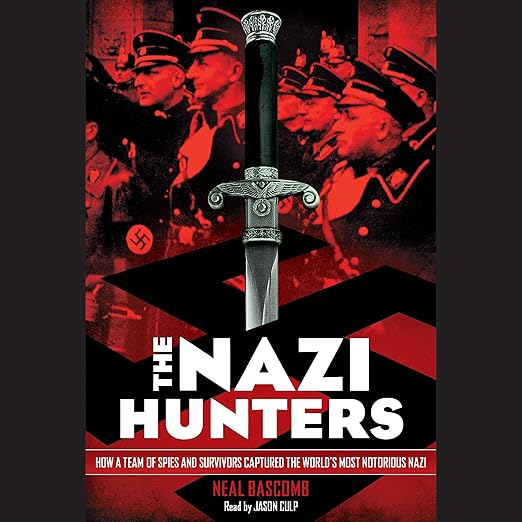
The Nazi Hunters is adapted from Bascomb’s adult best seller for middle-grade and YA audiences, and it does something genuinely difficult: it compresses a sprawling, morally layered manhunt into five and a half hours without flattening the people involved into symbols. Simon Wiesenthal, the blind Argentinean informant, the teenage daughter who helped crack Eichmann’s identity, the Mossad operatives who lost family in the camps, each gets enough page time to feel like a person rather than a plot device. That specificity is what separates narrative nonfiction of this quality from historical summary.
When the History Outpaces the Fiction
One reviewer compared this to spy fiction, noting that if it were invented, it would strain credulity. That observation stays with you as you listen. Adolf Eichmann, the bureaucratic architect of the Final Solution, spent sixteen years living under an assumed name in Argentina, working at a Mercedes-Benz plant, raising his family in a Buenos Aires suburb. The operation to identify, surveil, and extract him across international borders involved improvised safe houses, fake identities, sedated flights, and the coordinated deception of an entire neighborhood. Bascomb does not dress any of this up. He lets the operational complexity carry the suspense, and it does so without embellishment.
Jason Culp’s narration serves the material well. He avoids the trap of making the Mossad agents sound heroic in a cinematic sense, instead, there is a steadiness to his delivery that honors the gravity of what these people undertook and what they had survived before the mission even began. The sections covering the capture itself, and then the trial in Jerusalem, carry genuine weight in audio form in a way that might feel more distant on the page.
What Bascomb Gets Right About Eichmann
The most striking critical note I encountered in reader responses touches on Bascomb’s handling of Eichmann himself. One reviewer flagged that the portrait felt over-determined in places, leaning too hard on the monster framing. That is a fair critique, and Arendt’s concept of the banality of evil hovers over any serious engagement with the Eichmann case. But for a YA audience encountering this history for the first time, Bascomb’s choice to anchor the narrative in the survivors’ and operatives’ perspectives, rather than treating Eichmann as the psychological subject, is probably the right call. The book is about what it took to find him and bring him to justice, not about explaining him. That choice keeps the moral center where it belongs.
The trial section, which Bascomb treats as the culmination of the entire mission, is where the book earns its moral seriousness. The point was never just the capture. It was the public accounting, the testimony, the insistence that the Holocaust be named and documented in a global forum. A young reviewer wrote about discovering that Eichmann existed at all, that even the best-informed person can encounter a gap in their knowledge of the scale of what happened. That response is precisely what narrative nonfiction at this level is supposed to produce.
The Five-Hour Argument for Narrative Nonfiction
At five hours and twenty-nine minutes, this is a tight listen. Bascomb does not linger, and Culp does not either. There are moments where you might wish for more, a deeper accounting of the political tensions between Israel and Argentina over the kidnapping, for instance, or a fuller examination of why it took sixteen years to locate a man who was not hiding all that carefully. But those omissions are a function of the audience and the format, and the book is honest about what it is: narrative nonfiction for younger readers that prioritizes momentum and emotional engagement without distorting the historical record.
The rating of 4.6 across nearly 700 listeners tracks with the book’s genuine strengths. It is rigorously researched, compellingly structured, and narrated with appropriate seriousness. The one area where a more demanding reader might push back is the occasional tendency to editorialize, to remind us how evil Eichmann was in ways that crowd out the more disquieting work of understanding how ordinary the machinery of atrocity can appear from the outside. These moments are brief, and they do not undermine the overall project, but they are worth naming for listeners who come to the material already aware of Arendt’s framework.
What the book does particularly well is resist the temptation to make the Mossad operatives into flawless heroes. Several of them made errors during the surveillance phase, nearly losing Eichmann before the operation could proceed. Bascomb includes those near-failures, and they make the eventual success feel earned rather than inevitable. The operational anxiety of the Buenos Aires sequence, the safe house, the improvised disguises, the sedated flight, reads in audio as genuinely suspenseful because Culp maintains the tension without artificial amplification.
Who Should Listen, Who Should Pass
This audiobook is ideal for listeners aged twelve and up who want a serious first encounter with the Eichmann case, the Mossad’s early operational history, or the decades-long effort to hold Holocaust perpetrators accountable. It works equally well for adults who want a brisk, well-sourced narrative overview rather than a deep scholarly treatment. Listeners who have already read the adult version of Hunting Eichmann, or who have studied the Jerusalem trial in depth, will find the YA adaptation covers familiar ground with less nuance. And if you are looking for Arendt’s philosophical reckoning with the nature of evil, this is not that book, but it was never trying to be.
Frequently Asked Questions
Is this the same as Neal Bascomb’s adult book Hunting Eichmann?
It is adapted from that adult best seller and covers the same events, but it is condensed and written for middle-grade and YA audiences. The adult version goes deeper into the political fallout and intelligence details; this version prioritizes narrative drive and accessibility without distorting the historical record.
How does Jason Culp’s narration handle the Holocaust content?
Culp keeps his delivery measured and unflinching. He does not sensationalize the testimony or the descriptions of the camps, which is the right instinct for material this serious. The tone throughout is grave without being oppressive.
Is this appropriate for a younger listener encountering the Holocaust for the first time?
Yes, with some parental context. Bascomb does not spare the moral reality of the Final Solution, but the focus is on the spy mission and the trial rather than graphic descriptions of the camps. Multiple reviewers, including one who read it at age eleven, found it compelling rather than overwhelming.
Does the audiobook cover the Jerusalem trial, or does it end with the capture?
It covers both the capture operation and the trial in Jerusalem. Bascomb treats the trial as the culmination of the entire mission, arguing that the public accounting was as important as the arrest itself.