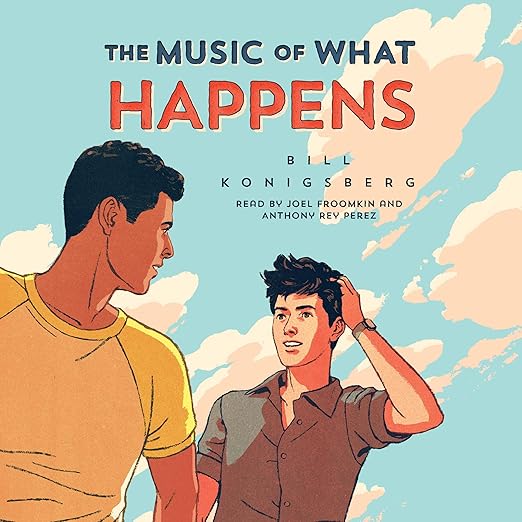
Bill Konigsberg's The Music of What Happens belongs to a specific strain of contemporary YA that takes its genre's emotional weight seriously rather than using it for backdrop. This audiobook, narrated by Joel Froomkin, is nine hours and seventeen minutes of two boys in Mesa, Arizona, in June, working a failing food truck called Coq Au Vinny and falling toward each other despite very good reasons to stay separate. Konigsberg built his reputation on queer coming-of-age stories that do not apologize for their darkness, and this novel is consistent with that project.
The novel's dual-narrator structure gives Froomkin something specific to work with. Max and Jordan are built as deliberate contrasts: Max is chill, sports-oriented, comfortable with his gay identity in the ways that matter to him, carrying a secret encounter with an older kid that he does not want to examine. Jordan is anxious, poetry-loving, shopping-mall-obsessed, never been kissed, convinced that no one suitable will ever want him, quietly managing a mother whose erratic spending threatens the family's stability. Every other chapter shifts between them, and the reader gets both interior perspectives on the same developing relationship.
One reviewer specifically highlighted that this dual structure gives both sides of the story rather than a single filtered version, which is true. Konigsberg is precise about how much each character conceals from the other and how much the reader can see that they cannot. Froomkin's performance is the critical variable in how well this translates to audio. He differentiates Max and Jordan with vocal choices that feel genuine rather than exaggerated: Max slightly more guarded and economy-of-words, Jordan more openly anxious and rhythmically faster in his internal monologue.
The food truck setting, with its prickly pears and cloud eggs and murky concepts of locally sourced cooking, becomes a credible comic counterweight through Froomkin's handling of those details. The Arizona heat, where temperatures hit 114 in June, functions almost as a narrative pressure device, creating a sensory environment that makes the characters' emotional intensity feel physically rooted rather than abstract.
The Strengths
The audiobook format does something specific for the material that print cannot entirely replicate: it enforces linearity. Konigsberg's dual-perspective structure is designed to make you sit with one character's incomplete understanding before getting the other's corrective view. In print, some readers skip ahead. In audio, you hear it in the order Konigsberg intended, which means moments of dramatic irony, where the listener knows something one protagonist does not, land with more precision. Several listeners who encountered the story in print reported that the audiobook felt like a better-calibrated version of the same material.
The tonal range this novel covers is wider than its food-truck premise suggests. Max's backstory involves a sexual encounter with an older teenager that he has never named to himself as assault, and Konigsberg handles that storyline with care rather than avoidance. Jordan's mother and the financial pressures she creates are treated with genuine complexity rather than as a simple villain dynamic. One listener noted they were not expecting to find themselves tearing up multiple times, which captures the novel's particular skill: it earns its emotional moments through character work rather than plot contrivance.
Before You Commit to The Music of What Happens
Listeners who come expecting a light summer romance will encounter heavier material earlier than anticipated. Both Max and Jordan carry significant baggage, and Konigsberg is more interested in how that baggage shapes their ability to reach each other than in the mechanics of the romance itself. The food truck setting and the humor around it provide genuine relief, but this is not a book that keeps the difficulty at a safe distance. Listeners who prefer their YA contemporary to stay on the lighter side of the genre should adjust their expectations.
The novel's title, drawn from a Seamus Heaney poem about the sound of happiness and wholeness, is not accidental. Konigsberg is writing about what it sounds like when people stop managing their pain long enough to let something good happen. Froomkin's narration draws on this without overplaying it, conveying the weight of what each character is carrying without making the listening experience feel relentlessly heavy.
The novel's title, drawn from a Seamus Heaney poem about the sound of happiness and wholeness, signals something important about what Konigsberg is aiming at. He is not writing toward a romantic resolution in the conventional sense; he is writing toward the moment when two people in genuine difficulty stop managing each other and start actually connecting. Froomkin's narration keeps that target in view even in the novel's heavier passages, making the eventual lightness feel earned rather than imposed.
Konigsberg's novel is also genuinely funny in ways that separate it from the earnest end of YA contemporary. The food truck sequences, particularly the recurring crisis of Coq Au Vinny's menu credibility, generate real comedy. Max and Jordan's bickering over what qualifies as locally sourced in Mesa, Arizona, in June, is handled with a timing that Froomkin nails, giving the humor the right beat before moving back into heavier emotional territory. That tonal range, between genuine comedy and genuine pain, is what makes this audiobook feel true rather than manipulative.
Recommended For
This audiobook suits listeners who enjoy YA contemporary fiction that handles queerness, trauma, and class anxiety without flattening any of them into plot devices. Joel Froomkin's narration is reason enough to choose the audio format over print. Those who prefer their summer romances uncomplicated should look elsewhere. Fans of Konigsberg's other work, particularly Openly Straight, will find this consistent with his approach: honest, emotionally demanding, and ultimately committed to the possibility of repair.
- Read by: Joel Froomkin's dual-voice performance captures Max and Jordan's distinct personalities clearly, making the alternating chapter structure work on audio in ways that genuinely matter.
- At its heart: Sexual trauma and recovery, queer identity, found family through summer work
- Vibe: Warm and emotionally dense, with genuine humor cutting through difficult material
- Short version: Bill Konigsberg writes YA that refuses to soften what it is about, and this audiobook delivers that honesty with a narrator who handles both voices with skill.
Frequently Asked Questions
How does Joel Froomkin's narration distinguish between Max and Jordan's perspectives in this audiobook?
Froomkin uses distinct vocal rhythms and register for each character , Max is more guarded and economical, Jordan more openly anxious with faster internal pacing. Listener reviews specifically cite his performance as a five-star element that makes the dual-perspective structure work more effectively on audio than it might in print.
Is this audiobook appropriate for older teens or primarily aimed at adult readers of YA?
Konigsberg's work consistently appeals to both teen and adult readers of the genre. The content includes sexual trauma, financial hardship, and queer identity explored with honesty rather than didacticism. Mature teen readers and adults who enjoy contemporary YA will both find it appropriate and rewarding.