Quick Take
- Narration: Virtual Voice (AI-generated), no human narrator performance; audio quality is functional but synthetic.
- Themes: Baseball history and mythology, sport as cultural mirror, underdog perseverance
- Mood: Enthusiastic and celebratory, a fan writing for fans
- Verdict: A breezy, accessible collection of baseball stories that works best as a gift listen or introduction to the game’s history, the AI narration is a limitation, but the content is genuinely entertaining.
Note upfront: this audiobook uses Virtual Voice, Amazon’s AI narration technology. That matters for the listening experience and I will address it directly below. The content itself, however, is more interesting than its modest length and independent publication might suggest.
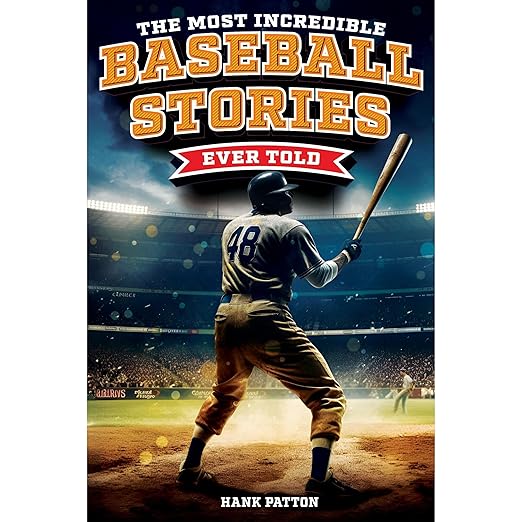
Hank Patton’s The Most Incredible Baseball Stories Ever Told collects fifteen stories drawn from across the game’s history, organized not by era but by theme, stories about perseverance, about sport intersecting with history, about the moments that define why a game lasts more than a century in the public imagination. At three hours and thirty-nine minutes, it is built for the casual listener rather than the baseball historian, and that calibration is honest. The book does not pretend to be exhaustive scholarship. It is a fan’s greatest-hits compilation with enough new angles on familiar stories to hold the interest even of listeners who already know who Ted Williams and Satchel Paige were.
Our Take on The Most Incredible Baseball Stories Ever Told
The range of stories Patton selects is the book’s main virtue. The historical breadth is genuine: Jackie Robinson and the intersection of baseball with civil rights, Sandy Koufax’s decision to sit out a World Series game on Yom Kippur, Jim Abbott pitching with one hand, Cal Ripken Jr.’s consecutive game record, the various curse-breaking World Series runs. These are not obscure choices, but Patton brings enough context to make them feel fresh rather than rote. The detail that Martin Luther King Jr. credited Jackie Robinson with making his civil rights work easier, something less often cited than Robinson’s on-field integration, is the kind of specific that lifts a story beyond the familiar.
Several reviewers noted that they bought the book as a gift, for fathers, for husbands, for baseball fans in their lives, and that the recipients loved it. That readership shapes what the book is and is not: it is a celebratory piece of fan literature, not a critical history. The writing is enthusiastic and accessible. Some stories move faster than readers familiar with the source material might wish; others add just enough texture to reward even well-read baseball fans with a detail they had forgotten or never known.
Why Listen to The Most Incredible Baseball Stories Ever Told
The short running time is an honest virtue. Three and a half hours is commitments-friendly, and the episodic structure, fifteen discrete stories rather than a continuous argument, means you can listen in segments without losing your place. For younger listeners being introduced to the game’s history, or for adults who know the names but not the full stories, the format works particularly well. Each story functions as a self-contained piece, which also makes it suitable for families who listen together on long drives.
The trivia dimension Patton promises in his marketing, stories that will “stump the biggest baseball heads”, is partially delivered. Some of the statistics reframe familiar players in ways that are genuinely surprising; others are things that baseball fans will have encountered before. The book is honest that its audience is broad rather than expert, and within those limits it delivers consistently.
What to Watch For in The Most Incredible Baseball Stories Ever Told
The Virtual Voice narration is a meaningful limitation for a book built on storytelling. Baseball stories live and die by the way they are told, the pause before the reveal, the vocal shift that signals importance, the warmth that makes a listener care about players they will never meet. AI narration renders these stories competently but not compellingly; the synthetic voice delivers the facts without the feeling that a good human narrator would layer underneath them. For listeners who are primarily interested in the content and can abstract away the delivery, this is workable. For those who find AI narration pulls them out of the listening experience, this is a significant drawback.
The book’s scope is also necessarily selective. Fifteen stories across more than 150 years of baseball means that entire eras, entire demographics, entire categories of extraordinary performance go unaddressed. Readers looking for depth on any single subject will want to look beyond this volume.
Who Should Listen to The Most Incredible Baseball Stories Ever Told
Best positioned as a gift listen for baseball fans of any age or depth of knowledge. Young listeners being introduced to the game’s history will get the most from it; seasoned baseball readers will find it a pleasant refresher with occasional new angles rather than new ground. The AI narration narrows the recommendation: listeners who are sensitive to synthetic audio will want to look for a human-narrated alternative or read the print edition instead. For those unbothered by AI narration, the content itself delivers what it promises.
Frequently Asked Questions
Is this audiobook appropriate for younger listeners who are new to baseball history?
Yes. The book is written with broad accessibility in mind, and the fifteen stories are chosen to introduce the game’s major cultural and historical moments. Younger listeners will find the material engaging without needing prior baseball knowledge, and the short running time is well-suited to younger attention spans.
Does the book cover baseball’s integration history and Jackie Robinson in meaningful depth?
Yes. Robinson’s story is covered with attention to both his on-field achievement and his wider cultural impact, including the often-cited detail that Martin Luther King Jr. credited Robinson with creating conditions that made civil rights work more possible. The treatment is accessible rather than exhaustive, readers wanting full depth should look to specific biographies of Robinson.
How does the Virtual Voice narration affect the storytelling quality?
It delivers the content accurately but lacks the emotional modulation that makes baseball stories compelling when told well. A human narrator would vary pace and tone to build suspense before a key moment; AI narration tends toward consistent delivery regardless of emotional weight. For a book explicitly built around storytelling, this is a genuine limitation.
Are the stories entirely about on-field moments, or does the book cover off-field history as well?
Both. Patton includes on-field achievements like Ripken’s consecutive game streak and Ruth’s home run records alongside off-field stories, Robinson’s integration of the league, Koufax’s religious observance decision, and the Ted Williams-John Glenn connection that spans baseball and military aviation. The mix is part of what makes the book more interesting than a straight statistics collection.