Quick Take
- Narration: Saskia Maarleveld is one of the most reliable voices in crime fiction audio, and she brings the right emotional texture to Nic’s damaged, hopeful interiority.
- Themes: sisterhood and grief, cold case obsession, the consequences of pursuing truth without institutional support
- Mood: Propulsive and emotionally charged, with a current of desperate hope running under the tension
- Verdict: Ashley Flowers’ second novel demonstrates that her debut was not a fluke, this is sharp, emotionally intelligent crime fiction with a twist that earns its impact.
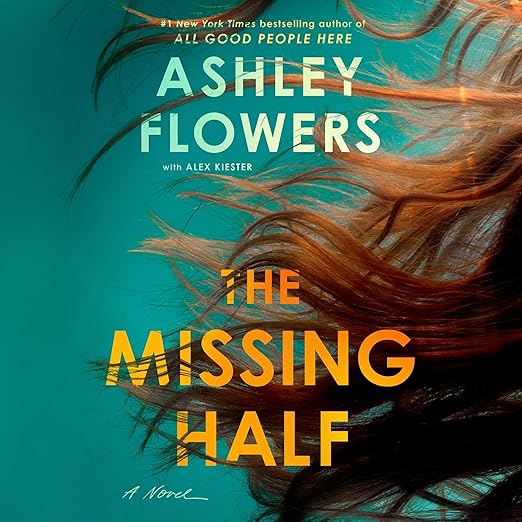
Ashley Flowers is the host of Crime Junkie, one of the most listened-to true crime podcasts in the world, and her first novel, All Good People Here, was a strong argument that her instincts for real-world crime translate effectively into fiction. The Missing Half is her second novel, and it is the book that should settle any remaining questions about whether she is a novelist or a podcaster who writes on the side. Gillian Flynn called it a propulsive mystery with excellent writing, and that is a blurb that carries weight precisely because Flynn has no reason to attach her name to something she does not mean.
I listened to this one over two evenings, the second of which extended well past midnight. The setup is deceptively simple: two women, each haunted by a sister who disappeared, find each other seven years after the cases went cold. Nic Monroe is twenty-four, living in the same small Indiana town where her sister Kasey vanished, doing the same job she has had since high school because inertia and guilt have calcified her life. Jenna Connor is looking for the same answers about her own sister, Jules, who disappeared two weeks before Kasey, in the same region, in the same uncanny way. When Jenna walks into Nic’s workplace and puts a name to the pattern neither of them could articulate alone, the novel properly begins.
Our Take on The Missing Half
What Flowers understands, better than most thriller writers, is that grief is not a state of heightened emotion. It is a state of diminished capacity, the exhaustion of carrying something unresolved for so long that it has become structural. Nic is not a grieving woman; she is a woman whose life has been organized around a grief she cannot put down. That distinction is rendered with real precision, and it gives her relationship with Jenna a texture beyond simple plot partnership. Jenna is not exactly functional either, but her damage runs differently, and the ways the two women misread and then recalibrate their trust in each other is the book’s most interesting thread.
The plot mechanics are solid: the cold cases, the parallel disappearances, the investigative decisions the women make outside official channels. Flowers knows how cold case logic actually works, and the procedural elements are credible without being dense.
Why Listen to The Missing Half
Saskia Maarleveld is an excellent narrator for this material. She has a quality of contained emotion that suits Nic’s voice precisely, someone who has learned to keep things in because letting them out has not historically helped. Maarleveld does not dramatize the text; she inhabits it, and the difference is audible. Her pacing through the investigation sequences is measured enough to let the logic land, and she handles the emotional disclosures between Nic and Jenna with the right amount of fragility rather than performance. For listeners who appreciate Maarleveld from other crime fiction narrations, this is among her stronger recent performances.
What to Watch For in The Missing Half
One reviewer noted that the ending makes both sisters into criminals and neither seems particularly troubled by this, which is a fair characterization of the novel’s conclusion, Flowers is not interested in wrapping the story in conventional moral clarity, and readers who need protagonists to remain within ethical lines may find the final act uncomfortable. That same reviewer found it reading more YA than adult fiction, which I think underestimates the emotional weight Flowers achieves but does point to a real quality: the prose is accessible rather than stylistically dense, and the character psychology, while true, is not baroque. Another reviewer loved it so much they read it in two days while working and parenting, which is perhaps the most honest testimonial available.
Who Should Listen to The Missing Half
Natural pick for listeners who have read All Good People Here and want to confirm that Flowers has built a sustainable fiction career alongside her podcast work. Also strong for crime fiction listeners who prioritize emotional authenticity over pure plotting, this is a book about loss and obsession that happens to have a mystery at its center, not a puzzle that happens to feature grieving women. The twist is genuine and not telegraphed. Fans of Karin Slaughter’s quieter domestic crime novels or Lisa Jewell’s investigative fiction will find it familiar in the best sense.
Frequently Asked Questions
Does The Missing Half need to be read after All Good People Here, or is it completely standalone?
It is entirely standalone. Different characters, different setting, different case. The only continuity is Flowers’ sensibility as a writer and her grounding in true crime research. New readers can start here without any background in her previous work.
Is the twist genuinely surprising, or does it telegraph itself through the investigation?
Multiple reviewers across rating levels described being genuinely caught off-guard, which suggests Flowers has constructed the misdirection with care. The reviewer who called it a big twist they did not see coming had read the full book, not just skimmed it, the setup does legitimate work to earn the surprise.
How does Saskia Maarleveld handle Nic’s first-person narration given that Nic is a self-described rut-case early in the book?
Maarleveld reads Nic’s flatness and inertia as a real emotional state rather than as a performance of sadness. The quality she brings to the character’s early chapters, contained, low-energy, slightly defensive, creates a meaningful baseline so that the moments of genuine engagement and fear register as changes rather than as consistent dramatic temperature.
Does the novel address the moral implications of what Nic and Jenna do outside official channels?
The book leans into rather than away from moral ambiguity in its conclusion. One reviewer noted that both characters end up having done things that are legally criminal, and the novel does not deliver a redemptive accounting of that. Readers who prefer their heroines unambiguously on the right side of the law should know this before starting.