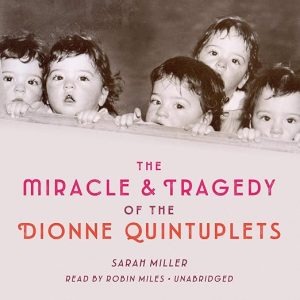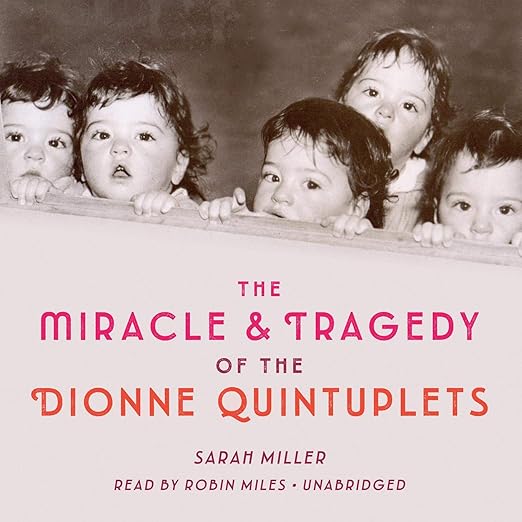
- Performance: Robin Miles is one of the best nonfiction narrators working today, and her measured, empathetic delivery is precisely what this material requires
- What it covers: Exploitation disguised as protection, media spectacle versus private humanity, the long aftermath of institutional harm
- Feel: Sobering and precise, carrying a slow-building outrage that the restrained prose makes more effective rather than less
- Our call: A meticulously researched account of one of history's most extraordinary cases of institutional exploitation, delivered with a clarity that honors its subjects without sentimentalizing them.
I had a passing familiarity with the Dionne quintuplets before I listened to this. That is, I knew they existed and that something had gone wrong. I did not know how wrong, or how systematically, or for how long. Sarah Miller's account is not a comfort read. It is closer to a reckoning. I listened to it over the course of a weekend, in the particular state of attention that comes when a book is keeping you slightly off-balance with each new detail, never quite as terrible as what comes next but always showing you that the next detail is waiting just around the corner.
Robin Miles is the narrator, and this is exactly the right casting decision. Miles has a quality that is rare in audio: she can convey emotional weight without performing it. Her reading of Miller's spare, controlled prose about the five Dionne girls, born May 28, 1934, weighing a collective thirteen pounds, surviving against all medical expectation, and then being systematically removed from their family and put on display for a decade, is never theatrical. It is steady and clear, and that steadiness accumulates in a way that theatrical delivery never could. By the time you reach the sections on Quintland and the one-way screens that tourists paid to peer through while the children played in their wading pool, the controlled tone feels like the only possible choice, the only dignified response to material this disturbing.
Miller identifies a central irony that organizes the entire account. The Ontario government took custody of the five girls on the grounds that it needed to protect them from exploitation by showmen and hucksters. It then proceeded, for the next nine years, to exploit them more systematically and profitably than any individual huckster could have managed. Quintland became a more popular tourist attraction than Niagara Falls. Product endorsements proliferated. Sightseers came by the millions. And at the center of it all were five small children who had no say in any of it, separated from their parents and siblings by the width of a road, watched constantly, performing their childhood for an audience that never acknowledged what it was taking from them in exchange.
One reviewer notes that the book made them appreciate the genuine early motivations to protect the babies while recognizing the exploitation as undeniable and sad. That is a fair reading of Miller's intentions. She is not writing a polemic. She presents the complexity of early motivations, the genuine medical achievement involved in keeping five premature infants alive in 1934, before documenting what came after with forensic precision. The transition from protection to exploitation was not a single decision. It was a series of small, financially convenient choices that nobody individual had to own.
The Strengths
The book runs just over nine hours, and the pacing is carefully managed. Miles navigates sections that require very different tonal registers: the medical drama of the early weeks, the gradual build of the tourist industry around the girls, the increasingly visible strain in the family across the road, and the quiet catastrophe of what happened when the quintuplets were eventually returned to their parents. Each transition requires Miles to recalibrate without making the recalibration visible as a performer's choice, and she accomplishes this with the kind of technical precision that deserves more attention than narration typically receives from reviewers.
Reviewer Kelly A. Asbury found the book's tone dry and insufficiently emotional, and this is a legitimate response. Miller's approach is journalistic in the best sense: she trusts the facts to carry the emotional weight rather than amplifying them with literary embellishment. Listeners who prefer their narrative nonfiction to be more expressly moved by what it is documenting will find Miles's controlled delivery mirrors the book's restraint. Listeners who believe that restraint is a form of respect for the subject will find it exactly right for this material.
Before You Commit to The Miracle & Tragedy of the Dionne Quintuplets
One reviewer with prior knowledge of four different books on the Dionnes found this the most thoroughly researched, drawing from multiple sources reliably. The same reviewer notes a wish for more material on the surviving quintuplets in the years after 1998, speculating that the living sisters, Annette and Cecile, may not have participated in this book's research. Miller's decision to draw a line at a certain point in time is visible and honest, but it does mean the book is not the final word on its subjects' lives beyond a certain date.
Miller's previous book covered the Lizzie Borden case, and fans of that work will recognize the same methodological precision and the same willingness to sit with complexity rather than resolve it falsely. This is historical narrative as a form of witness, delivered with care by one of the best nonfiction narrators working in audio today.
Who Should Listen to The Miracle & Tragedy of the Dionne Quintuplets
Listeners who want rigorously researched narrative nonfiction delivered with emotional intelligence will find this essential. Robin Miles's narration elevates it further. Readers already familiar with the Dionnes will learn new details from Miller's primary source research. Listeners who need their difficult historical material wrapped in more explicit emotional commentary may find the restraint frustrating rather than effective. This is not a book for someone wanting a comprehensive account of the quintuplets' adult lives, but as a document of their extraordinary and exploited childhood, it is definitive.