Quick Take
- Narration: Phil Cavell reading his own book brings the authority of a biomechanics specialist who has had these exact conversations with clients for two decades.
- Themes: Aging and athletic performance, cardiac risk and midlife training load, the science behind sustained high-level cycling
- Mood: Thoughtful and occasionally sobering, with the practical warmth of someone who wants you to still be riding in twenty years
- Verdict: The most scientifically grounded guide available to serious midlife cyclists, though listeners who race casually or ride recreationally will need to calibrate the content to their own context and intensity.
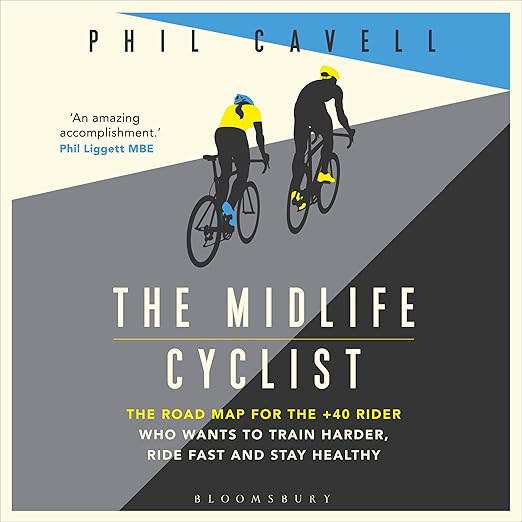
I started cycling seriously in my late thirties, which means I am now navigating exactly the kind of questions Phil Cavell writes about in The Midlife Cyclist. Not racing questions, exactly, but questions about how the body changes during sustained training in middle age, what the warning signs of overtraining look like in a fifty-year-old cardiovascular system rather than a twenty-five-year-old one, and whether the training approaches that produced reliable results a decade ago are still appropriate or quietly becoming counterproductive. I found Cavell’s audiobook during a stretch of recovery from a minor knee issue and came to it with the particular attentiveness of someone who has recently been reminded that the body keeps score even when you are not.
Cavell is a renowned cycling biomechanics pioneer who has worked with professional cyclists across career lengths that would have been considered physiologically unusual in previous generations of the sport. His central observation, which anchors the entire book, is that we are a qualitatively different kind of middle-aged cyclist than any generation before us. An ever-growing cohort of riders in their fifties and sixties are not winding down their engagement with the sport. They are training seriously, entering events, and in some cases attempting things their earlier selves would not have imagined possible. The medical and scientific research on how to support that ambition safely is still catching up to the population that needs it.
The Biomechanics Lens That Sets This Apart
Cavell’s expertise in bike fit and biomechanics gives The Midlife Cyclist a physical specificity that most cycling fitness books entirely lack. He is not simply addressing cardiovascular conditioning and power output in the abstract. He is thinking about how an aging musculoskeletal system interacts with the particular physical demands of the cycling position, where decades of riding, at any level, can create asymmetries and structural adaptations that affect not just performance but injury risk over time. This dimension of the book is where his professional background pays off most clearly for the serious listener.
The contributions from coaches, ex-professionals, and pro-team doctors that Cavell draws on across the book add perspectives that prevent it from becoming a single-viewpoint work built around one person’s philosophy. Fabian Cancellara’s gentle barb in his endorsement that Cavell is certainly old enough to write this book captures something real about the authority the material carries: it is not theoretical. The conversations Cavell has had professionally with riders at various stages of their engagement with the sport are visible throughout, giving the book a texture of accumulated practical experience that distinguishes it from academic sports science written for a lay audience.
The Cardiac Risk Sections and Why They Matter
The sections on sudden cardiac death and cardiac risk in older cyclists are where the book becomes most sober, and also where it provides the most genuinely useful information for listeners who have not thought carefully about the specific cardiovascular demands of racing and hard training efforts at midlife. Cavell does not sensationalize these risks, but he does not minimize them either. He addresses the specific physiology of why high-intensity efforts create different risk profiles for older hearts, and what that means for how serious midlife riders should approach their training structure and their relationship with cardiac screening.
Reviewer RGMac, in his fifties and specifically not a racer, noted that the book centers around racing scenarios and that the cardiac risk material derives substantially from the extreme demands of sprinting in competitive conditions. That observation is accurate and worth acknowledging. Casual riders and recreational cyclists will need to do calibration work, understanding that the risks and training prescriptions described are written for people consistently pushing toward physiological limits, not for those riding three days a week at moderate effort. The core principles of the cardiac risk discussion translate across intensity levels, but the specific prescriptions need adjustment for the recreational context.
Self-Narration Across Nearly Ten Hours
Nearly ten hours with a single narrator who is also the author creates particular demands on listener patience, and Cavell’s narration will not satisfy anyone looking for professional voice work. He is a biomechanics specialist, not a performer, and his delivery reflects that professional identity rather than a performance one. What he brings to the material is the tone of a knowledgeable professional speaking to informed listeners who have come with genuine questions rather than passive curiosity. The technical passages, including the physiological explanations and the training prescription sections, are delivered with matter-of-fact confidence that suits the material better than theatrical rendering would.
Reviewer elessar89 described the book as getting better and better as it progresses, with the final chapters being particularly valuable. That tracks with the structural arc: Cavell builds from foundational physiology and biomechanics toward more specific and actionable training and racing guidance that riders in their fifties and sixties most urgently need. Listener Howard noted that the level of detail was precisely calibrated to recommend targets and boundaries without demanding laboratory measurements, which is the appropriate balance for an audiobook format that cannot accompany every listener to a proper physiological assessment.
Who This Book Is For and Who Might Find It Frustrating
Listen to The Midlife Cyclist if you are a serious cyclist in your forties, fifties, or beyond who trains with intention and wants to understand what the science actually says about supporting performance and managing risk at this stage of athletic life. Listen if you have worked with a coach or taken your performance seriously and want a framework for the physiological changes you are experiencing or anticipating. Listen if you are interested in the intersection of aging, athletic adaptation, and the biomechanics of cycling performance at levels that most sports science writing does not address.
Reviewer MacGyverJr found the book too jargon-heavy and too European in its frames of reference for a casual American rider who was looking for something directed to the novice, and that is a fair limitation to name honestly. This book was written from within cycling’s professional and semi-professional culture, with all the assumptions that implies. The 4.4 stars across 780 reviews reflect an audience that largely found exactly what it was looking for, but that audience skews decisively toward the serious and committed end of the cyclist spectrum.
Frequently Asked Questions
Is The Midlife Cyclist relevant only to competitive cyclists, or does it also serve recreational riders in their fifties and sixties?
The book is written primarily from a competitive and semi-competitive perspective. Recreational riders will find relevant information but should expect to do some calibration work, scaling the training prescriptions and risk discussions to their actual intensity level and specific goals.
Does Phil Cavell address the risk of sudden cardiac death in midlife cyclists, and how seriously should non-competitive riders take that discussion?
Yes, and Cavell treats it seriously without sensationalizing it. The risk is presented primarily in the context of very high-intensity competitive efforts. Non-competitive riders face lower risk in normal riding but should still engage with the cardiac monitoring and screening recommendations Cavell provides.
Does Phil Cavell’s self-narration make the technical biomechanics content easier or harder to follow in audio format?
His narration has the matter-of-fact confidence of a specialist speaking to informed listeners. Technical passages are delivered clearly if not dramatically. Listeners who find dense physiological content easier to process in print may want a physical copy available for the most technical chapters.
How does The Midlife Cyclist differ from general cycling fitness books written for older athletes?
Cavell’s biomechanics background gives the book a physical specificity covering musculoskeletal adaptation, bike fit considerations, and structural asymmetries that general fitness books for older athletes typically lack. The contributions from pro-team doctors and coaches also give it access to performance knowledge filtering down from elite sport.