In Brief
- Narration: Simon Winchester narrates his own work and the decision is unambiguously right. His broadcaster's baritone and genuine enthusiasm for American geography give the material the texture of a well-prepared lecture from someone who has actually walked the ground he is describing.
- Themes: American geography as national character, infrastructure and identity, the stories history does not make room for
- Mood: Expansive and sometimes personal, like a long drive through country you thought you knew
- Verdict: Winchester brings his characteristically readable approach to the story of how America was physically knit together, and self-narration elevates material that could easily have felt like a textbook.
Simon Winchester has a particular gift that I have been thinking about since I first encountered it in The Professor and the Madman: he can make the functional feel magnificent. That book was about the making of a dictionary. This one is about surveyors, railroad engineers, and highway builders. In both cases Winchester identifies something that most people use without thinking and traces it back to its origins in specific human decisions made by specific people under specific circumstances, and by the time he is done the thing in question has become strange and wonderful in the way that only familiarity can prevent you from seeing.
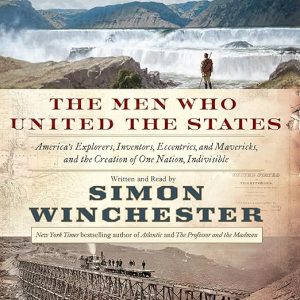
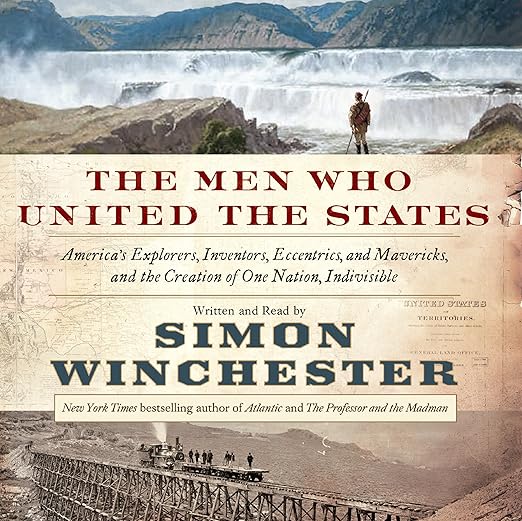
The Men Who United the States covers what Winchester considers the foundational acts of American physical unification, from the early expeditions of Lewis and Clark and the government surveyors who followed them through the construction of the transcontinental telegraph, the railroads, the Interstate Highway System, and the laying of undersea cables. The organizing argument is that the United States became a coherent nation not only through political institutions but through acts of physical connection, through the literal binding together of disparate geographies that would otherwise have remained regions rather than becoming a country.
First, the Big Picture
Winchester is at his best when he is rehabilitating figures who were central to the story but are not remembered by the general public. The chapter on John Wesley Powell, the one-armed Civil War veteran who led the first survey expeditions through the Grand Canyon and became one of the most consequential voices in American conservation policy, is as good a piece of popular history writing as anything I have encountered this year. Winchester has a knack for finding the moment where a historical figure's personal character intersects with a larger historical force, and in Powell he has an extraordinary subject.
The book moves through what Winchester calls the five classical elements as an organizing principle, with sections devoted to the exploration of earth, water, fire, air, and aether, the last serving as his vehicle for discussing telegraph, telephone, and digital communication. This structure is more suggestive than rigorous, and some reviewers have found it slightly strained, but it gives the book a thematic coherence that a purely chronological arrangement would lack. Winchester is not trying to write a comprehensive history of American infrastructure. He is trying to argue something about what physical connection means for national identity, and the elemental structure serves that argument.
Why The Men Who United the States Works as an Audiobook
Winchester narrates his own book, and this is the right decision for material this personally engaged with. He has traveled extensively to the places he describes, and the narration has the quality of someone recounting experiences rather than reciting research. The authority is worn lightly, which is the right way to wear it in thirteen hours of popular history.
Several reviewers note that Winchester's own political and social perspectives surface in the text, sometimes in ways that are not clearly flagged as perspective rather than reporting. One reviewer made the comparison to Francis Parkman, whose historical biases shaped his presentation of facts while remaining largely invisible to the contemporary reader. This is a fair observation. Winchester writes as an Anglophile American by adoption, with the particular affection and occasional condescension that combination can produce. Listeners who share his general political orientation will find these moments unremarkable. Those who do not will notice them.
The 4.3 rating across nearly a thousand listeners is slightly lower than Winchester's other work tends to receive, which likely reflects the structural ambition of the book not quite matching the narrative intimacy of his best profiles. The Men Who United the States is broader than Atlantic or The Meaning of Everything, and breadth in Winchester's case means slightly less of the specific human drama that makes his best work compulsive.
The Caveats
The most valuable service this book performs is the lateral one: by organizing American history around acts of physical infrastructure rather than political events, Winchester makes visible a class of people, engineers, surveyors, telegraph operators, highway planners, who are largely absent from standard histories but whose work was necessary for the events those histories record. A reviewer described the book as making visible the unsung heroes who contributed to the many inventions we take for granted today. That is exactly what Winchester is doing, and for that project alone the book earns its thirteen hours.
Who Should Pick Up The Men Who United the States
Listen to this if you enjoy narrative history that follows people rather than events, and if American geography in the largest sense, its exploration, mapping, and physical development, interests you. Winchester self-narrates beautifully and is a reliable companion for a long drive. Skip it if you want strictly chronological or comprehensively political American history. This is selective, thematic, and occasionally personal, which is its strength and its limitation.
Questions Listeners Ask
How does Winchester's self-narration compare to having a professional narrator read the book?
Winchester's broadcaster background makes him an unusually strong self-narrator. His voice has the right authority and warmth for this material, and his genuine enthusiasm for the places and people he describes comes through consistently. Listeners accustomed to professional audiobook narrators may notice occasional differences in pacing, but the personal investment more than compensates.
Does the book address the dark aspects of American expansion, including displacement of indigenous peoples?
Winchester addresses these dimensions, though some reviewers have found his treatment uneven. The explorers and surveyors he celebrates operated within systems that often caused devastating harm to indigenous peoples, and Winchester acknowledges this without making it the central focus of any chapter. Listeners who want more sustained engagement with this dimension will want to supplement with dedicated histories.