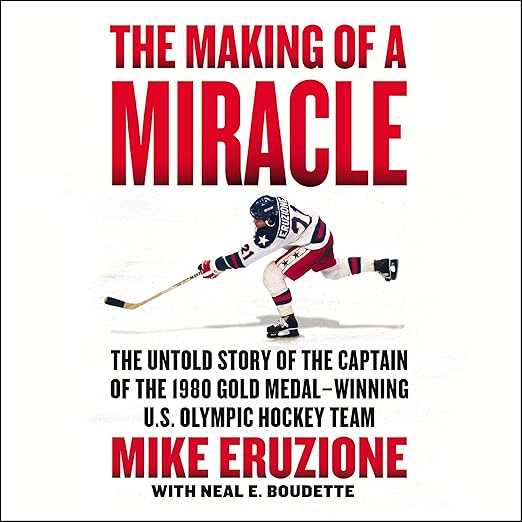
The Making of a Miracle
Audiobook & Ebook

The Making of a Miracle by Mike Eruzione | Free Audiobook

By Mike Eruzione

Narrated by George Newbern

🎧 7 hours and 8 minutes 📘 Harper 📅 January 28, 2020 🌐 English
🎧 Listen Free on Audible 📖 Read on Kindle

Free 30-day trial · Cancel anytime

About This Audiobook

On the fortieth anniversary of the historic “”Miracle on Ice,”” Mike Eruzione—the captain of the 1980 U.S Men’s Olympic Hockey Team, who scored the winning goal—recounts his amazing career on ice, the legendary upset against the Soviets, and winning the gold medal.

It is the greatest American underdog sports story ever told: how a team of college kids and unsigned amateurs, under the tutelage of legendary coach—and legendary taskmaster—Herb Brooks, beat the elite Soviet hockey team on their way to winning the gold medal at the 1980 Lake Placid Olympics. No one believed the scrappy Americans had a real shot at winning. Despite being undefeated, the U.S.—the youngest team in the competition—were facing off against the four-time defending gold medalist Russians. But the Americans’ irrepressible optimism, skill, and fearless attitude helped them outplay the seasoned Soviet team and deliver their iconic win.

As captain, Mike Eruzione led his team on the ice on that Friday, February 22, 1980. But beating the U.S.S.R was only one of the numerous challenges Mike has faced in his life. In this inspiring memoir, he recounts the obstacles he has overcome, from his blue-collar upbringing in Winthrop, Massachusetts, to his battle to make the Boston University squad; his challenges in the minor leagues and international tournaments to his selection to the U.S. team and their run for gold. He also talks about the aftermath of that stupendous win that inspired and united the nation at a time of crisis in its history.

Eruzione has lived a hockey life full of unexpected twists and surprising turns. Al Michaels’ famous call in 1980—””do you believe in miracles? YES!””—could have been about Mike himself. Filled with vivid portraits—from his hard-working, irrepressible father to the irascible Herb Brooks to the Russian hall of famers Tretiak, Kharlamov, Makarov, and Fetisov—this lively, fascinating look back is destined to become a sports classic and is a must for hockey fans, especially those who witnessed that miraculous day.

Supplemental enhancement PDF accompanies the audiobook.

🎧 Listen Free on Audible

Free 30-day trial · Cancel anytime

Quick Take

  • Narration: George Newbern brings warmth and athletic energy to Eruzione’s voice, matching the memoir’s blue-collar Boston authenticity without overselling the sentiment.
  • Themes: Underdog triumph and national identity, blue-collar perseverance, the weight of a single historic moment
  • Mood: Rousing and nostalgic, with genuine emotional intelligence beneath the sports-memoir surface
  • Verdict: A richer account of the Miracle on Ice than most listeners will expect, Eruzione delivers context, character, and personal stakes that the documentaries never captured.

I was in a used bookshop in Boston a few winters ago when I overheard two men in their sixties debating whether they had actually watched the 1980 game live or were misremembering. Both were certain. Both had incompatible memories of where they were. I thought about that conversation while listening to The Making of a Miracle, because Mike Eruzione’s memoir is partly about exactly that, the way a single game became so embedded in American collective memory that everyone has a personal version of it, and yet the people who were actually on the ice have a story that is almost nothing like the one the country remembers.

Eruzione was the captain of that team, the man who scored the winning goal against the Soviet Union on February 22, 1980, and he has spent the decades since living inside the mythology that moment created. What he has written here is not a retelling of the game, though the game is present throughout, but an account of the full arc of a life that happened to contain that particular afternoon. That framing is the book’s greatest strength, and what separates it from the documentary record that most fans already know.

Winthrop, Massachusetts, Before the Ice

The early chapters covering Eruzione’s blue-collar upbringing in Winthrop, Massachusetts, are where the memoir distinguishes itself most clearly from the mythology. He writes about his father with genuine affection and specificity, a hard-working man whose support was constant and whose presence in the book gives the later triumph its proper emotional weight. The account of Eruzione’s struggle to make the Boston University squad, his years in the minor leagues and international tournaments, and the uncertainty that surrounded his selection to the Olympic team all read as the kind of story that is genuinely interesting independent of where it ends. He was not considered a lock for the team. He was a borderline choice who maximized limited raw ability through relentlessness and character, and that is a different and more complicated story than ‘great players beat the Soviets.’

The portrait of Herb Brooks is one of the book’s most rewarding elements. Eruzione captures the coach as a contradictory figure, brilliant, driven, often maddening, capable of manufacturing the exact team chemistry that the moment required through methods that bordered on psychological warfare. The dynamic between Brooks and his players comes through with a texture and specificity that neither the documentary nor the Disney film could fully render, because both required narrative simplification that Eruzione, speaking from inside that relationship, does not need to impose.

February 22, 1980, Without the Mythology

The Lake Placid chapters are well-crafted and appropriately climactic, but what makes them work is that Eruzione has earned the emotional stakes through the preceding material. He writes about the Soviet team with genuine respect, the portraits of Tretiak, Kharlamov, Makarov, and Fetisov are specific enough to humanize opponents who are often rendered as an undifferentiated force of Cold War symbolism. He is also honest about what the American team was and was not: they were undefeated going in, yes, but they were also young, outmatched on paper, and operating under a coach who had spent months deliberately keeping them uncertain of their standing in order to sustain competitive hunger. The win was real. So was the improbability.

One reviewer noted that despite having already seen both major documentaries and the Disney film, the book delivered significant new insight into the composition, character, and values of that team. That rings true. Eruzione has access to the interior of the experience that no outside account can replicate, and he uses it well, not to correct the record so much as to add the grain and weight that memory and intimacy provide.

George Newbern and the Question of Memoir Performance

George Newbern’s narration is a strong fit for this material. He delivers Eruzione’s Boston working-class voice without caricature, and his pacing through the emotional high points of the memoir is restrained in the right ways, he lets the events carry the weight rather than loading the narration with extra sentiment. The seven-hour runtime passes quickly, which is the best evidence that the pacing works. Newbern handles the hockey terminology and the period-specific cultural references cleanly, and his transitions between the reflective and the action-oriented sections of the memoir feel natural rather than mechanical.

The memoir does not avoid the post-1980 story, which is a genuine asset. Eruzione is clear-eyed about the strange aftermath of becoming a national symbol: the way that moment followed him, defined him in certain rooms, and the work of building a meaningful life around an identity that was fixed at age twenty-five. That honesty is what prevents The Making of a Miracle from collapsing into simple triumphalism. It is a sports memoir, but it is also a book about what it means to live with a defining moment for the rest of your life.

For Hockey Fans and Those Who Were Never Fans

Listeners who watched that game live and have never stopped thinking about it will find this rewarding in ways that are probably impossible to explain to people who were not there. But the memoir also functions for listeners with no prior investment in hockey, because Eruzione is writing about universal things, family, effort, belonging, the weight of expectation, that transcend the sport. Those who have seen the documentary and the film and wonder what more there is to know will find, as Colorado Reader noted in their review, that there is genuinely more to know. The book is not a redundant retelling. It is an inside account that the external record cannot substitute for.


Frequently Asked Questions

Do I need to be a hockey fan to get something meaningful from this audiobook?

No. Eruzione writes about hockey, but the memoir is fundamentally about family, perseverance, and the experience of carrying a defining public moment through a private life. The skating and tactical details are present but never so technical that non-fans will lose the thread.

If I have already seen the ‘Do You Believe in Miracles’ documentary and the Disney film, does this audiobook add anything?

Yes, significantly. Reviewers who knew both well reported that the memoir provided substantial new context about team dynamics, Herb Brooks’s methods, and the interior experience of the players. Eruzione’s access to the inside of that story is what neither outside account could fully render.

How does George Newbern handle the task of voicing a first-person Boston working-class narrator?

Newbern delivers Eruzione’s voice with warmth and appropriate regional authenticity without veering into imitation. His approach is restrained, he lets the events generate the emotion rather than applying narrated sentiment, which suits the memoir’s honest, unpretentious tone.

Does the memoir cover what happened to Eruzione and the team after 1980, or does it focus primarily on the game itself?

The memoir covers Eruzione’s full life arc, from his Winthrop childhood through the Olympics and into the decades that followed. The aftermath of the win, the way that moment defined his public identity, receives serious treatment, which gives the book a more complete and honest shape than a pure sports triumph narrative would offer.

Ready to listen?

🎧 Listen to The Making of a Miracle for free

Free 30-day trial · Cancel anytime

What Listeners Are Saying

★★★★★

GReat read-A must read!

Mike did an amazing job. It was such a special time and inspired so many people. It will never get old! Thank you and your teammates for this piece of history. USA USA USA never gets old!

– Kdog
★★★★★

Do You Believe in Miracles?

The game between the USA and Soviet Union in 1980 was the first hockey game I ever watched. As an Olympics junkie, every sport interested me. As I cleaned the house, I listened to the game. Stopping to watch now and then. Finally I realized the US could win and…

– D. M. Hunt
★★★★★

Eruzione scores again

Full of interesting background from the captain of the biggest upset in sports history.

– Craig Pushard
★★★★★

Someone is going to beat those guys….

Despite my strong interest in the 1980 US Olympic hockey team, I debated buying this book. I’ve already seen both the “Do you believe in miracles” documentary and the Disney “Miracle” film. What more is there to know?But after reading the reviews I decided to take a chance on it…

– Colorado Reader
★★★★☆

Great read!

Great story. Read it all in 3 days.

– Tyler M.

Start Listening: The Making of a Miracle


Free 30-day trial · Cancel anytime

Alexandra Reed

Written by Alexandra Reed

Founder & Literary Critic