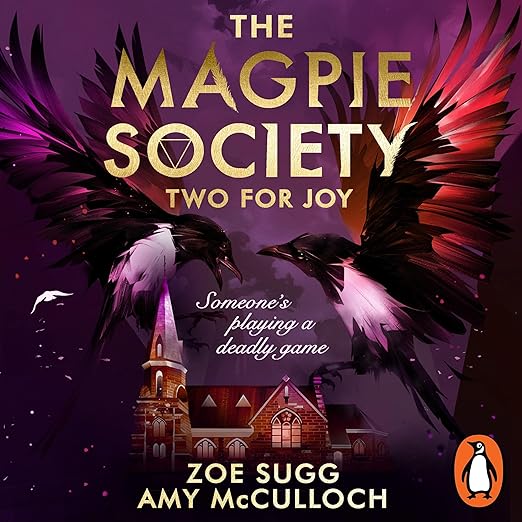
Quick Take
- Narration: Katie Leung brings precise, grounded authority to the boarding school world – her reading makes Audrey and Ivy feel like real young women rather than thriller archetypes.
- Themes: Institutional secrecy, the danger of inherited privilege, friendship as investigative partnership
- Mood: Gothic and propulsive, with a boarding school atmosphere that earns its comparisons to prestige teen drama
- Verdict: A confident sequel that deepens the Magpie Society’s mythology and earns its cliffhanger ending – though newcomers should start with One for Sorrow first.
I picked up The Magpie Society: Two for Joy on a rainy Thursday evening, having spent the previous week finishing the first volume. The boarding school mystery genre has a long literary lineage – from Josephine Tey’s early work through the present wave of gothic YA – and Zoe Sugg and Amy McCulloch are working that lineage with clear-eyed awareness of what makes it compelling and what makes it feel stale. Two for Joy leans decisively toward the compelling.
The setup continues directly from One for Sorrow’s events: Audrey and Ivy are still at their elite boarding school, still motivated by their determination to bring Lola Radcliffe’s killer to justice, and now facing a new disappearance that connects to the enigmatic Magpie Society through a mysterious card. The blurb’s comparison to Serial at Malory Towers is the most useful shorthand for what the series does. It takes the cozy institutional trappings of boarding school fiction and runs a genuinely dark investigative thread through them. The school’s secrets, Two for Joy makes clear, are not incidental to its function. They are its function.
Our Take on The Magpie Society: Two for Joy
What the sequel does better than the first volume is develop Audrey and Ivy’s partnership as a dynamic rather than a premise. In One for Sorrow, they are two people reluctantly allied by circumstance. By Two for Joy, they have become something more interesting: investigators who have different skills, different blind spots, and different relationships to the institution’s hierarchies. That differentiation is where the book’s best character work lives. Jennifer Niven’s endorsement of the first volume – nail-biting page turner with cinematic sparkle, depth, and a heap of charm – applies here too, with the qualification that Two for Joy is somewhat more gothic and somewhat less charming on the surface. The darkness has accumulated.
Why Listen to The Magpie Society: Two for Joy
Katie Leung is an excellent choice for this material. Her experience as an actor has given her a precise understanding of how to inhabit a world where the surface is one thing and the reality is another, which is exactly what boarding school gothic fiction demands. Her narration keeps both Audrey’s American-outsider perspective and Ivy’s insider ambivalence distinct and credible. The nine-hour runtime gives the plot room to breathe and build without the pacing problems that sometimes afflict shorter YA thrillers that try to generate tension too quickly. The audiobook format also serves the ending: the cliffhanger that frustrated one reviewer actually lands harder in audio, which is not necessarily a complaint.
What to Watch For in The Magpie Society: Two for Joy
The ending has divided readers. One listener explicitly noted that the book offers what appears to be a tidy resolution and then restructures it for everyone in the final pages. If you need your conclusions clean and final, Two for Joy will frustrate you. This is a series built on accumulation and ongoing mystery, and the second volume maintains that structure rather than offering closure. The review that called it a good sequel that keeps you guessing until the very end is the more accurate frame. Readers who enjoy the sustained uncertainty of serialized mystery will find this a strength; those who came for resolution will leave wanting.
The Magpie Society itself – the secret organization whose mysterious card arrives during the new investigation – is the series’ most interesting invention. It functions like a palimpsest: the school’s present-day secrets are layered over historical ones, and the Society’s membership spans generations in ways that the second volume makes considerably more complicated than the first suggested. Sugg and McCulloch are constructing a mythology rather than a plot, and Two for Joy makes that ambition clear.
The collaborative authorship between Zoe Sugg and Amy McCulloch produces something more interesting than either writer working alone might. Sugg brings a particular attunement to the emotional lives of teenage girls navigating social hierarchy; McCulloch brings thriller construction experience. The combination means the book never neglects the internal drama for the external mystery, or vice versa. That balance is harder to maintain than it looks, and Two for Joy maintains it through to its deliberately unsettled ending.
Who Should Listen to The Magpie Society: Two for Joy
This audiobook is for young adult readers – and adults who read YA – who have already completed One for Sorrow and are ready for the series to expand its mythology. Katie Leung’s narration makes it particularly well-suited to the audio format. Don’t start here; the character relationships and institutional history that make Two for Joy work are built in the first volume. For boarding school gothic fans who enjoyed series like Stalking Jack the Ripper or Miss Peregrine’s Home for Peculiar Children, the Magpie Society is a strong addition to the genre, and this second entry shows real confidence in where the story is going.
Frequently Asked Questions
Does The Magpie Society: Two for Joy work as a standalone, or do I need to listen to One for Sorrow first?
You need One for Sorrow first. Two for Joy opens in the direct wake of the first volume’s events and assumes complete familiarity with Audrey, Ivy, Lola’s murder, and the school’s dynamics. Starting here would mean arriving in the middle of a story that has already established its most important character relationships and ongoing investigations.
How does Katie Leung’s narration compare to what listeners who know her as an actor might expect?
Leung’s audio performance draws on genuine acting experience. She handles the dual-protagonist structure with clear character differentiation and brings particular authority to the boarding school setting’s social hierarchy – the class dynamics between insiders and outsiders that the book relies on for its tension. Her narration is one of the audiobook’s consistent strengths.
Is The Magpie Society: Two for Joy significantly darker than the first book in the series?
Yes, somewhat. Two for Joy has accumulated more institutional dread than One for Sorrow – the Magpie Society’s mythology expands in directions that are more overtly threatening, and the new disappearance introduces stakes that feel higher than the first volume’s setup. The boarding school charm that Jennifer Niven praised in One for Sorrow is still present but operating under more pressure here.
Does Two for Joy resolve the mystery from One for Sorrow – is justice served for Lola Radcliffe?
Without specific spoilers: the investigation into Lola’s death is ongoing in Two for Joy and is complicated by the new disappearance, which connects to the same institutional secrets. The series’ structure is cumulative rather than episodic – each volume develops the larger mystery without necessarily concluding it. The ending of Two for Joy has been described by readers as surprising rather than satisfying in a conventional sense.