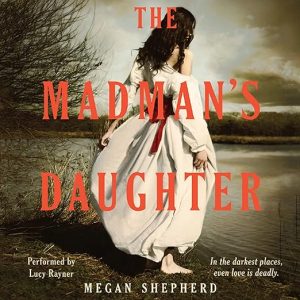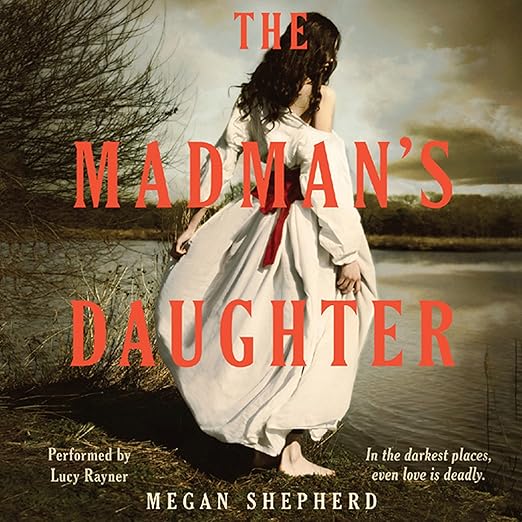
Juliet Moreau, the sixteen-year-old protagonist of Megan Shepherd's The Madman's Daughter, opens this audiobook - narrated by Lucy Rayner - in a London that has already stripped her of almost everything. Her father, the scientist Dr. Moreau, has been driven from England following accusations that he performed grotesque experiments on animals. Her family's social standing collapsed with his departure. She has rebuilt herself into something functional, fragile, and determinedly forward-facing - until news arrives that her father is still alive, operating in secret on a remote tropical island.
Rayner's narration establishes Juliet's voice in the opening chapters with a precision that the book requires: she is intelligent enough to know exactly what going to that island means, and damaged enough by her father's absence that she goes anyway. The Madman's Daughter is book one of the Madman's Daughter trilogy, inspired by H.G. Wells's The Island of Dr. Moreau, and Shepherd structures her retelling with considerable skill. At 12 hours and 50 minutes, it is a substantial YA listen that earns its runtime through consistent atmospheric density and a three-way romantic tension that does not resolve as neatly as the genre usually requires. The endorsement from Carrie Ryan, who praised the audiobook's breakneck pacing and pulse-pounding mystery, is borne out from the first hour.
How The Madman's Daughter Holds Up
What Shepherd does well in this opening volume is hold the gothic and the romantic in genuine tension rather than letting one subsume the other. The island is genuinely menacing - populated by Moreau's experimental creatures, governed by his logic rather than the island's own ecology, and structured by a power dynamic between Moreau and the people who surround him that becomes more disturbing the more it is examined. Juliet's scientific curiosity about her father's work coexists with horror at what that work produces, and Rayner navigates that double response without simplifying either element.
The triangle between Juliet, Montgomery - her father's handsome assistant - and Edward, the enigmatic castaway, is handled with more complexity than the standard YA configuration. One reviewer found Juliet's decision-making frustrating at several points, particularly the central revelation about her father's genius being present in her own blood. That frustration is almost certainly intentional. Juliet is a character written to be a little maddening, because she is a person caught between the pull of her father's intellect and the knowledge of what that intellect produces, and a reader who never wanted to shake her would be reading something less honest than what Shepherd provides. Rayner's performance keeps that frustration in the service of sympathy rather than irritation.
Why The Madman's Daughter Works as an Audiobook
Lucy Rayner's narration is one of the audiobook's genuine assets. She manages the gothic atmosphere without turning the reading into a performance of atmosphere - no exaggerated breaths or theatrical horror-voice. The island sequences, which shift between tropical beauty and something viscerally wrong, work well in audio precisely because Rayner trusts the material. The horror in the novel is conceptual as much as visceral, rooted in what Dr. Moreau's experiments imply rather than in graphic description, and Rayner's measured approach serves that quality well.
The book draws favorable comparison to Libba Bray's gothic work, and Shepherd knows how to construct a chapter that ends at exactly the right moment of incompletion - a skill that translates well to an audio format where each listening session tends to end at a natural pause. The 12-hour runtime does not drag; the pacing is genuinely propulsive through the middle section, which is where gothic YA often loses momentum. The three-way character dynamic between Juliet, Montgomery, and Edward is managed with enough distinction in Rayner's differentiation of voices that listeners can track the emotional stakes of each relationship without difficulty across the full runtime.
Weak Spots in The Madman's Daughter
The Wells source material is treated as a springboard rather than a blueprint. Readers familiar with The Island of Dr. Moreau will find significant parallels and significant divergences - Shepherd's interest in Juliet as a protagonist shifts the moral center of the story from Wells's male narrator to a character who has personal stakes in the island's secret. The retelling respects the source while doing something genuinely different with it, which is the best case for literary retellings of this kind.
As a first book in a trilogy, the ending does not resolve the central tensions but reaches a natural conclusion point. Listeners who prefer standalones should know this going in: the fate of the island and the relationships on it are left with significant threads open. The sequel continues directly from where this volume ends, and listeners who finish wanting more will find it available. One reviewer described finding the book's horror, romance, adventure, and mystery in good contrast - a valid summary of what Shepherd achieves across the full 12 hours.
The Right Listener for The Madman's Daughter
This audiobook works well for YA readers who like their gothic with genuine menace - not the sanitized version where danger is always at a safe remove. Fans of Libba Bray's Gemma Doyle trilogy or anyone drawn to Victorian-era gothic fiction with a scientific bent will find the atmospheric territory familiar and well-executed. Listeners who want romance to dominate over horror will find the balance slightly tilted toward Shepherd's island darkness, which is probably the right call. Rayner's narration makes the 12-hour commitment feel worth the time, and the trilogy opens strongly here.