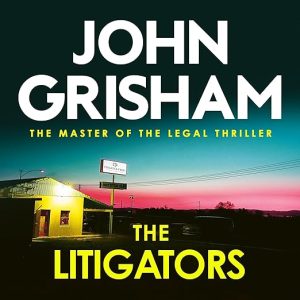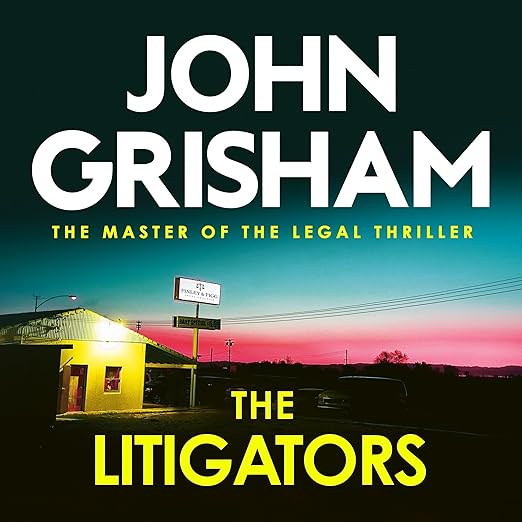
Grisham at his most comedic is still Grisham under pressure, and The Litigators is a reminder that the legal thriller can carry genuine humor without losing its teeth. This audiobook clocks in at just over 11 hours, which is tight for a Grisham novel, and that compression suits the material. The premise is almost farcical: David Zinc, a Harvard-trained corporate lawyer grinding himself to exhaustion at a high-end firm, snaps one morning and stumbles into the offices of Finley and Figg, a two-man Chicago outfit that files no-fault divorces and chases ambulances for a living. What follows is a collision between institutional law and street law that Grisham uses to expose the absurdity of both, and Dennis Boutsikaris narrates with precisely the deadpan quality the material requires.
Boutsikaris has narrated Grisham before, and the familiarity shows in how comfortably he inhabits the legal register without making it feel like performance. His version of David Zinc is a man whose professional identity has been constructed for him by institutions that have now used him up, and the slow recalibration of that identity across 11 hours is the emotional engine of the novel. Grisham's prose in this book is drier and more sardonic than in his earlier thrillers, and Boutsikaris reads it with exactly the right register: not playing for laughs, but never letting the comedy land flat either.
First, the Big Picture
What distinguishes The Litigators from the weightier entries in Grisham's catalog is that it knows it is partly a comedy of manners. Oscar Finley and Wally Figg are not heroes. They are opportunists whose ambition perpetually exceeds their competence, and Grisham watches them improvise with a kind of affectionate contempt that is different from his usual moral architecture. These are characters who would be villains in a more earnest legal novel, but here they are the protagonists because the novel understands that the legal system's dysfunction runs deeper than individual bad actors.
The Big Pharma angle, with Finley and Figg stumbling into a class action involving a defective drug that is well beyond their experience, gives the novel its structural spine. Reviewer Mr. August observed that Grisham fashioned a two-man office and then added a Harvard grad making it three, which neatly captures how the book functions: as an examination of what happens when street law meets institutional power, with all the attendant gaps in competence and expectation. David Zinc functions as the audience's entry point, his disorientation calibrated to keep the comedy grounded in genuine stakes. He has skills. He just has no idea how to deploy them in a world that does not run on the rules he was trained for.
The Best Parts of The Litigators
The audiobook format suits this novel particularly well because Boutsikaris's timing is a genuine asset. The verbal sparring between Finley and Figg, the client interactions that range from pitiable to absurd, and Zinc's growing awareness that he has traded one kind of dysfunction for another all require a narrator who can modulate comic and dramatic registers without announcing the shift. Boutsikaris does this consistently. Reviewer Renee Sheehan noted that the characters' flaws make them relatable and made her want to cheer for them, which is the particular skill Grisham brings to this material: making underdogs out of people who are not entirely sympathetic and making you want them to win anyway.
At 11 hours and 32 minutes, this sits comfortably in the range where audiobook listeners can finish it across a long weekend without feeling they have signed up for a project. The plot does not require intensive tracking of multiple timelines or dense legal procedures. It rewards more passive engagement in a way that Grisham's more procedurally demanding novels do not. Reviewer Amazon Customer admitted to staying up far too late listening, which suggests the pacing is real regardless of the lighter tone.
A Few Reservations
Readers coming to this directly from Grisham's more serious thrillers, the ones where everything converges on a moral reckoning of genuine weight, may find the lighter tone initially unsatisfying. The pharmaceutical antagonist is a structural villain more than a fully rendered one, and the resolution lands somewhere between comic and conventional. The emotional stakes are gentler here than in The Firm or A Time to Kill, which is not a flaw if you approach the novel correctly but does affect the gravity of the finale.
There is also the question of whether the satirical ambition fully follows through. The novel sets up Finley and Figg's dysfunction so effectively that the Big Pharma pivot risks turning them into heroes by default rather than by genuine transformation. Grisham partly sidesteps this by keeping the comedy in play through the final act, but listeners who were hoping for a sharper accounting of what these characters actually deserve may feel the ending is more expedient than honest.
Who Should Listen to The Litigators
This audiobook works best for Grisham readers who want something brisker and more irreverent than his weightiest novels, or for listeners new to legal fiction who want an accessible entry point into the genre. The combination of Grisham's structural skill and Boutsikaris's narration makes it consistently listenable, and the ambulance-chasing premise gives it a satirical edge that distinguishes it from more earnest legal thrillers. Skip it if you want Grisham at maximum moral seriousness. Reach for it when you want a legal novel that allows itself to be genuinely funny while keeping its plot mechanics in good working order.
Before You Listen
Does the audiobook of The Litigators work if you haven't read other Grisham novels?
Completely. The Litigators is a standalone novel with no continuity requirements. David Zinc is a new character, the Finley and Figg firm is self-contained, and Grisham provides all the context you need within the first hour of listening.
Is Dennis Boutsikaris's narration of The Litigators a good fit for Grisham's comedic tone here?
It is an excellent fit. Boutsikaris keeps the comedy grounded without playing it too broadly, handling Grisham's satirical take on street lawyers and their overmatched ambition with consistent timing. His version of David Zinc's slow-building bewilderment is one of the audiobook's real strengths.
At just over 11 hours, is The Litigators audiobook the right length for the story?
Yes. Grisham keeps the plot tight enough that 11 hours never drags, and the compression suits the comedy. It is a comfortable long-weekend listen, and the format rewards the kind of sustained listening that lets the comedy and the legal mechanics build their own rhythm together.