Quick Take
- Narration: Sean Barrett is one of the most respected audiobook narrators in the UK tradition, and his voice gives Thomas Cale’s story an authority and menace the material earns; this is a production that benefits significantly from the audio format.
- Themes: Religious extremism and its human cost, violence as survival mechanism, the corrupting weight of prophecy
- Mood: Dark and relentless, with flashes of sardonic wit that make the brutality bearable
- Verdict: A distinctive debut that makes sharp use of alternate history and religious critique, though the abrupt ending may leave listeners immediately wanting the next volume.
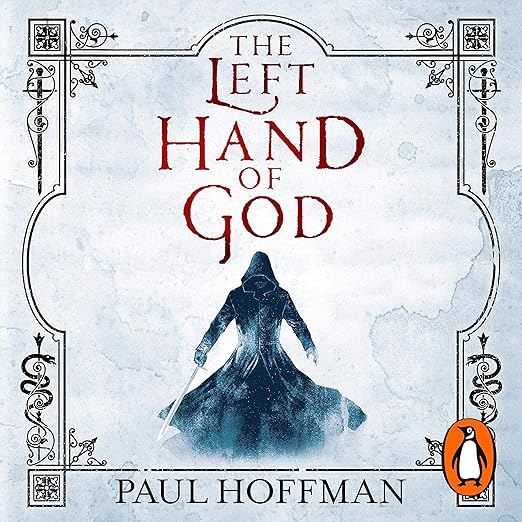
I picked up The Left Hand of God after a friend described it as the book she recommended to people who said they wanted something that felt like Philip Pullman but darker. That description is both accurate and incomplete, and understanding where it falls short tells you something important about what Paul Hoffman is doing. I listened through the last third on a Saturday afternoon when the light was already going by three o’clock, which was the appropriate atmosphere.
The Sanctuary of the Redeemers is an institution that is, as Hoffman’s first sentence makes clear, named after a lie. There is no redemption happening there and less sanctuary. It is a place of systematic violence, isolation, and indoctrination, run by the Lord Redeemers in the service of the One True Faith. Thomas Cale has grown up inside it. He is perhaps fourteen or fifteen years old. He opens the wrong door at the wrong time and witnesses something that makes leaving not a choice but a necessity. What he carries with him when he escapes to Memphis is both the obvious secret and a much more terrifying one he does not know he has.
What Hoffman Is Actually Building
The comparisons to Pullman’s His Dark Materials and Umberto Eco’s The Name of the Rose are printed on the cover and they are not wrong, but they risk obscuring what makes the Left Hand of God trilogy its own thing. Hoffman is constructing a secondary world that maps onto something recognizably medieval European, but with a religious orthodoxy that bears deliberate resemblance to no single tradition and pointed resemblance to several. The Redeemers are not a simple allegory for the Catholic Church or for any other specific institution. They are an argument about what religious extremism does to the people it forms, and Cale is the central evidence for that argument.
One reviewer describes loving novels that take the evil in religion and make that the religion. That captures the book’s basic provocation without quite capturing its ambition. Hoffman is not simply making the Redeemers villains. He is showing how people who have been formed by the Redeemers, including Cale, carry that formation with them even when they escape it. Cale’s violence, his social inability, his instinctive responses to threat, are all products of the Sanctuary. He cannot leave those behind even when he leaves the place.
The Mixed Critical Responses and What They Reveal
The reviews for The Left Hand of God are unusually candid about divergent experiences of the same text, and that candor is itself revealing. One reviewer calls it terrible in terms of writing while simultaneously admitting they want to know what happens next. Another describes the writing as requiring work on the reader’s part while still recommending it. A third gives it five stars and describes a cult classic.
These responses are pointing at the same quality from different angles. Hoffman’s prose is not conventionally polished. It is direct, sometimes abrupt, occasionally jarring in its tonal shifts between the brutal and the sardonic. The world-building is deep enough to reward careful attention but is not handed to you in organized exposition. Readers who need their fantasy fiction to meet certain formal standards of literary craft will find it resistant. Readers who are willing to meet an unconventional text on its own terms will find the texture of the writing eventually becomes part of what makes the book feel distinct from the genre mainstream.
Sean Barrett and Thomas Cale
Sean Barrett is among the most experienced and distinguished narrators in the British audiobook tradition. His reading of The Left Hand of God is one of those performances that justifies the audiobook format as an independent artistic object rather than a substitute for print. Cale’s voice in Barrett’s hands has the right combination of youth, suppressed violence, and dark wit. The Redeemers sound institutional and cold. Memphis, the city of breathtaking beauty and infinite godlessness, shifts the vocal register to something lighter and more uncertain, which mirrors Cale’s own disorientation at encountering a world that operates by different rules than the one that formed him.
At just over twelve hours, the pacing Barrett establishes draws out the atmosphere of the Sanctuary and the subsequent flight without losing the urgency of the plot. The book’s abrupt ending, which multiple reviewers note, arrives suddenly enough that Barrett’s delivery cannot fully prepare you for it. But that quality belongs to the text rather than the narration.
Series Commitment and the Abrupt Ending
The Left Hand of God ends in a way that functions as a setup for the second volume rather than a self-contained conclusion. Multiple reviewers flag this, with reactions ranging from frustration to immediate interest in continuing. For listeners who prefer their audiobooks to resolve their central conflicts within a single volume, this is a genuine limitation. For those who are comfortable committing to a trilogy, the ending will simply push you directly to the next book, which is presumably what Hoffman intended.
Frequently Asked Questions
Is The Left Hand of God appropriate for younger listeners given its YA classification?
The book is shelved as young adult, but its content is considerably darker than typical YA. The Sanctuary sections depict systematic violence, psychological abuse, and institutional cruelty in frank terms. The religious critique is pointed and will be uncomfortable for some readers. Mature teenage readers can handle it, but it should not be assumed safe for younger audiences based on the YA label alone.
Does the book require familiarity with either Philip Pullman or Umberto Eco to follow?
No. The comparisons on the cover are marketing analogies rather than prerequisites. The Left Hand of God builds its own world with its own rules, and prior familiarity with either His Dark Materials or The Name of the Rose is not required to follow the plot or engage with Hoffman’s arguments about religion and violence.
How does The Left Hand of God end and should listeners be prepared to continue immediately with the series?
The ending is deliberately abrupt and functions as a setup for the second volume rather than a resolution of the central conflicts. Multiple reviewers describe starting the sequel immediately after finishing this one. If you prefer standalone audiobooks with complete narrative arcs, this series structure will be frustrating. If you are comfortable with serialized storytelling, the ending will feel like a reasonable cliffhanger.
What makes Sean Barrett’s narration particularly suited to this material?
Barrett’s experience in the British audiobook tradition gives him the range to handle Hoffman’s tonal shifts between institutional coldness, dark humor, and action sequences without losing the thread of Cale’s specific character voice. His reading gives the Sanctuary a weight and menace that reinforces the horror of what formed Cale, while allowing the Memphis sections to breathe differently.