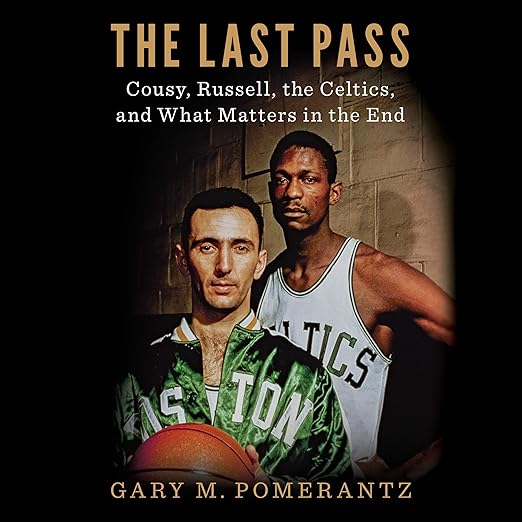
Quick Take
- Narration: Gary Pomerantz narrates his own book, and his intimate familiarity with Cousy gives the performance a warmth that a third-party narrator could not replicate.
- Themes: Racial guilt and late-life reckoning, the mythology of sports dynasties, legacy and what it costs
- Mood: Reflective and elegiac, with a quiet urgency
- Verdict: A sports biography that earns its place alongside serious American racial history, not merely the sports shelf.
I have been reading sports biographies long enough to recognize the difference between a book that uses a sport as a frame for something larger and a book that thinks the sport is the story. Gary Pomerantz’s The Last Pass belongs firmly in the first category. I listened to it on a series of early morning walks over the course of a week, and I found myself returning each day with something close to eagerness, not for the basketball, though the basketball is rendered beautifully, but for the larger human question at the book’s center: what do we owe the people we failed to defend when it mattered?
Bob Cousy is ninety years old when Pomerantz’s account begins, and he has one remaining piece of unfinished business. His partnership with Bill Russell on the Boston Celtics produced six championships and established the dynasty that would eventually become the most decorated franchise in American professional sports. By the standards of that era’s white sportswriters, it was Cousy’s team. But as the civil rights movement found its footing and Russell became publicly involved in it, absorbing ugly repercussions in a city with a fraught racial history, Cousy stood at a distance he now finds unforgivable in himself.
Our Take on The Last Pass
What distinguishes this book from conventional sports biography is Pomerantz’s refusal to let Cousy entirely off the hook. The portrait of Cousy that emerges is genuinely complex: a man of unusual generosity and imagination who was also capable of the ordinary moral failures of his time and class. The self-blame Cousy carries into his eighties is neither performed nor resolved neatly. Pomerantz sits with it, and the reader sits with it, and the result is a meditation on legacy that feels earned rather than manufactured.
Pomerantz narrates his own book, which is the right call here. His voice carries the weight of his long relationship with Cousy, the years of interviews, the proximity to a man reflecting on his own life at its end. The narration is unhurried and thoughtful, occasionally allowing itself small emotional textures that a strictly neutral narrator would flatten. Reviewers consistently describe the listening experience as absorbing rather than merely informative.
Why Listen to The Last Pass
The historical canvas Pomerantz works with is enormous. The Celtics dynasty is placed against the full arc of American life in the 1950s and 1960s: the emergence of the modern NBA, the civil rights movement, the ugly particulars of racial tension in Boston, and the ways sports both mirrored and occasionally challenged the wider society. Wilt Chamberlain’s arrival and the Celtics-Lakers rivalry are rendered with the attention they deserve, and Coach Red Auerbach is drawn with affectionate precision as a figure simultaneously charming and morally limited.
But the book earns its deepest resonance in the Cousy-Russell relationship, or rather in its absence. These two men were basketball’s Ruth and Gehrig, as Pomerantz writes, and yet they were never intimate. Cousy is trying, at ninety, to understand what he could have done differently and whether it is too late to say so. That question, genuinely simple and genuinely unanswerable, gives the book an emotional gravity that transcends its sports context.
What to Watch For in The Last Pass
Listeners expecting a fast-paced sports narrative will need to adjust their expectations. The book moves at the pace of a life reflected upon, and its pleasures are cumulative rather than immediate. Some reviewers who came looking primarily for basketball history found themselves surprised by how much of the book is about race, guilt, and the passage of time. That is not a flaw, but it is a fair thing to know in advance.
The Cousy-centric framing also means Russell is always seen at some remove. Pomerantz is honest about this limitation. Russell’s interiority is not fully available to him, and he does not pretend otherwise. The result is a book that is ultimately Cousy’s testament, seen through Pomerantz’s eyes, and Russell remains a somewhat oblique presence despite being central to the moral stakes.
Who Should Listen to The Last Pass
Readers interested in the intersection of sports history and American racial history will find this essential. Fans of the early NBA era who want the Celtics dynasty placed in full social context will be well served. Listeners who enjoyed books like Taylor Branch’s civil rights trilogy will find Pomerantz working in a related register, even if at a different scale. Pure basketball fans who have no patience for the wider frame may want to manage their expectations.
Frequently Asked Questions
Do you need to know anything about 1950s and 1960s basketball to appreciate this book?
No. Pomerantz provides enough context for listeners without prior knowledge of the era. The basketball serves the larger human story rather than requiring specialist knowledge to follow.
Does the book address Russell’s perspective directly, or is it told from Cousy’s point of view?
The book is primarily Cousy’s story as told through Pomerantz’s extended interviews with him. Russell’s perspective is present but indirect. Pomerantz is transparent about this limitation.
Gary Pomerantz narrates his own book. Is this effective for a listener who has not read the print version?
Yes, and arguably the self-narration adds something the print version cannot replicate. Pomerantz’s voice carries the intimacy of his relationship with Cousy and the weight of the material’s emotional stakes.
Bob Cousy was awarded the Presidential Medal of Freedom in 2019. Does the audiobook mention this?
The audiobook was released in October 2018. The Medal of Freedom was awarded in August 2019 and postdates the recording. Listeners who want the full arc of Cousy’s public recognition will need to look beyond the audiobook itself.