Quick Take
- Narration: Mia Hutchinson-Shaw handles Sloan’s fractured perspective with conviction, threading the line between sympathy and unreliability without tipping either way too early.
- Themes: Trauma bonding, gaslighting, cult psychology, queer identity under duress
- Mood: Tense and claustrophobic, with a lurching third-act pivot
- Verdict: A queer YA thriller with a genuinely unsettling premise, though listeners who need clean answers will find the pacing tests their patience.
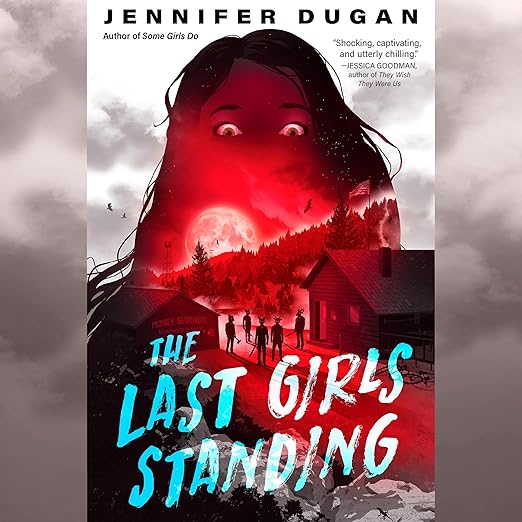
I was about three hours into The Last Girls Standing on a foggy Tuesday morning when I paused the playback and just sat with what I had heard. Jennifer Dugan had set up something genuinely disquieting: two young women, sole survivors of a summer camp massacre involving masked attackers with machetes and what appears to be a ritual element, now inseparable and mutually dependent in a way that starts to look less like love and more like a shared wound that neither of them can let heal. The premise is strong. What Dugan does with it is more complicated.
The central relationship between Sloan and Cherry is the engine of the story. They met days before the attack, bonded through survival, and are now so entangled that Sloan cannot clearly distinguish her own perceptions from what Cherry tells her to believe. When new evidence suggests Cherry may have been more than a fellow victim, the novel pivots into the terrain that its promotional blurbs promise: gaslighting, sanity slippage, and the specific horror of suspecting that the person keeping you together might be the one who has been pulling you apart.
Our Take on The Last Girls Standing
Dugan is a genuinely skilled writer of YA romance, and her previous work including Some Girls Do demonstrates a real facility for queer emotional dynamics. Here she is working in thriller territory, and the seams show in places. The novel’s middle section is long on suspicion and short on revelation, Sloan suspects Cherry, then doubts herself, then suspects again, across enough pages that a reviewer who called it a hundred pages too long has a point worth taking seriously. The cult subplot, which the synopsis gestures at through the phrase ritual killing, is handled with more restraint than horror readers might hope for. The book earns its 3.7 average rating through inconsistency rather than failure: what it does well, particularly the opening and the final quarter, it does with real menace. What it does poorly, the extended middle spiral of suspicion without escalation, it does at length.
Why Listen to The Last Girls Standing in Audio
Mia Hutchinson-Shaw’s performance is the clearest argument for the audio format. Sloan is a narrator with a fractured relationship to her own memory and judgment, and Hutchinson-Shaw calibrates her voice to reflect that, the hesitations feel real rather than performed, the moments of doubt read as genuine cognitive struggle. In a thriller built around an unreliable narrator, the narrator’s voice is doing structural work, and Hutchinson-Shaw understands that responsibility. The claustrophobia of Sloan’s point of view, the way the whole world compresses to Cherry, Cherry, Cherry, is more effectively conveyed in audio than it would be in print, where the reader can take their eyes off the page. Listening does not allow that distance, which suits the material.
What to Watch For in the Third Act
Without significant spoilers: the ending is divisive, and reviewers are almost evenly split between those who found it genuinely shocking and those who felt it strained the novel’s internal logic. A reviewer who said this is not exactly what I thought it would be, and it was so much better reflects one valid response. The reviewer who said they wanted to love this but couldn’t get past the structural looseness of the middle reflects another. Both are right about different parts of the same book. Listeners who are drawn in by the queer representation, which is handled thoughtfully and is not incidental to the plot, and who can tolerate ambiguity in their thrillers will likely land on the positive side of that split.
Who Should Listen to The Last Girls Standing
Recommended for YA thriller readers who want LGBTQ+ protagonists in genuinely dark situations, and for listeners who find the unreliable narrator device compelling when it is executed with atmosphere. Skip it if you need your mysteries resolved cleanly and your pacing tight throughout. This one asks for patience in the middle and rewards it, but not always in proportion to the time invested.
Frequently Asked Questions
Is the LGBTQ+ content integral to the story or does it feel incidental?
It is genuinely integral. Sloan and Cherry’s relationship is the structural and emotional center of the thriller. The fact that they are both young women in a queer relationship affects how they are perceived by others and how their bond is read, by them, by the people around them, and by the reader.
How graphic is the violence, given the summer camp massacre premise?
Less graphic than the premise suggests. The massacre itself is not depicted in real time, we enter the story in its aftermath, with Sloan reconstructing events through fragmented memory. The horror is psychological rather than visceral.
Does Mia Hutchinson-Shaw differentiate between Sloan’s rational and dissociated states in the narration?
Yes, and this is one of the stronger elements of the production. She uses subtle shifts in pace and steadiness to signal when Sloan is lucid versus spiraling, which helps listeners track a narrative that is deliberately difficult to read clearly.
Is this a good entry point for Jennifer Dugan’s work, or should I start with Some Girls Do?
Some Girls Do is a more polished introduction to Dugan’s voice because it works within a genre she handles more fluently. The Last Girls Standing is worth listening to, but it is a riskier starting point given its uneven pacing.