Quick Take
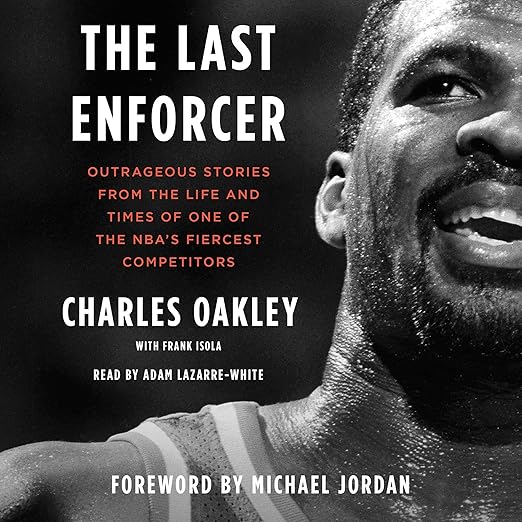
- Narration: Adam Lazarre-White brings Oakley’s street-level directness to life with a cadence that feels like the man himself, no polish, all conviction.
- Themes: Physical loyalty, NBA era nostalgia, identity outside the stat sheet
- Mood: Loose, funny, and occasionally raw
- Verdict: One of the most honest accounts of what it actually felt like to play in the physical NBA of the 1990s, told by someone who was at the center of all of it.
I listened to most of this during a long drive through a stretch of flat highway where there was nothing to look at, which turned out to be exactly right. Charles Oakley doesn’t ask you to sit still and take notes. He talks at you the way a guy talks when he’s been carrying these stories for thirty years and finally has permission to let them out. I was halfway through the chapter on Michael Jordan before I realized I hadn’t thought about where I was going in forty minutes.
Adam Lazarre-White is the right choice to narrate this. He has the range to handle Oakley’s shifts between locker room humor and genuine heat without losing the thread, and he never lets the delivery feel performed. This is a book with a strong voice baked into the writing, and Lazarre-White’s job is essentially to stay out of its way while giving it rhythm. He does that well. The result has the texture of a long, unguarded conversation rather than a polished memoir.
Our Take on The Last Enforcer
Oakley’s premise is simple: he was not a statistically dominant player, but he was at the center of more significant moments in NBA history than anyone who looks at a box score would ever suspect. The synopsis compares him to Forrest Gump, which is playful but not entirely wrong. He played alongside Michael Jordan during the championship years, was close enough to James Dolan to eventually have one of the most public arena confrontations in recent NBA memory, and he crossed paths with figures ranging from Pat Riley to Donald Trump. What gives the book its texture is that Oakley doesn’t reframe these encounters to make himself look consistently heroic. He tells you what he saw, what he did, and occasionally what he regrets. That willingness to stay close to the unvarnished version is rare in athlete memoirs.
Why Listen to The Last Enforcer
The 1990s NBA occupies a particular place in collective sports memory: an era of physical play, genuine animosity between teams, and a cultural intensity that the modern game has moved away from. Oakley was the embodiment of that era’s values in a way that is difficult to communicate through highlights alone. Reading about it tells you the facts. Listening to Oakley tell you what it smelled like in the paint, what Jordan said before games, and how loyalty was actually practiced rather than just talked about, that is a different kind of understanding. Several reviewers note that the book made them laugh out loud, and that is accurate. Oakley’s comic timing is genuine, and Lazarre-White knows when to let a line breathe. One reviewer from the New York Knicks community described how different the team felt to the city when Oakley was part of it, and the book captures why that was true.
What to Watch For in The Last Enforcer
The book’s structure is relatively episodic rather than strictly chronological, which suits Oakley’s storytelling style but can occasionally feel like it skips over context. Listeners who came to the NBA after Oakley’s playing days may want to keep a loose mental timeline of his career, he moved from the Bulls to the Knicks early in his career, and a fair amount of the material is anchored to those two franchises. His analysis of the modern NBA, which comes toward the end of the book, is pointed and occasionally provocative. He is not diplomatic about the changes he sees, and some of those observations will land differently depending on your own loyalties. The stories touching on his relationship with George Floyd are handled with care and add unexpected emotional weight to a book that is largely funny and combative.
Who Should Listen to The Last Enforcer
Basketball fans who remember the 1990s will find this essential. Anyone who ever watched Oakley and wondered what was actually going on behind those elbows and that expression will find the answers here, or at least Oakley’s version of them. This also works for readers interested in sports memoir more broadly who appreciate unfiltered accounts over carefully managed public images. It is less useful if you are primarily interested in strategic basketball analysis or championship breakdowns, this is a personality memoir, not a tactical one. At under ten hours, it is also one of the more manageable listens in the genre.
Frequently Asked Questions
Do you need to be a Knicks fan to enjoy this, or does it cover Oakley’s whole career?
The book covers his full nineteen-year career, including his time with the Bulls alongside Michael Jordan. The Knicks years get substantial focus, but non-Knicks fans will find plenty to engage with throughout.
How does Adam Lazarre-White handle the tonal range of the material?
Very well. He matches Oakley’s natural directness without over-performing it, and he manages the shifts between humor and genuine emotion convincingly. The narration feels consistent with the personality expressed in the writing.
Is this appropriate for younger listeners who may not know much about the 1990s NBA?
The language and some content is adult in nature. Listeners unfamiliar with that era of basketball will still enjoy it but may benefit from some background on the key players and franchises Oakley mentions.
Does the book address Oakley’s 2017 Madison Square Garden incident with James Dolan?
Yes, Oakley discusses his relationship with Dolan and the arena incident, offering his unfiltered perspective on the conflict and what he believes it represented.