Quick Take
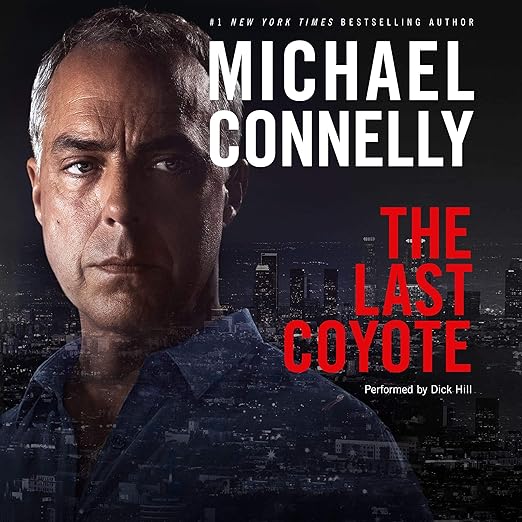
- Narration: Dick Hill’s graveled, deliberate delivery suits Harry Bosch’s internal monologue and the slow accumulation of a cold-case investigation.
- Themes: Personal obsession, institutional corruption, the weight of unresolved grief
- Mood: Dark and methodical, with the specific tension of a man operating without a safety net
- Verdict: The most emotionally exposed Harry Bosch novel Connelly had written up to that point – and the one that explains everything that came before.
There is a particular category of crime fiction that operates as excavation rather than puzzle – where the detective is not assembling facts toward a satisfying solution so much as digging toward something buried inside themselves. The Last Coyote is that kind of novel, and it is the most nakedly personal entry in the Harry Bosch series to the point where the investigation and the protagonist are essentially the same subject. I listened to it on a long drive through the kind of flat, grey landscape that suited the material, and by the time I was home I understood Bosch in a way I hadn’t after the first three books.
Michael Connelly sets up a situation that forces Bosch into exactly the vulnerability he spends his life avoiding. Suspended from the LAPD after attacking his commanding officer. Home condemned by earthquake damage. Girlfriend gone. No shield. No structure. Nothing to do but sit with a department-mandated psychiatrist and be told to talk about his feelings – which is, of course, the last thing Harry Bosch is going to do voluntarily. Into this enforced emptiness, he pulls the one case he has never been able to let go: the 1961 murder of his mother, a prostitute, which has remained officially unsolved for thirty years.
Our Take on The Last Coyote
What Connelly does brilliantly here is refuse to separate the personal from the procedural. The investigation into Marjorie Lowe’s murder is also an investigation into why Harry Bosch became who he is, what it cost him, and whether a man defined entirely by his dedication to “everybody counts, or nobody counts” can actually follow that philosophy when the victim is the woman he never got to grieve properly. One reviewer cited that motto – and the way Bosch applies it with particular urgency when the victim is someone of low social status – as the thematic center of the novel. That is exactly right. The murder of a prostitute in 1961 is the kind of case that would disappear from institutional memory without someone who refused to accept that some deaths count less than others.
The political dimension of the investigation, in which Harry’s questions begin generating heat among Los Angeles power brokers decades after the fact, is classic Connelly: the notion that the city’s surface glamour has always been built on arrangements that cannot survive examination. The “someone very powerful” the synopsis gestures at is handled with restraint – Connelly never tips into cartoonish villainy, preferring instead the more disturbing reality of ordinary people who make self-serving decisions and then spend decades protecting them.
Why Listen to The Last Coyote
Dick Hill has been the voice of Harry Bosch long enough that the character and the narration have become genuinely inseparable. His version of Bosch is not glamorous or witty – it is tired and relentless, a man who keeps going because he does not know what else to do. That quality, which Hill conveys through cadence and a kind of controlled exhaustion in his voice, is the right register for a novel about compulsive pursuit. The cold-case structure, with its research montages and interview scenes rather than active-threat sequences, gives Hill’s quieter, more internal performance room to work. He handles the psychiatric session scenes, which could easily become awkward in audio format, with enough care that they function as character revelation rather than therapeutic boilerplate.
At thirteen hours and twenty-six minutes, this is a substantial listen, but the pacing rarely feels slow. Connelly’s plotting is architecturally sound – the twists and misdirections one reviewer noted are present, and they feel earned rather than arbitrary because the novel has established a clear set of stakes: not just who killed Marjorie Lowe, but whether her son can survive knowing.
What to Watch For in The Last Coyote
This is Book 4 in the Harry Bosch series, and while Connelly writes each novel to function independently, The Last Coyote benefits significantly from having read the earlier entries. The weight of Bosch’s previous cases, his history with the LAPD, and the texture of his self-destructive tendencies all carry more resonance if you’ve watched them develop. New readers will follow the investigation without difficulty but may miss some of the emotional depth that series readers bring to Bosch’s predicament.
The Los Angeles of 1961 that Connelly reconstructs through records, interviews, and institutional memory has a period atmosphere that some listeners will find absorbing and others may find slows the present-day investigation. The dual timeline is not a formal structural device here – it is rendered through what Harry uncovers rather than through explicit chapters – but the past does occupy substantial narrative space.
Who Should Listen to The Last Coyote
Essential listening for Harry Bosch series followers. For crime fiction enthusiasts who haven’t yet encountered Connelly’s work, it is worth starting at Book 1 and building to this one – the payoff is considerably larger with context. Listeners who appreciate psychological depth in crime fiction, particularly novels that treat the detective’s inner life as seriously as the external case, will find this among the stronger examples the genre offers. Dick Hill’s narration is reason enough to choose audio for Bosch purists, and this is the installment where his performance most fully earns its place.
Frequently Asked Questions
Can I start the Harry Bosch series with The Last Coyote, or should I read earlier books first?
The novel is technically followable as a standalone, but it functions as a culmination of Bosch’s character development across the first three books. Starting from Book 1 significantly deepens the emotional resonance of everything Harry discovers here.
How does the mandatory psychiatric evaluation subplot work in the story – is it handled realistically?
Connelly uses the psychiatric sessions as a way to surface Bosch’s backstory without resorting to pure flashback. The sessions are tense rather than therapeutic – Harry resists them – and they function as a structural device for character excavation rather than as a realistic portrait of LAPD behavioral health protocols.
Is Dick Hill’s narration consistent across the full Harry Bosch series, or does it vary significantly between entries?
Hill is the established voice across the early Bosch novels and maintains a consistent characterization. His performance in The Last Coyote, which requires more interior emotional work than the action-heavier entries, is widely regarded as among his best in the series.
How does the 1961 setting and period research affect the pacing of the present-day investigation?
The historical reconstruction occupies significant narrative space and does affect pacing. Listeners who enjoy period detail and procedural archival research will find it engaging; those who prefer contemporary thriller momentum may find the historical passages slower going.