Quick Take
- Narration: Karissa Vacker captures Claire’s anxiety-brain narration with real authenticity, the internal worst-case-scenario spirals feel lived-in rather than performed.
- Themes: Survival against unknown threat, female friendship under pressure, anxiety and competence
- Mood: Ominous and tightly wound, with a Maine island wilderness that feels genuinely hostile
- Verdict: Sarah Beth Durst delivers a lean, effective survival thriller with three distinct protagonists and enough atmospheric dread to justify the Yellowjackets comparison.
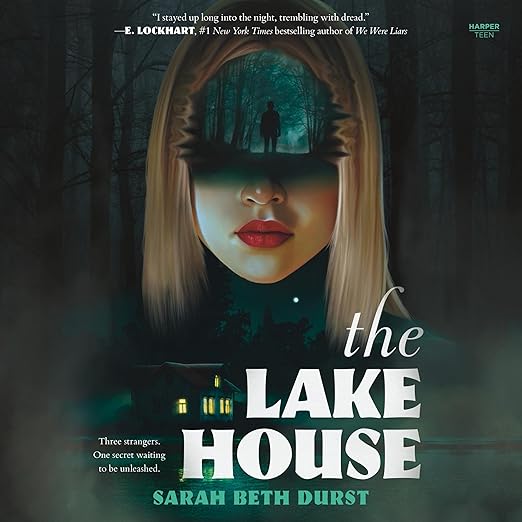
I came to The Lake House on a recommendation from a colleague who described it as the kind of book you listen to in one sitting even when you know you should stop for the night. She was not wrong. There is something about the premise, three girls, a burned-out camp, a Maine island with no way off, and something in the woods, that bypasses intellectual resistance and goes straight for the nervous system.
Sarah Beth Durst, a New York Times bestselling author with a long track record in fantasy, makes a notable genre shift here into survival thriller territory, and the transition suits her strengths. Her world-building instincts, honed across fantasy novels, translate into an exceptionally well-realized sense of place. The island feels large and indifferent. The forest feels like a space with its own rules. The burned lodge establishes from the first minutes of listening that no one is coming to help.
Our Take on The Lake House
The three-protagonist structure is the book’s most significant achievement. Claire, Reyva, and Mariana are genuinely distinct characters rather than variations on a type. Claire is the anxiety-prone introvert, triple-checking locks, running worst-case scenarios before every decision. Reyva and Mariana bring different skills and temperaments that the plot actually uses. This is not a setup where one character obviously dominates while the others provide color.
The Yellowjackets comparison in the marketing is apt in atmosphere if not in scope. This is a YA novel, so the darkness is calibrated accordingly, but Durst does not sanitize the threat. The dead body the girls discover early in the narrative is handled with appropriate weight. The sense that the island is actively working against their survival builds steadily through the middle sections of the book.
Why Listen to The Lake House
Karissa Vacker’s narration is well-matched to Claire’s voice. The anxiety-brain interior monologue, the lists, the probability calculations, the endless second-guessing, could easily become exhausting in lesser hands, but Vacker finds the rhythm of Claire’s thinking and makes it feel like character rather than tic. The moments when Claire’s competence breaks through her fear are more satisfying for the patience Vacker invests in the anxious passages that precede them.
The book has accumulated a range of responses from readers, a 3.8 average from 161 ratings, which for a YA survival thriller suggests it lands differently depending on reader expectations. Those who came looking for a contemplative character study were sometimes frustrated by what they read as convenient survival solutions. Those who came for atmosphere and a tight three-girl dynamic found exactly what they wanted. The audio format, with Vacker’s consistent characterization, arguably benefits the latter experience.
What to Watch For in The Lake House
Claire’s anxiety is not simply a personality trait, it is the book’s central argument about preparation versus helplessness. Pay attention to how the narrative positions her worst-case-scenario thinking as both a liability and an unexpected asset. Some readers found her anxiety episodes too dramatic, and there is a version of that criticism that holds. But the book is also genuinely interested in the idea that the person who has already imagined every terrible outcome is, in some ways, better prepared for a survival situation than someone who has not.
The reveal of what is actually hunting them is handled with deliberate restraint. Durst delays the full picture long enough that the ominous atmosphere does most of the work. When the explanation arrives, some listeners may find it less satisfying than the dread that precedes it, a common tension in horror-adjacent fiction.
Who Should Listen to The Lake House
Ideal for listeners who enjoy survival fiction with strong female ensemble casts and would rather experience dread through atmosphere than explicit violence. Fans of E. Lockhart’s We Were Liars will find some of the same Maine-adjacent unease here. This is not the right choice for listeners who need their survival solutions to feel rigorously plausible, or who find anxiety-brain narration wearing over nine hours. For everyone else: a focused, effective listen with one of the more distinctive female protagonists in recent YA thriller fiction.
Frequently Asked Questions
Is The Lake House appropriate for middle-school-age listeners or does it skew older YA?
It sits at the older end of middle grade and into YA, the horror elements are real and include a dead body, but the content stays within YA parameters. Delta High School Library reviewed it approvingly, suggesting it works for high school audiences comfortably.
How does the audio version handle the three-girl dynamic compared to reading on the page?
Karissa Vacker narrates the entire book in Claire’s first-person voice, so Reyva and Mariana are rendered through Claire’s perceptions. The characterization of all three is clear enough that you never lose track of who is who, even through extended action sequences.
Does the explanation for what is hunting them hold up logically?
It depends on your tolerance for horror logic. The explanation is consistent with the rules the book establishes, but several readers found the reveal less satisfying than the buildup. The book is stronger as an atmosphere piece than as a puzzle-box mystery.
Is this a standalone or part of a series?
Completely standalone. The story resolves fully within this single volume, no sequel hooks or unresolved threads.