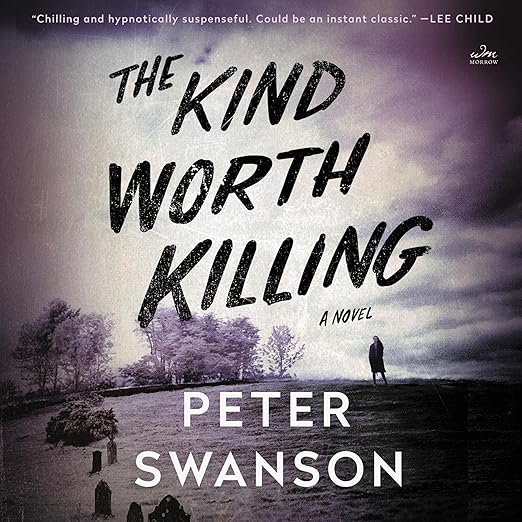
Quick Take
- Narration: Johnny Heller brings reliable thriller-genre competence to the multi-perspective structure – clear and propulsive without particular interpretive flair.
- Themes: Murder as collaboration, unreliable alliances, the predatory underneath the polished
- Mood: Cool and disquieting, with mounting unease
- Verdict: A structurally clever psychological thriller that rewards patient listeners willing to let Swanson withhold information longer than is comfortable.
I started this one on a transatlantic flight, which felt appropriate given that its central relationship begins exactly that way – two strangers sharing too many drinks somewhere above the ocean, confessing things that should stay private. By the time we landed, I was three hours in and had already changed my assessment of the book’s central character twice. Peter Swanson’s particular skill is making you feel confident about where you stand and then quietly moving the ground under your feet.
The Kind Worth Killing is the first book in the Henry Kimball series, published originally in 2015 and reissued in this audiobook edition from William Morrow. It has attracted sustained comparison to Patricia Highsmith – specifically to Strangers on a Train – and to the wave of domestic suspense fiction that followed Gone Girl. The marketing framing is aggressive, with Entertainment Weekly asking whether this might be “the next Gone Girl.” That kind of comparison usually promises too much. In this case, it’s not entirely wrong, but the resemblance is more structural than tonal.
Our Take on The Kind Worth Killing
The premise: Ted Severson, a wealthy but unhappy businessman, meets Lily Kintner on a night flight from London to Boston. Over drinks, their conversation turns confessional. Ted reveals that his wife Miranda is cheating on him with their contractor. When the game turns darker and Ted mentions that he could kill her, Lily responds calmly that she’d like to help. What makes the premise more than a gimmick is what Swanson reveals gradually about Lily’s past – specifically, her history with murder, which extends much further back than this conversation would suggest.
One reviewer calls it a “compelling read of psychological suspense” and praises the character development in terms that suggest the book succeeds on its own terms rather than just relative to its marketing. A more mixed review observes that the pace “feels odd; sometimes rushed but 80% of the time is spent in descriptions” and that a major plot twist was “unexpected but not in the exhilarating way I expected.” Both responses are honest, and both are tracking real features of the book’s structure.
Why Listen to The Kind Worth Killing
The multi-perspective structure is where Swanson earns his reputation. The novel is told in alternating first-person accounts – primarily Ted’s and Lily’s, with additional perspectives introduced as the investigation develops – and the gap between what each narrator reveals and what they’re concealing is where the real narrative lives. This is particularly effective in audio, where the voice shift between chapters gives each perspective a distinct presence and makes the dramatic irony of their contradictions more immediately felt.
Johnny Heller narrates with the kind of brisk, genre-appropriate clarity that serves a thriller well. He doesn’t bring theatrical distinction to the different voices, but he keeps the multi-perspective structure audible and the pacing tight. The audiobook runs just over ten hours, and the material sustains that length without significant padding.
What to Watch For in The Kind Worth Killing
The negative-leaning review in the dataset makes a structural observation worth registering: the first quarter of the book is the most propulsive, and then the pace shifts substantially as Swanson settles into extended backstory and character history. If you expect thriller momentum to build consistently from page one, you will find the middle of this book frustrating. Swanson is more interested in revealing who Lily is through accumulated detail than in maintaining constant external action.
The Gone Girl comparison also sets up a specific expectation – twists that fundamentally reframe what came before – and while The Kind Worth Killing does have significant reveals, their emotional effect is different. This is a colder book than Flynn’s, less interested in domestic dysfunction as a social critique and more interested in the quiet psychology of people who have decided that some people are genuinely worth removing. Whether that premise excites or disturbs you is a reasonable indicator of whether the book will work for you.
Who Should Listen to The Kind Worth Killing
Listeners who enjoy Highsmith’s blend of cool affect and moral inversion will find this immediately hospitable. Fans of domestic suspense who have moved through Flynn and Hawkins and are looking for something with a similar structure but a different emotional register will likely find it satisfying. Lawyers, detectives, and readers interested in the procedural dimension of the plot will appreciate the Henry Kimball character when he arrives.
This is not for listeners who need their thrillers to accelerate continuously. The book asks for patience during its extended backstory sections, and the payoff requires you to sit with uncertainty about who to trust for longer than some genre readers will tolerate comfortably. It is for listeners who think character is what makes a crime story interesting and who find Highsmith’s particular kind of elegant wrongness appealing.
Frequently Asked Questions
Is The Kind Worth Killing the first book in a series, and does it end on a cliffhanger?
Yes, it is the first in the Henry Kimball series. The novel has a complete, self-contained resolution – it is not designed as a cliffhanger leading into the next book. Subsequent books in the series revisit characters and themes, but this entry tells a complete story.
How does Johnny Heller handle the alternating first-person narrators?
Heller distinguishes the perspectives clearly through tonal and pacing shifts rather than dramatically different vocal characterizations. The chapter transitions between Ted’s and Lily’s perspectives are audible without being theatrical. For listeners who find over-performed multi-voice narration distracting, Heller’s approach is a good fit.
The marketing compares this to Gone Girl – how similar is it really?
The structural comparison is fair: both are domestic suspense novels with multiple unreliable narrators and significant mid-book reveals. The tonal comparison is less accurate. Gone Girl is angrier and more socially satirical; The Kind Worth Killing is cooler, more aligned with Highsmith’s moral detachment. Readers who loved Gone Girl’s emotional temperature may find this less satisfying; readers who found Gone Girl too hot may prefer Swanson’s register.
Is this audiobook appropriate for someone who hasn’t read the other Henry Kimball books?
Completely appropriate. The Kind Worth Killing is the series’ origin, and the narrative is designed to stand alone. No prior knowledge of Henry Kimball or any related characters is required. If you enjoy it, subsequent books build on characters introduced here.