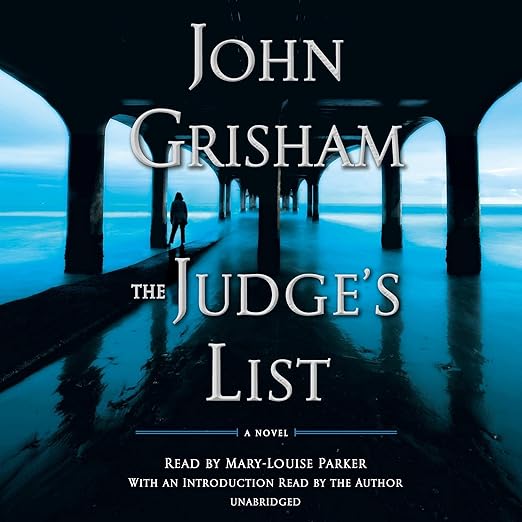
Quick Take
- Narration: Mary-Louise Parker delivers Lacy Stoltz with measured composure and quiet intensity, letting the procedural tension build rather than forcing drama onto every scene.
- Themes: Judicial corruption, obsession and cold-case pursuit, institutional complicity
- Mood: Taut and methodical, with a slow-burn dread that accumulates steadily
- Verdict: A sharply constructed legal thriller that rewards patience, anchored by a protagonist worth following and a villain whose intelligence makes him genuinely frightening.
I started listening to The Judge’s List on a Tuesday evening after a particularly grinding workday, and by Thursday I had cancelled two plans because I could not bring myself to stop. That almost never happens to me with legal thrillers. I grew up reading Grisham, worked through most of his catalog in my twenties, and had settled into a comfortable expectation of what his books would deliver. This one surprised me in ways I did not anticipate.
The setup is deceptively simple: Lacy Stoltz, a senior investigator at Florida’s Board on Judicial Conduct, receives a visit from a woman using multiple aliases. That woman is Jeri Crosby, and she has spent twenty years stalking a man she believes murdered her father. That man is a sitting judge. What follows is not a conventional whodunit. We know almost from the start who the killer is. The tension comes from how Lacy can possibly move against someone with full knowledge of law, forensics, and procedure, someone who, as Grisham writes it, is the most cunning of all serial killers because he has spent a career watching investigators make mistakes.
The Architecture of a Legal Predator
What distinguishes The Judge’s List from standard serial-killer fare is how seriously Grisham takes the villain’s intelligence. This is not a monster who leaves convenient evidence or makes rash emotional decisions. The judge has kept a meticulous list of his victims and potential targets, maintained over decades, with the patience of someone who has no deadline and no fear of suspicion. That psychological portrait is the book’s real achievement. By the time we understand the full scope of what he has done, the horror is not visceral but structural. He has used the system itself as a weapon, and Lacy has to find a way to dismantle him using the same system, without placing herself on his list.
Mary-Louise Parker narrates with a stillness that matches the material perfectly. She does not overplay Lacy’s growing fear; instead she lets it accumulate in the pauses and in the way Lacy approaches each new piece of evidence with increasing care. Parker has an ability to convey thought rather than just speech, which works beautifully for a character whose survival may depend on keeping her conclusions private. When the story requires her to handle moments of genuine menace, she calibrates the temperature shift without resorting to theatrical tricks.
What Jeri Crosby Brings to the Investigation
The relationship between Lacy and Jeri is more interesting than a standard informant setup. Jeri is not a victim seeking institutional protection. She is a woman who has dedicated her adult life to this case, who has conducted her own parallel investigation across state lines, who understands the limits of what Lacy’s office can actually do. That dynamic creates a productive friction. Jeri has evidence that cannot be touched legally. Lacy has authority that requires proper channels. The novel works through how these two very different approaches to justice can be brought into alignment, and what each woman has to sacrifice to make that happen.
Reviewers who know the first Whistler novel will find Lacy more worn in this one. Three years on from a near-fatal attack, she is approaching forty and genuinely uncertain whether her career holds any further meaning. Grisham does not resolve that question cheaply. The personal fatigue gives weight to the professional stakes in a way that the first book did not quite achieve.
Where Grisham Is at His Most Disciplined
At just under twelve hours, the audiobook maintains a pace that rewards attention. Grisham’s plotting is precise here in a way that his more sprawling novels sometimes are not. Each chapter moves something forward. The procedural details about the Board on Judicial Conduct are genuinely interesting rather than dry, because Grisham understands that the institution’s limitations are as important as its powers. Lacy cannot simply call the FBI. She cannot subpoena. Her office operates with specific constraints that the judge has clearly studied, and watching her work within those constraints without tripping the wire is the book’s central pleasure.
There is a structural choice in the final third that some listeners may find frustrating rather than satisfying. I will not detail it, but the resolution involves a kind of leverage that operates outside traditional legal procedure. It is not implausible, and Grisham earns it with careful setup, but it may feel to some readers like a slightly deflating conclusion to a very high-stakes chase. That said, the Wall Street Journal called it one of the best crime reads of the year, and I am not in a position to argue.
Who Should Listen, Who Should Pass
This is the right audiobook if you want a legal thriller that treats its readers as adults, where the mechanics of institutional jurisdiction matter as much as the emotional beats, and where the villain’s intelligence is never cheapened by convenient errors. You do not need to have listened to The Whistler first, though the prior relationship with Lacy enriches the experience considerably. Pass on it if you need your thrillers fast and action-heavy from the first chapter. This one earns its revelations slowly, and the payoff is measured rather than explosive.
Frequently Asked Questions
Do I need to listen to The Whistler before starting The Judge’s List?
You do not strictly need to, but having listened to The Whistler gives you context for Lacy’s emotional state and the attack she survived. The Judge’s List recaps enough to follow the plot on its own, but the prior backstory deepens Lacy’s motivations considerably.
Is Mary-Louise Parker a good fit for Lacy Stoltz as a narrator?
She is an excellent fit. Parker plays Lacy’s careful, deliberate nature with restraint rather than theatrics, and the result is a narration that matches the book’s methodical pacing. Listeners who prefer high-energy performances may want something brisker, but for this character she is well cast.
How graphic is the violence in The Judge’s List?
The violence is present but not graphic. Grisham focuses on the psychological weight of the killings rather than their physical details. The horror is largely implied and procedural, which makes it feel more disturbing than explicit description might.
Is The Judge’s List available as a free audiobook on Audible?
Yes, The Judge’s List is listed at $0.00 on Audible, making it a free audiobook for eligible members through the Audible Plus catalog or with a credit.