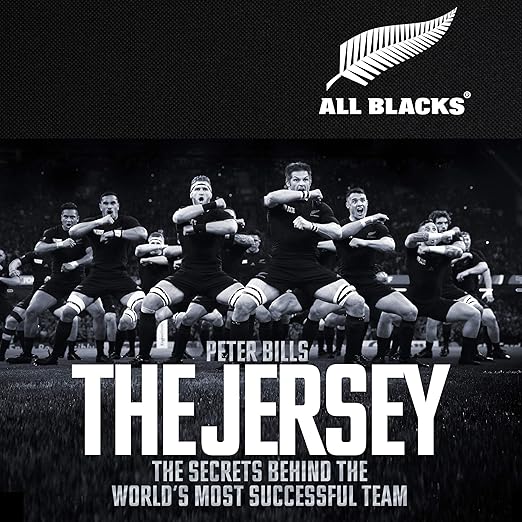
Quick Take
- Narration: Mike Sengelow delivers a steady, clear performance across a 14-hour oral history, managing a large ensemble of voices from the All Blacks’ history without losing the thread.
- Themes: National identity fused to sporting culture, the transmission of legacy across generations, what separates consistent excellence from occasional greatness
- Mood: Authoritative and reverent, with the occasional flash of the candor that comes from ninety-plus exclusive interviews
- Verdict: The most comprehensive account of All Blacks culture and history available in audio, essential for rugby fans and worthwhile for anyone interested in how a small nation builds an enduring institution.
I came to The Jersey knowing enough about the All Blacks to appreciate the question at the center of the book without having spent decades following international rugby. That felt like the right entry point. Peter Bills is asking something genuinely interesting: how does a country of 4.8 million people sustain a winning record across more than a century that no other sports team in history can match? The answer, as Bills discovers across ninety-plus interviews with figures from Richie McCaw to the late Sir Colin Meads, is not a simple one, and this audiobook does not offer a simple answer. What it offers instead is an accumulation of testimony, perspective, and historical detail that, by the end of fourteen hours, begins to sketch something true.
Bills spent decades reporting on international rugby before being given the exclusive access that produced this book. The interviews span generations and roles: players, coaches, officials, supporters, and those who have worn the jersey itself. Steve Hansen and Beauden Barrett contribute. Dan Carter, whose influence on the modern game is difficult to overstate, speaks at length. The breadth of the access is unusual enough to be genuinely meaningful, and Bills uses it well.
Our Take on The Jersey
The book’s greatest strength is its scope. Bills is not interested solely in match recaps or tactical analysis; he is investigating culture, identity, and the relationship between a rugby team and the nation that produced it. The story of the original Originals, the 1905 touring side that effectively established the All Blacks’ global reputation, is given the space it deserves as the origin of something that has lasted more than a century. The first-settler chapters are genuinely interesting as history, and they give the later material about modern players and tactics a context that makes the winning record feel less inevitable than it might otherwise appear.
One reviewer noted that the book provided very little history of the jersey itself, despite the title, feeling that the emphasis on player and coach interviews came at the expense of the material and symbolic history of the garment. This is a fair observation, and listeners who come specifically for the textile or design history of the black jersey should know that this is a book about the institution and culture the jersey represents, not a detailed study of the object itself. The title is metaphorical, which is legitimate but worth knowing.
Why Listen to The Jersey
Mike Sengelow’s narration across fourteen hours is reliably clear and well-paced. This is oral history of a fairly demanding kind, requiring a narrator to manage large numbers of quoted voices, historical transitions across more than a century, and the tonal difference between anecdote and analysis. Sengelow handles these demands without calling attention to the effort, which is the sign of a narrator who has genuinely understood the material. The production by Macmillan Digital Audio is professional throughout.
The running time reflects the ambition of the project rather than editorial self-indulgence. Bills is covering a 120-year span with contributions from dozens of first-hand sources, and the length is justified by the material. Listeners who find sports histories that treat institutional culture as seriously as match results will find this a rewarding long listen. It compares well with books like Michael Lewis’s explorations of how organizations succeed or fail, though Bills’ subject is more culturally specific.
What to Watch For in The Jersey
The book operates in a consistently reverential register, which reflects both Bills’ obvious respect for the institution and the nature of the access he was granted. Readers expecting a more critical or contrarian examination of the All Blacks mythology will not find it here. The closing question, whether the All Blacks could get even better, is asked and answered with the enthusiasm of someone deeply sympathetic to the subject rather than an arm’s-length interrogator.
The geographic and cultural specificity of New Zealand runs through every chapter, and listeners without some baseline familiarity with New Zealand history and culture may find certain passages more opaque than they would for a native reader. This is not a disqualifying issue, but it is worth noting that the book’s richest layers are accessible to those who already have some relationship to the country and its self-understanding.
Who Should Listen to The Jersey
Rugby fans globally, and All Blacks followers in particular, will find this the most comprehensive oral history of their team’s culture that exists in audio format. The access is unique and the scope is serious. Non-rugby listeners who are drawn to the question of how institutions sustain excellence across generations will also find value, particularly in the sections on coaching philosophy, cultural transmission, and the relationship between national identity and sporting achievement. Skip it if you want tactical rugby analysis or match-by-match history; this is a cultural and institutional portrait rather than a record of results.
Frequently Asked Questions
Does The Jersey cover the full history of the All Blacks or focus on a particular era?
The book spans the full history from the original 1905 touring side through to modern players like Beauden Barrett and Richie McCaw. Bills traces the institutional culture across more than a century rather than focusing on any single era, which is both the book’s ambition and its primary achievement.
How much of the book is match coverage versus cultural and historical analysis?
The balance is weighted significantly toward cultural and historical analysis rather than match-by-match coverage. Bills is investigating how the All Blacks became and remain what they are, not documenting specific test results. Listeners seeking tactical breakdowns or match histories will find this less useful than they might hope.
Is this book accessible to someone with limited knowledge of rugby?
Reasonably so. Bills explains context as needed, and the cultural and institutional themes are broadly accessible. However, the richest reading of the book benefits from some baseline rugby literacy, particularly around the significance of specific players and tournaments referenced throughout.
Does Mike Sengelow’s narration distinguish between the many quoted voices across the book’s 14 hours?
He manages this reliably without attempting impressionistic character voices. The approach is professional oral history narration rather than full-cast performance, which suits the book’s documentary register. Ninety-plus interview subjects is a demanding roll call, and Sengelow keeps the flow coherent throughout.