Quick Take
- Narration: Ron McLarty is a reliable choice for Baldacci’s propulsive prose style, grounding Will Robie’s laconic competence without overselling the action sequences.
- Themes: Moral compromise in state-sanctioned violence, the protection of innocents, institutional betrayal
- Mood: Fast and clinical, occasionally warm
- Verdict: A strong opening to the Will Robie series for thriller readers who want a professional protagonist with a genuine moral compass beneath the tradecraft.
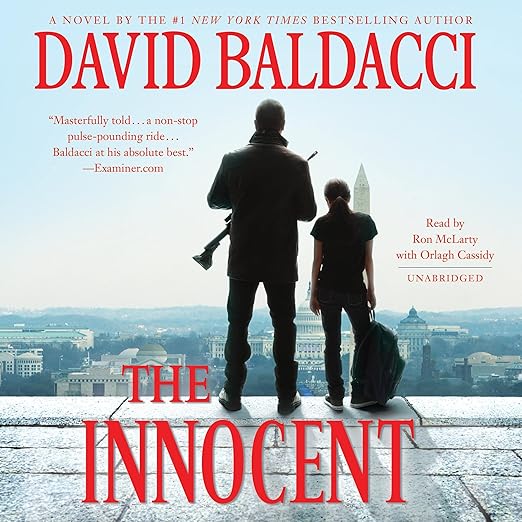
I started this one on a Friday afternoon intending to listen for an hour before making dinner, and found myself still on the couch at nine in the evening with the kitchen untouched. The Innocent is the first book in David Baldacci’s Will Robie series, and it does what the best opener in a franchise does: it introduces a character whose defining crisis is right there in the premise. Robie is a government hitman who, on a job in Washington D.C., decides not to pull the trigger. That refusal is where the novel begins, and it is a sharper setup than most in this genre.
The plot that follows is elaborate but not opaque. Robie is now a target himself. In the process of running, he encounters a fourteen-year-old girl named Julie whose parents have just been murdered and who is herself in danger. Against everything his training demands, Robie decides to protect her. What follows is a cover-up that reaches into the kind of power structures Baldacci has always been good at locating in Washington’s operational shadows.
Our Take on The Innocent: A Novel
Ron McLarty has a steady, unhurried quality that suits Robie’s controlled exterior. Baldacci writes action with mechanical clarity rather than stylistic flourish, and McLarty honors that by not gilding it. The result is a listen that moves efficiently, which is the appropriate register for a book that is primarily trying to generate momentum. One reviewer noted some jarring present-to-past tense shifts in the prose that feel like copy-editing misses rather than intentional technique. In the audiobook format, these transitions are slightly less disorienting than they would be on the page, because McLarty does not stumble over them.
The character of Robie himself is this series’ most interesting element. He is, as one reader observed, adequately human: he makes mistakes, he feels things, but Baldacci is careful never to make him seem genuinely imperiled. That might frustrate some listeners. It did not frustrate me because the threat in this book is never primarily physical. The threat is institutional. Robie’s government is the entity most likely to destroy him, and that dynamic generates a more interesting tension than any single physical confrontation.
Why Listen to The Innocent: A Novel
The Robie-Julie dynamic is what elevates this book above a competent but standard thriller. Julie is not a passive charge. She is a fourteen-year-old who has survived something terrible and who functions as a moral mirror for Robie throughout. Her refusal to simply be grateful, her own considerable capacity for practical thinking under pressure, gives the relationship between them a specificity that prevents it from collapsing into a sentimentalized adult-protects-child formula.
At twelve hours and fourteen minutes, this is a workout even for committed thriller listeners. But the pacing rarely flags. Baldacci knows when to cut away from a scene before it exhausts its tension, and that instinct keeps the narrative in motion. The Washington D.C. setting is deployed with the authority of a writer who knows that city’s institutional geography well enough to make the cover-up feel grounded rather than abstract.
What to Watch For in The Innocent: A Novel
Multiple reviewers mentioned that Baldacci’s twists are mildly predictable if you are well-read in the genre. I would not call this a weakness exactly. Predictability in a well-built thriller is like recognizing a chord progression in jazz: you can still enjoy how it resolves, even if you heard it coming. The pleasure here is less about being surprised than about watching a competent author manage multiple moving parts without losing control of any of them.
The tonal shift between Robie’s professional coldness and his growing investment in Julie’s safety is gradual enough to be convincing. Baldacci does not rush it. That restraint is one of the better craft decisions in the book, and McLarty’s narration serves it well by keeping the emotional register consistent rather than telegraphing sentiment ahead of the prose.
Who Should Listen to The Innocent: A Novel
This will satisfy thriller readers who want a protagonist with operational credibility and a believable moral crisis rather than superhero invulnerability. It is also a reasonable starting point for the Will Robie series if you have not read Baldacci before, since the series mythology is introduced cleanly here. Skip it if genre-convention twists frustrate you, or if you need morally uncomplicated heroes. The premise requires sitting with a protagonist who has killed people for a living and is learning to feel the weight of that, which demands a certain tolerance for ambiguity.
Frequently Asked Questions
Is The Innocent a good starting point for the Will Robie series, or does it reference earlier Baldacci characters?
It is the first book in the Will Robie series, so it is the correct place to start. Robie does appear in other Baldacci crossover contexts, but The Innocent requires no prior knowledge of any of Baldacci’s other series.
How does Ron McLarty handle the transition between the thriller action and the quieter character scenes?
McLarty is steady throughout. He does not differentiate the action scenes through dramatic escalation in his delivery, which actually works for Baldacci’s prose style. The tone is consistent and controlled, which suits a protagonist defined by emotional restraint.
Does the fourteen-year-old character Julie feel convincingly written, or is she a narrative convenience?
She is one of the better-realized elements of the book. She is practical, difficult, and not inclined to cooperate with Robie simply because he saved her. That friction gives the protective relationship texture rather than sentimentality.
Are there content warnings that prospective listeners should know about?
The book involves the murder of Julie’s parents, the death of a government target in the opening sequence, and some violence consistent with a mainstream political thriller. It is not gratuitous by genre standards, but it is not a light listen.