Quick Take
- Narration: Richard Reed delivers a measured, dry performance that perfectly captures the ancient, world-weary absurdity of two undying rivals.
- Themes: Rivalry across millennia, the comedy of obsession, immortality as burden and farce
- Mood: Darkly comedic and unexpectedly melancholic, spanning geological timescales
- Verdict: One of the rare Warhammer 40K novels that functions as genuine literature first and tie-in fiction second.
A colleague who has followed Warhammer 40K fiction for years described this book to me as the one he hands to people who think tie-in novels are inherently disposable. I filed that away and finally listened on a quiet weekend when I had 13 hours to spare and low expectations. By the midpoint I had abandoned any pretense of doing other things simultaneously.
The Infinite and the Divine is, at its core, a comedy about two very old men who hate each other with the focused intensity of people who have absolutely nothing else to do for the rest of eternity. That it is also a meditation on the weight of immortality, on what obsession does to a being across thousands of years, is what elevates it from clever genre exercise to something that lingers.
Our Take on The Infinite and the Divine
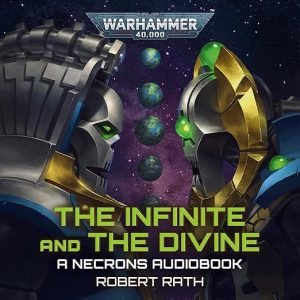
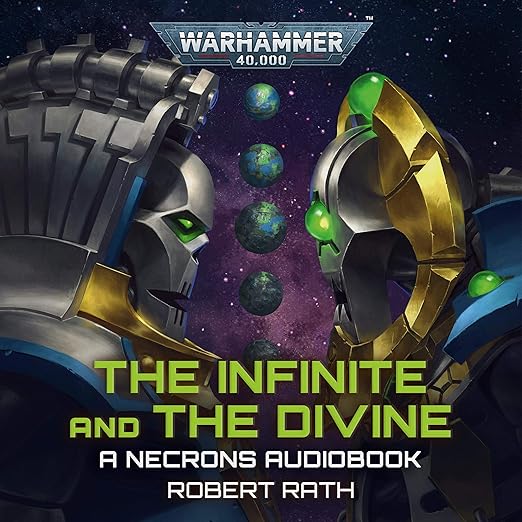
Robert Rath does something genuinely difficult here: he takes two characters from the Necrons faction of the Warhammer universe, beings of immortal metal who traded their flesh for survival and have been contemptuous of biological life ever since, and makes them the most human characters I have encountered in any book this year. Trazyn the Infinite, a collector of historical oddities and living artifacts, and Orikan the Diviner, a chronomancer of terrifying precision, are opposites in every meaningful way. Their rivalry spans not decades but civilizations. They end each other’s plans. They steal each other’s prized possessions. They would rather see entire species collapse than give the other a moment of satisfaction.
What makes this work is Rath’s refusal to reduce the comedy to mere farce. One reviewer compared them to Skeletor and Cobra Commander locked in a petty eternal feud, which is not wrong, but the book goes deeper than that joke suggests. The millennia-spanning structure lets Rath show how obsession calcifies, how two beings who might once have had genuine philosophical differences have long since become caricatures of those differences, and how that calcification is itself a form of tragedy.
Why Listen to The Infinite and the Divine
Richard Reed’s narration is a precise fit for this material. He plays the dual perspective structure with a wry economy that suits the ancient, seen-everything affect of both characters. The comedy lands cleanly because Reed never pushes it, never tips the wink at the listener. He trusts the writing, and the writing trusts him back.
The audiobook format also handles the book’s sprawling timeline remarkably well. Rath’s narrative jumps between eras that span the pre-Imperial age of humanity, the rise of the aeldari, the founding of the Necrontyr civilization, and the present-tense Warhammer 40K setting. In audio, these transitions feel less like chapter breaks and more like the turn of pages in one of Trazyn’s own collected histories.
What to Watch For in The Infinite and the Divine
Several reviewers flag that some familiarity with the 40K setting deepens the experience. You do not need to be a veteran of the lore to follow the narrative, but knowing the basic shape of the universe enriches the jokes and the tragedy alike. One reviewer noted that binge-watching lore videos beforehand significantly improved their enjoyment, and I would echo that advice for listeners who are genuinely new to the setting.
The novel is also, as one reader noted, simultaneously a comedy and a dead-serious exploration of time and eternity. If you come expecting only one of those registers, the other will catch you off guard. The tonal range is the book’s greatest strength and, for some readers, its biggest adjustment.
Who Should Listen to The Infinite and the Divine
Existing 40K readers will find this among the best the line has produced. Complete newcomers to the setting can still enjoy it but will benefit from a brief orientation beforehand. Readers who appreciate novels that pair genuine wit with genuine weight, who enjoyed something like Pratchett’s use of comedy as a philosophical instrument, will find Rath’s sensibility rewarding. Skip it only if you have zero tolerance for fiction built around a central relationship dynamic rather than conventional plot momentum.
Frequently Asked Questions
Do I need to know Warhammer 40K lore before listening to The Infinite and the Divine?
Not strictly, but some familiarity helps. The novel works as a standalone story about two rival immortals, but understanding the broader 40K universe enriches the jokes and the tragedy. Most reviewers recommend at least a brief introduction to the Necrons faction beforehand.
Is this more of a comedy or a serious science fantasy novel?
Both, genuinely. Robert Rath sustains a darkly comic tone throughout while also delivering real emotional and philosophical weight about immortality and obsession. The tonal range is wide and that is part of what makes it unusual in the tie-in fiction space.
How does the multi-millennia timeline structure affect the listening experience?
It works well in audio. Richard Reed handles the era transitions with enough tonal distinction that listeners can orient themselves quickly. The long span of time is also central to the book’s themes rather than a structural gimmick.
Is The Infinite and the Divine part of a series or does it work as a standalone?
It functions as a complete standalone novel. While it is set within the larger Warhammer 40K universe, the story of Trazyn and Orikan reaches a satisfying conclusion within this single volume.